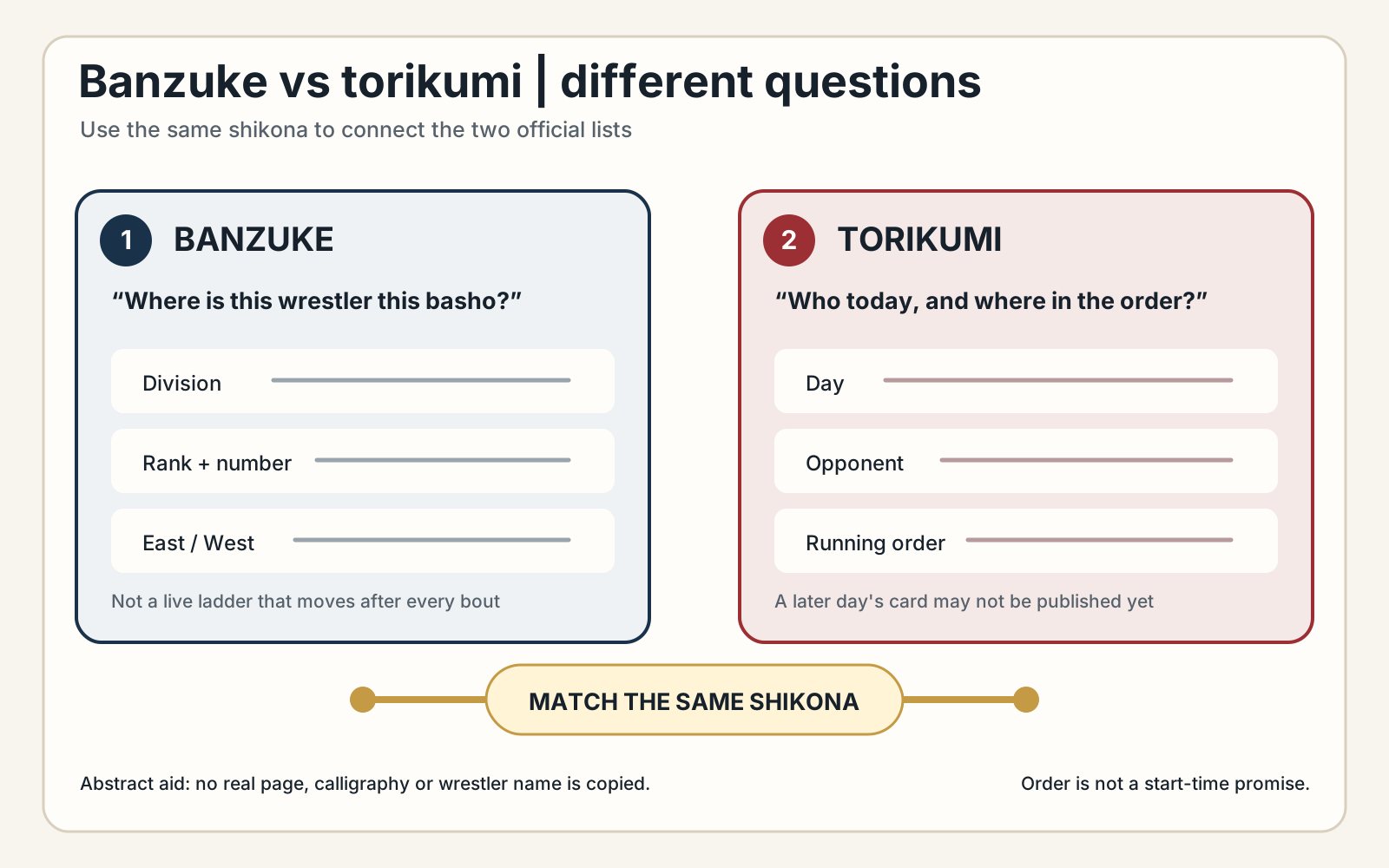
A banzuke is the official ranking for an entire tournament. It tells you where every wrestler sits, from yokozuna down to jonokuchi. A torikumi list is the card for a particular day: it tells you who faces whom and in what order. Check the banzuke to understand a wrestler’s position; check the day’s torikumi to find his opponent and place in the running order. You will usually need both, because neither list answers the other’s question.
This distinction solves a very practical first-visit problem. A traveler searches for a favorite wrestler, finds his name on the ranking, and assumes the bout must be listed somewhere on the same page. Or a daily bout card appears, but its compact rows provide too little context to explain why a Maegashira is facing a Komusubi.
Think of the banzuke as a map and the torikumi as today’s itinerary. Put the map under the itinerary, and one short line of names starts to carry a story.
Detailed description of this diagram
The left synthetic card lists the tournament-long position fields answered by the banzuke. The right lists day, opponent and running order answered by the torikumi. A connector says to match the same shikona. No real page, calligraphy, wrestler name, current matchup or publication time is copied.
Graphic: SUMO ARCHAEOLOGY CLUB · Figure source 1 · Figure source 2 · Figure source 3
The banzuke answers “Where is he this tournament?”
The banzuke places wrestlers by division, rank, number and East or West side. The Japan Sumo Association explains that promotion and demotion based on tournament results are published through this ranking. It is prepared for the coming basho and remains that tournament’s official frame of reference.
It is not a live table that changes after every bout. A wrestler who loses on Day 1 does not wake up one line lower on Day 2. His results accumulate across the tournament and feed into the process that produces the next banzuke.
For a newcomer, the useful fields are simple: division, exact rank, East or West, and number where one exists. You do not have to decipher every column of the traditional calligraphy before attending.
The torikumi answers “Who does he face today?”
The Japanese word *torikumi* can refer to a bout or the arranged matchups. In sumo language, a matchup or the bout list is also called a *wari*. The Association says the judging department’s oyakata arrange the day’s contests; the completed card is checked by the responsible gyoji before it is printed and released.
The card is not a complete round-robin schedule fixed at the start of the basho. As results develop, later matchups can bring together championship contenders or adjust the expected sequence of top-rank meetings. That is why the opponent for a late-tournament day may not be available when you first make travel plans.
For the Tokyo tournament, the Association’s current venue guide says the day’s bout sheet is scheduled to be posted by 8:00 a.m. Treat that as a Tokyo-specific current instruction, not a universal promise for every venue and year. Always check the official guide for your tournament.
Banzuke-making and bout-making are different jobs
The similar vocabulary causes much of the confusion. *Banzuke hensei* is the process of composing the next ranking from tournament results. *Torikumi hensei* is the process of making specific matchups during the current tournament.
The Association’s organization page assigns preparation of honbasho matchups to the judging department and separately explains how ranks are published as a banzuke. One process creates a position lasting through a tournament; the other creates a contest for a day.
So “the banzuke has been published” never means all 15 opponents have also been announced. It means the stage and its ranked cast are known. The daily scenes are still being arranged.
East and West do not perform exactly the same function on both pages
On a banzuke, East and West help order wrestlers at the same rank and number, with East placed slightly higher. On a torikumi card, East and West identify the two sides of that particular contest and the corresponding approach to the dohyo.
Neither label tells an overseas visitor the wrestler’s nationality. Nor should the ring’s East and West labels be treated as a phone compass reading inside the arena. Use the labels as sumo’s internal orientation system.
This is another reason to keep the two documents distinct: the same characters or English labels can be doing related but not identical work.
A two-minute routine before leaving your hotel
First, open the current official banzuke and find one wrestler. Write down his exact rank. Next, open the official torikumi for your ticket date and find the same shikona. Note his opponent and approximate place in the sequence.
Do not turn the order into an exact start-time guarantee. Earlier bouts, ceremonies and operational changes can affect the day’s timing, so arrive with room to spare and use the current venue schedule.
If you have another minute, look up the opponent’s rank too. “My wrestler is eighth on the card” is useful logistics; “a newly promoted Komusubi is meeting an Ozeki” is the beginning of attention.
The paper list can make tomorrow arrive early
On some tournament days, a senior gyoji performs *kaobure gonjo*, formally announcing the following day’s makuuchi matchups during the interval. A name you first met as ink on the banzuke becomes a sound, then appears beside a new opponent on the next torikumi.
That is my favorite small shift. The ranking no longer feels like a static poster, and the daily card no longer feels disposable. One preserves the wrestler’s place for the basho; the other keeps asking what he will do from that place today.
Learn the difference once, and the official site’s many lists stop competing with one another. They begin passing the tournament from page to page.
Sources
- Japan Sumo Association, mission and organization page, quiz No.1413, Tokyo tournament day guide, and September 2026 banzuke (checked September 3, 2026)
Source links used for verification
Each link was used for the corresponding claim in this article; inclusion is not a blanket endorsement of the whole page.
Article verified:
- Japan Sumo Association mission and organization: banzuke and judging departmentPrimary source (as checked for this article)
- Japan Sumo Association quiz No.1413: arranging and publishing torikumiPrimary source (as checked for this article)
- Japan Sumo Association Tokyo tournament day guidePrimary source (as checked for this article)
- Japan Sumo Association September 2026 banzukePrimary source (as checked for this article)