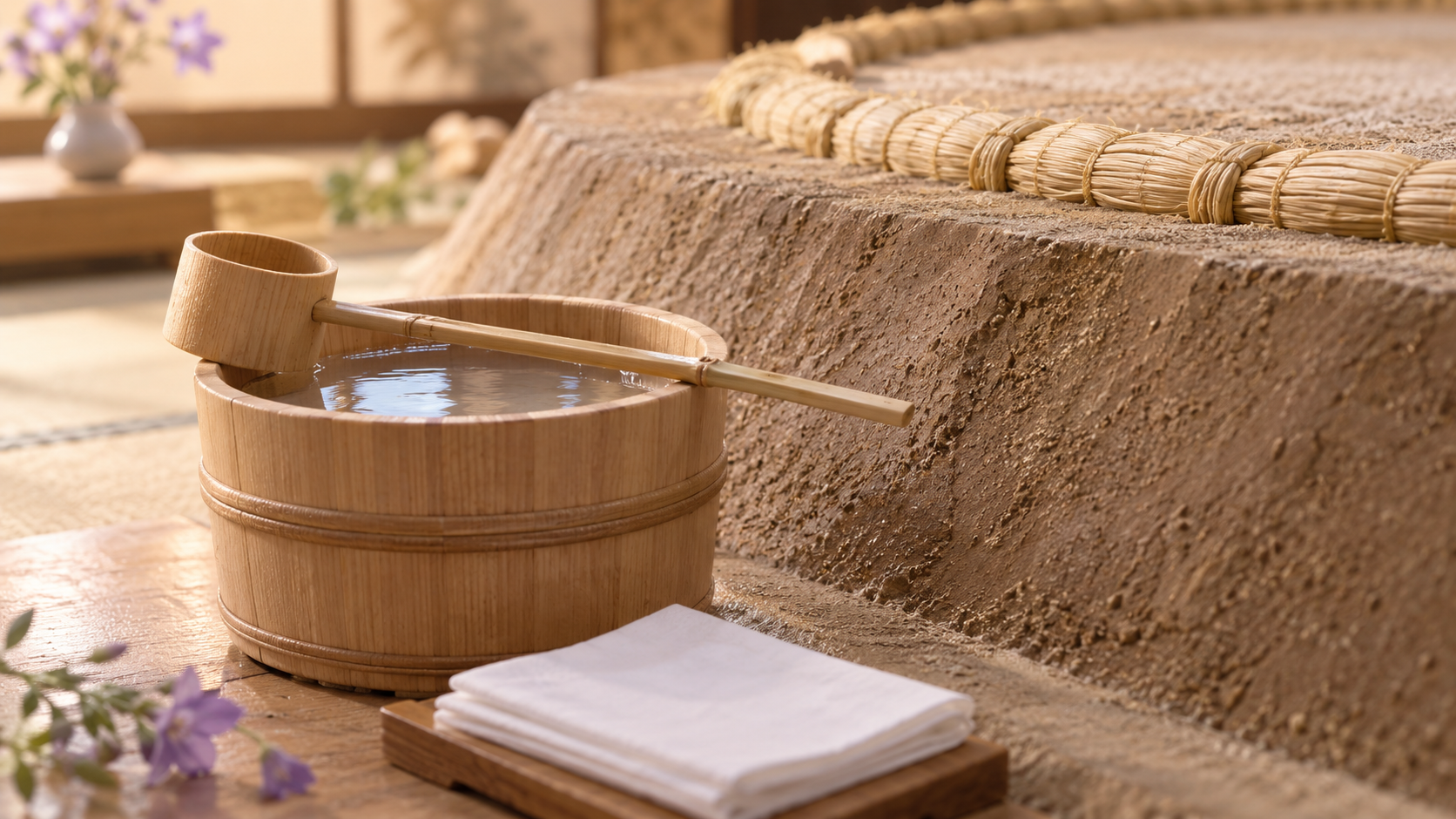
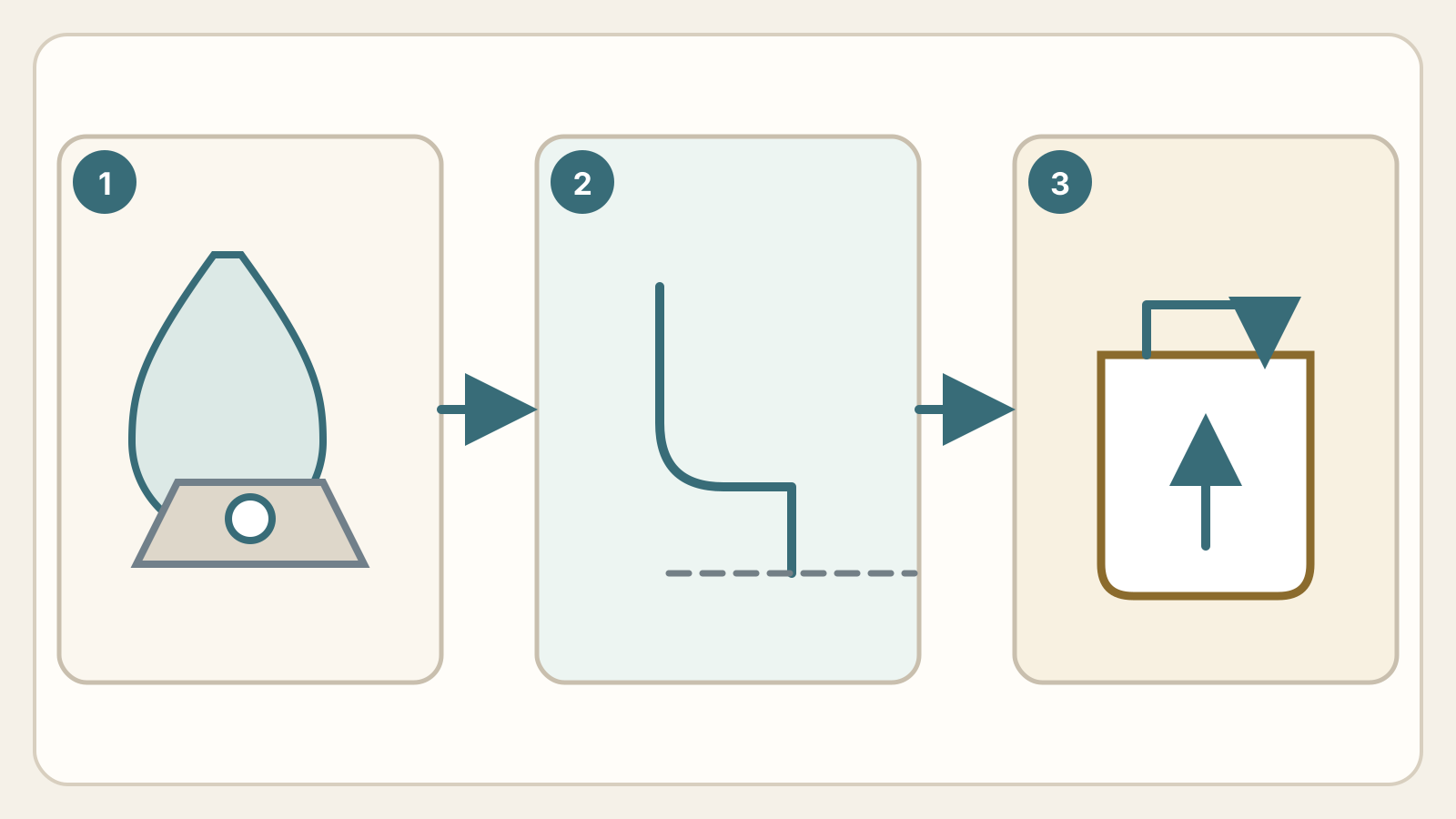
After a wrestler rinses his mouth with the water commonly called *chikara-mizu*, he discards it through a drainage opening built into the sloping side of the dohyo. At Tokyo’s Ryogoku Kokugikan, the Japan Sumo Association says that opening connects to sewerage below the ring. At regional grand-tournament venues, a tank is installed beneath the dohyo and collected after the event. In the Kokugikan and regional grand-tournament arrangements described by the Association, the water is not presented as simply soaking into the clay. This is not a claim about every sumo venue.
Television usually shows the ladle, the wrestler’s face and the white paper used afterwards. The water then seems to disappear, which makes the physical question easy to miss: where did that mouthful go? One official photograph shows a dark opening in the slope and turns a ceremonial platform into working venue infrastructure. We do not infer the opening’s dimensions from that image.
Detailed description of this diagram
Graphic: SUMO ARCHAEOLOGY CLUB · Figure source
The mizuhake-guchi sits in the slope
The Association calls the opening a *mizuhake-guchi*, literally a water-disposal opening. Its purpose is to take the water that wrestlers spit out after rinsing their mouths. It is made in the sloping side of the raised dohyo, not in the contest circle, the straw boundary or the smooth sand immediately outside it.
From an ordinary seat, and in most broadcast shots, it may be difficult or impossible to see. This is not a scavenger hunt worth leaning over barriers or approaching a restricted working area. The official image and description are enough to alter the next side view of the ring. The clay slope is not merely the base of an old ritual platform; one documented opening in it performs drainage; its size is not published.
The Association source explains function and present arrangements. It does not establish the first historical date on which such an opening was used. Calling it an ancient custom without separate evidence would turn a useful current fact into an unsupported origin story.
The Kokugikan arrangement is venue-specific
In its September 2025 explainer, the Association says the mizuhake-guchi at the Kokugikan connects to sewerage beneath the dohyo. Discarded water therefore passes through the opening and into that system.
The phrase “at the Kokugikan” matters. The source distinguishes a sewer connection at the Kokugikan from tanks at regional grand tournaments, but it does not document the architectural reason or every venue’s construction. A Ryogoku detail should not automatically be copied into another arena guide.
This is a useful lesson in travel information, and it does not depend on an unpublished opening size. “How sumo works” sometimes has a national answer; “where this material goes” can have a building-specific one. Attach the fact to the venue and it remains useful rather than becoming folklore.
Regional tournament rings use a tank
The same Association explanation says that at regional grand-tournament venues, a tank is placed under the dohyo and recovered after the tournament. The source does not provide its capacity, precise material, collection schedule or disposal procedure, so we should not fill those gaps with guesses.
What it does reveal is already fascinating. The surface presented to spectators remains recognisably the same circle of clay and straw, while the hidden drainage solution changes with the building. A temporary or venue-adapted ring needs an infrastructure answer appropriate to its setting.
Traditional appearance and modern sanitation are not competing versions of sumo. The practical system enables the repeated ritual to take place throughout an event without treating water as if it vanished by symbolism alone.
Water, paper and salt also appear in the written rules
A separate Association item explains that the dohyo provisions require water, paper and salt to be available. The rinsing water is formally described simply as “water”; the white half-sheets used around a wrestler’s mouth are formally “paper,” although *kesho-gami* is a common name.
That written list provides the top half of the story. Water is placed beside the ring, used in a formal preparation and then must be handled as matter. The mizuhake-guchi is part of the bottom half—the route after the visible action.
If we discuss only purification, a mouthful of water becomes an abstract symbol. If we discuss only plumbing, the ritual sequence disappears. Hold both ideas together and the object becomes richer. It has meaning to the wrestler and a physical path through the venue.
The dohyo is deeper than the circle seen from above
The legal contest area is a 4.55-metre circle, but a public dohyo is built as a raised platform. It has a top surface, a straw boundary, a ring of prepared sand and sloping sides. The separate drain source documents a sewer destination at the Kokugikan and a tank at regional grand tournaments, but not a generic hidden void or a complete cross-section.
When a camera looks down from above, the ring is almost a diagram: circle, two white lines, two wrestlers. A side angle reveals height. The source gives two destinations below the visible surface—sewerage at the Kokugikan and a tank for regional grand tournaments—but does not publish pipe routes, tank position or geometry. The visible form is only the documented start of the system.
The official drain description links a wrestler’s visible rinse to venue infrastructure below the ring. It does not identify who installs or services each drain or tank, so this article explains the route without inventing a staff assignment.
Watch the direction, not the opening
At the next bout, follow one wrestler through the water-and-paper sequence. Notice the direction in which he turns to discard the rinse. You may never see the opening itself, and you do not need to. Knowing that a designed route begins in the slope is the discovery.
Keep its scope honest: Kokugikan sewer connection, regional-venue tank, no unsupported claim about the ultimate origin of the practice. That modest certainty is more exciting than a grand myth. A single mouthful leads from ritual to architecture, from Tokyo to travelling tournaments and from the clay surface to what lies beneath it. The dohyo looked like a circle; now it has depth.
Sources
- Japan Sumo Association, Sumo Quiz No.1355, published 24 September 2025 (checked 3 September 2026)
- Japan Sumo Association, Sumo Quiz No.693, published 2 December 2023 (checked 3 September 2026)
- Japan Sumo Association, Sumo Quiz No.830, published 17 April 2024 (checked 3 September 2026)
Source links used for verification
Each link was used for the corresponding claim in this article; inclusion is not a blanket endorsement of the whole page.
Article verified:
- Japan Sumo Association Sumo Quiz No.1355: the dohyo water drainPrimary source (as checked for this article)
- Japan Sumo Association Sumo Quiz No.693: water, paper and salt in the dohyo rulesPrimary source (as checked for this article)
- Japan Sumo Association Sumo Quiz No.830: dohyo regulationsPrimary source (as checked for this article)