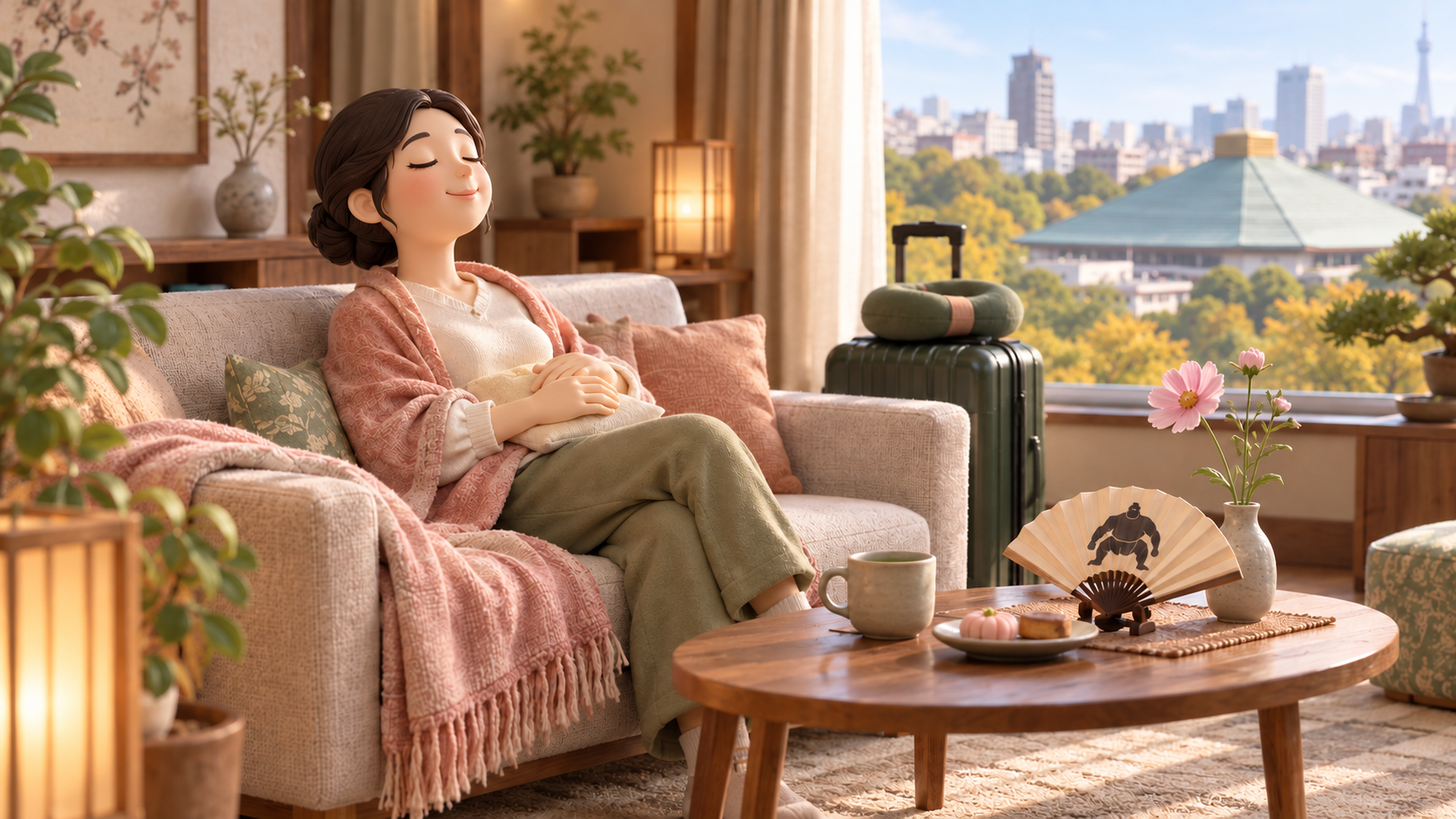
If you have just arrived in Japan, do not make an opening-to-closing stay your definition of a successful sumo day. Choose the one session you most want to see, work backwards from the official daily timetable, and eat or rest before entering. September allows one re-entry per day, but a single continuous visit is usually the lower-effort plan.
A honbasho day grows from lower-division bouts in the morning to the top division late in the afternoon. Watching that whole arc can be wonderful, but duration is not a test of sincerity. Two alert hours may give you more than a full day spent fighting sleep.
Pick one non-negotiable moment
Perhaps it is the makuuchi ring entrance, the juryo division, or the quiet atmosphere around early lower-division bouts. Pick one. Check the Japan Sumo Association’s timetable for your actual date rather than treating a time copied into an old blog as permanent. The sequence can move, so leave a margin instead of aiming for the exact listed minute.
If your dream is the top-division ring entrance, a travel itinerary does not need to label the morning opening time as “sumo starts.” Your day starts when the part you chose becomes realistically reachable. If you want the morning divisions, you are equally free to leave before the final bout.
Complete the practical tasks before admission
By the day before, prepare essential medication according to your own medical instructions, charge the ticket phone and share a written meeting point with companions. Put medication, the phone and anything needed during the visit in a pocket you can reach by hand without unpacking the whole bag at the seat. If you cannot verify the current re-entry procedure, drop the hotel-nap plan and switch to one shorter continuous visit. If you wake too unwell to travel safely, shorten the visit further or miss it; this article does not turn a ticket into medical advice.
The official September notice allows one re-entry per day and requires the ticket stub for the return procedure. That option may help if the day changes, but a hotel nap creates two extra crowd movements and uses the only stated re-entry. Arrange food, water, essential medication, charging and the meeting point with companions before you pass the gate. Follow your own medical advice for medication and health needs; this is a travel-planning article, not medical guidance.
Inside, watch from your assigned seat and avoid moving while a bout is in progress, as the notice requests. If exhaustion becomes distracting, move at a natural break and ask staff where you may rest. On-site instructions take priority over this article.
Follow one wrestler instead of learning the whole banzuke
Jet lag makes a page of unfamiliar names especially slippery. Choose one wrestler. Notice the moment he steps onto the dohyo and the bow after the result. Write one ordinary phrase about the opening: “stayed low,” “moved left,” or “pushed back.” You do not need the official technique name yet.
Waiting for one person has a curious side effect: the surrounding bouts become visible too. One wrestler throws much more salt; another completes the shikiri quickly; the yobidashi voices do not all carry in the same way. The day you stop trying to collect everything may be the day one tiny difference stays with you.
Decide again after waking in Japan
Do not lock every minute before the flight. On the morning of the ticket date, check how you feel and consult the current official schedule. A later arrival is not a failed visit. Your ticket is permission to meet that day’s sumo, not an endurance examination.
Evidence limits and event-day fallback
Confirmed fact: The Association schedule gives approximate dohyo timing and a dated visitor notice gives that tournament’s entry/exit terms. This article does not diagnose sleepiness, medication or bodily response.
What remains unknown: Jet-lag severity, sleep, food/hydration, medicine timing, conditions, sensory load and tolerable visit length are individual unknowns. Re-entry also requires the correct dated notice.
Reasoned inference: Choosing one protected moment is likely to make rest easier than treating a full day as compulsory. Confidence is medium; this does not infer symptom improvement.
Editorial suggestion: Follow appropriate doctor/pharmacist advice for medicine or symptoms; this article offers only later-arrival and shorter-visit options. It is not medical advice.
Fallback: With severe sleepiness, unsteadiness, pain, confusion or medication uncertainty, shorten or leave; involve a companion, staff and appropriate professional help as needed.
Sources
- Japan Sumo Association, September 2026 dohyo timetable and spectator notice, checked September 3, 2026. Recheck the dated timetable and re-entry notice on the visit day.
Source links used for verification
Each link was used for the corresponding claim in this article; inclusion is not a blanket endorsement of the whole page.
Article verified:
- Japan Sumo Association September 2026 dohyo timetablePrimary source (as checked for this article)
- Japan Sumo Association September 2026 spectator informationPrimary source (as checked for this article)