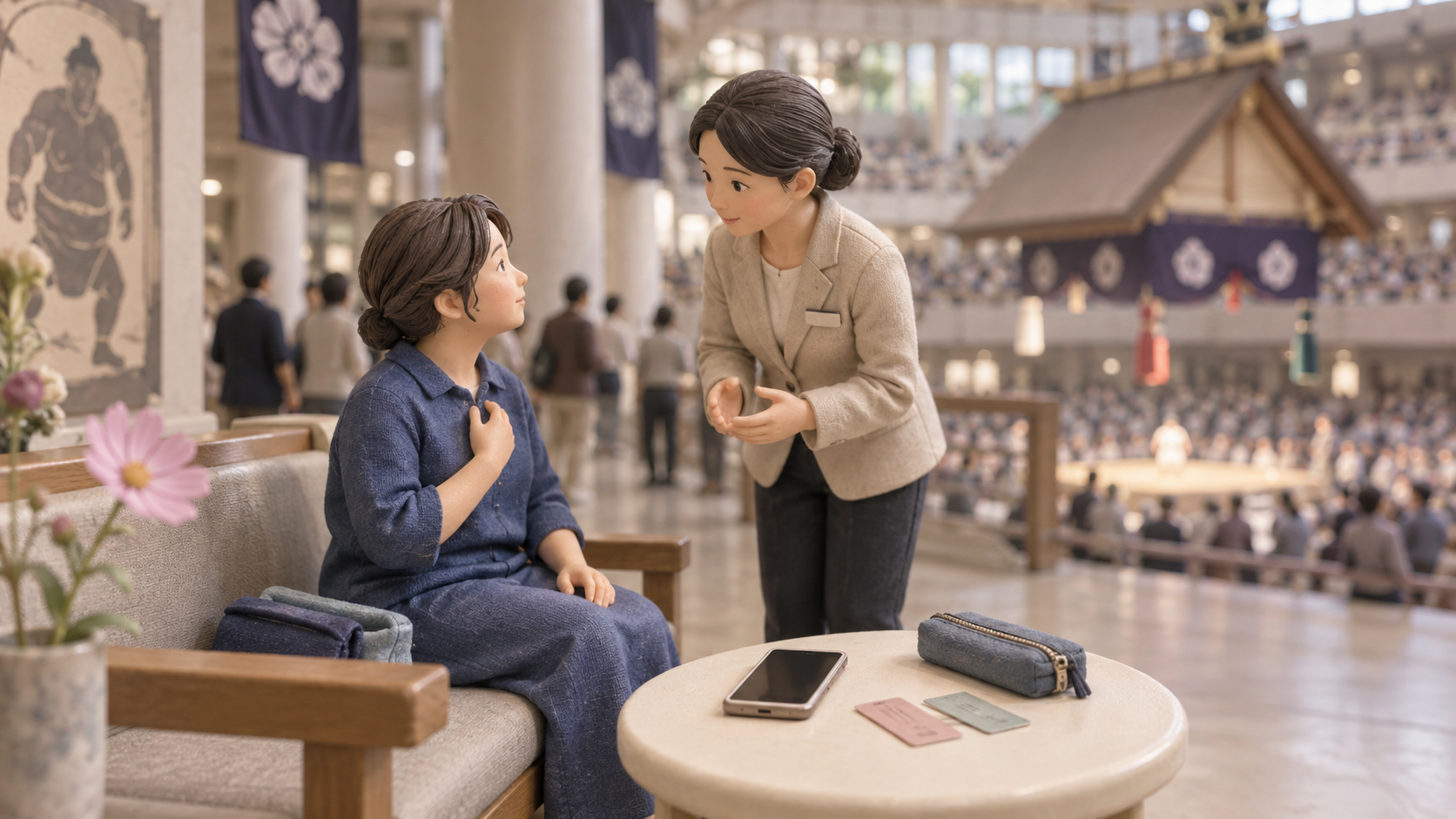
If you or a companion becomes suddenly unwell at Ryogoku Kokugikan, stop making programme decisions and get help: move only as far as is safely necessary, alert the nearest attendant, and describe the location and symptoms. Call 119 for an emergency. When you are unsure whether an ambulance or urgent medical assessment is needed, the Tokyo Fire Department’s #7119 consultation service operates 24 hours a day, every day.
A visitor may hesitate because a favourite wrestler is due soon, the ticket was expensive or asking for help in another language feels embarrassing. None of those concerns should delay an urgent response. Leaving a bout unseen is a reversible disappointment. Waiting through a serious change in somebody’s condition may not be.
This page is a communication plan, not a diagnosis guide. Follow the individual emergency instructions provided by your clinician where applicable.
Alert an attendant and describe where you are
Do not wander across the arena looking for a room whose current location or service you do not know. Ask a companion or nearby spectator to attract an identifiable attendant. If you can move, avoid stopping in an aisle, on stairs or in an exit route, and follow the attendant’s direction. The Japan Sumo Association’s spectator contract requires compliance with organiser and staff instructions.
Useful facts are concrete: floor, arena side, seat type and number; when the change began; whether the person is conscious and breathing normally; visible symptoms; important allergy or medical information; and any medicine already used. You do not have to name the illness. “Second-floor west chair seating, sudden difficulty breathing, responding slowly” is more useful than an uncertain diagnosis.
We have not verified in public current information the operating hours, staffing, clinical capacity or exact day-of-event location of a Kokugikan first-aid room. Nor does this article promise the placement of an AED or the availability of medicine. Ask staff and emergency professionals rather than relying on an old floor plan or the sentence “there must be a medical room.”
Use 119 for an emergency
Call 119 when the situation is an emergency. If your phone cannot connect, you cannot speak, or you cannot explain the Japanese location, ask the attendant or another person to call. Give the venue name, your floor or section and the observable condition. Do not independently select an ambulance meeting door; follow the dispatcher and venue staff so responders can be brought to the correct place.
The Tokyo Fire Department states that Tokyo 119 calls can use simultaneous interpretation through a contracted centre in English, Chinese, Korean, Portuguese and Spanish. Do not assume that every other language or every operational situation has instant interpretation. A short note with “Ryogoku Kokugikan,” your seat and critical medical information can still reduce confusion.
Use #7119 when the emergency decision is unclear
Tokyo’s Emergency Telephone Consultation Center at #7119 is intended for a sudden illness or injury when a person is unsure whether to call an ambulance or seek medical care immediately. A consultation team that includes doctors, nurses and personnel with ambulance-service experience operates 24/7. When the assessment indicates high urgency, the service can transfer the call to 119 or ask the caller to call back on 119.
#7119 is not a reason to insert a consultation before an obvious emergency. It is the branch for genuine uncertainty. The Tokyo Fire Department also provides a web-based Tokyo Emergency Medical Guide with an English option. The online guide needs connectivity and cannot replace immediate help from people beside you.
Share one line of essential information before the visit
A companion should know where prescribed emergency medication and the person’s medical information are carried. Record an emergency contact, major allergy or relevant condition in a place that can be found without unlocking several apps. Medication choice and use belong to the person’s clinician, not a travel website.
For a solo visit, tell a trusted person the date and ticketed seat before you go. That does not create live monitoring, but it gives an emergency contact a starting point. An information card can include the Japanese name 両国国技館 and the seat notation from the ticket.
Use the Kokugikan food-allergy plan for the venue’s unconfirmed menu safeguards, and the heat- and cold-sensitive day plan for a day whose indoor temperature should not be guessed. A visitor already managing pain or limited stamina can build an earlier stopping point with the chronic pain and fatigue guide.
The body decides whether the sumo day continues
A temporary improvement is not something this page can medically evaluate. Follow professional advice and the individual plan. If leaving is appropriate, the early-departure guide helps with an ordinary calm exit; an emergency always outranks the request to wait between bouts.
Choosing health does not show insufficient love for sumo. Wrestlers repeatedly check breath, balance and footing before committing their bodies to the tachiai. A spectator can respect bodily information too. Let the missed bout become a reason to return on a safer day, not a price that had to be paid for asking for help.
Sources
- Tokyo Fire Department, Emergency Telephone Consultation Center #7119 (checked 3 September 2026)
- Tokyo Fire Department, Disaster and Emergency Information Center and multilingual 119 calls (checked 3 September 2026)
- Japan Sumo Association, September 2026 Tokyo spectator notice (checked 3 September 2026)
- Japan Sumo Association, spectator contract (checked 3 September 2026)
Source links used for verification
Each link was used for the corresponding claim in this article; inclusion is not a blanket endorsement of the whole page.
Article verified:
- Tokyo Fire Department Emergency Telephone Consultation Center #7119Primary source (as checked for this article)
- Tokyo Fire Department Disaster and Emergency Information Center and multilingual 119 callsPrimary source (as checked for this article)
- Japan Sumo Association September 2026 Tokyo spectator noticePrimary source (as checked for this article)
- Japan Sumo Association spectator contractPrimary source (as checked for this article)