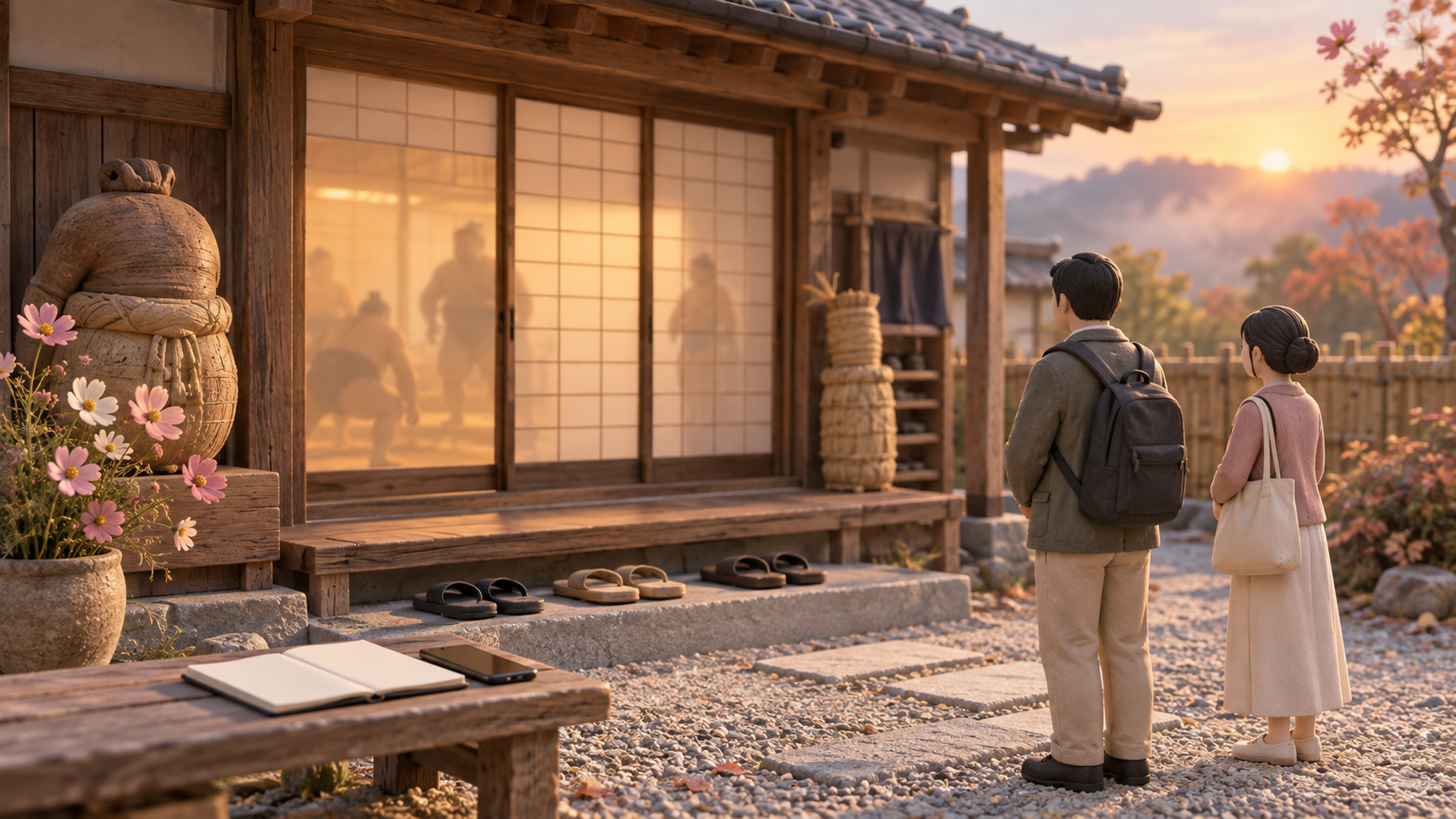
Some sumo stables allow visitors to watch practice, but there is no universal walk-in system. Do not travel to a stable simply because its address appears online. Confirm a current notice from the stable or its authorised organiser, whether a reservation is required, whether practice is taking place on your date, how to arrive and what rules apply to speech, photography and departure. If permission cannot be confirmed, do not go.
Morning practice is compelling precisely because it is not a tournament performance. Feet scrape the clay, bodies meet before the arena crowd exists, and the same movement may be repeated until it changes by a fraction. Yet a heya is also a home and workplace. Wanting to see closely creates a responsibility to respect the boundary that makes close access possible.
The official answer is “some stables”
The Japan Sumo Association has stated in an official feature that practice can be observed at some stables. The word “some” carries the rule. It does not establish public access at every heya, on every morning or without advance contact.
The Association’s stable directory is useful for confirming official names, members and locations. An address is not an invitation. Look for the stable’s own current website or official social account, a supporters’ association notice, or an organiser explicitly authorised by the stable. A travel blog describing an earlier visit can explain atmosphere, but it cannot grant permission today.
Check five things in this order
- Authority: Is the instruction from the stable or a clearly authorised host?
- Reservation: Are advance booking, identification, minimum age, group-size or language conditions stated?
- Date: Is normal practice happening, or are wrestlers at a tournament, regional tour, rest period or in transit?
- Arrival: Where and when should visitors gather, and what happens if they are late?
- Conduct: Are still photographs, video, shutter sounds, conversation, food, gifts or early departure permitted?
Do not phone repeatedly when a stable provides no visitor process. Do not use a map pin, an open door or other tourists waiting outside as substitute permission. A policy can change between two mornings.
Quiet is part of the training environment
Practice does not pause to create a clean photograph. Coaching may be private; a wrestler may be injured; long sections may consist of repetition rather than spectacular collisions. Put every device on silent, and follow instructions about where to sit or stand. Flash is only one issue: shutter noise, whispered commentary and a screen held in another visitor’s view can all interrupt concentration.
Do not block an entrance, wait for wrestlers after the authorised period, or approach for photographs and autographs unless the host explicitly offers that opportunity. Staying within the published place and time protects both the working stable and future visitors.
Public practice events can be a clearer first step
The Yokozuna Deliberation Council’s open practice session, keiko soken, is sometimes made available to the public at Ryogoku Kokugikan. On May 1, 2026, the Association announced a free public session with doors around 8:00 a.m. and practice ending around 11:00. It brought wrestlers from multiple stables into an official event with an identifiable entrance and timetable.
That does not mean every future session will be public. Wait for a new official notice rather than projecting the May conditions onto another date. A regional tour is another structured option: its published day commonly includes morning practice before afternoon bouts.
Watch one movement, not every famous face
If you receive permission, release yourself from the need to recognise everyone. Choose one repeated action: the point where a foot lands after shiko, the distance covered by suriashi, or the pause needed to recover after lending or borrowing a chest in butsukari practice.
The next televised tachiai may then look thicker. Behind a collision measured in seconds, you can imagine the quiet repetitions you saw in the morning. Stable practice is not valuable only because a visitor stood near a well-known wrestler. It can change what an ordinary bout looks like—and that is a more durable form of access.
Return from a Label to the Next Observable Action
Do not reduce a person to body size, age, nationality, hometown, school or role title. Follow a hand position, task, bout sequence or official record in the next appearance instead. An attribute can start a question; it is not a conclusion about character, strength or future.
Sources
- Japan Sumo Association, Sumo Quiz No. 605 (published 5 September 2023; checked 2 September 2026)
- Japan Sumo Association, notice for the May 2026 public training session (checked 2 September 2026)
- Japan Sumo Association, stable directory (checked 2 September 2026)
Source links used for verification
Each link was used for the corresponding claim in this article; inclusion is not a blanket endorsement of the whole page.
Article verified:
- Japan Sumo Association Sumo Quiz No. 605Historical primary source (record from that period)
- Japan Sumo Association notice for the May 2026 public training sessionHistorical primary source (record from that period)
- Japan Sumo Association stable directoryPrimary source (as checked for this article)