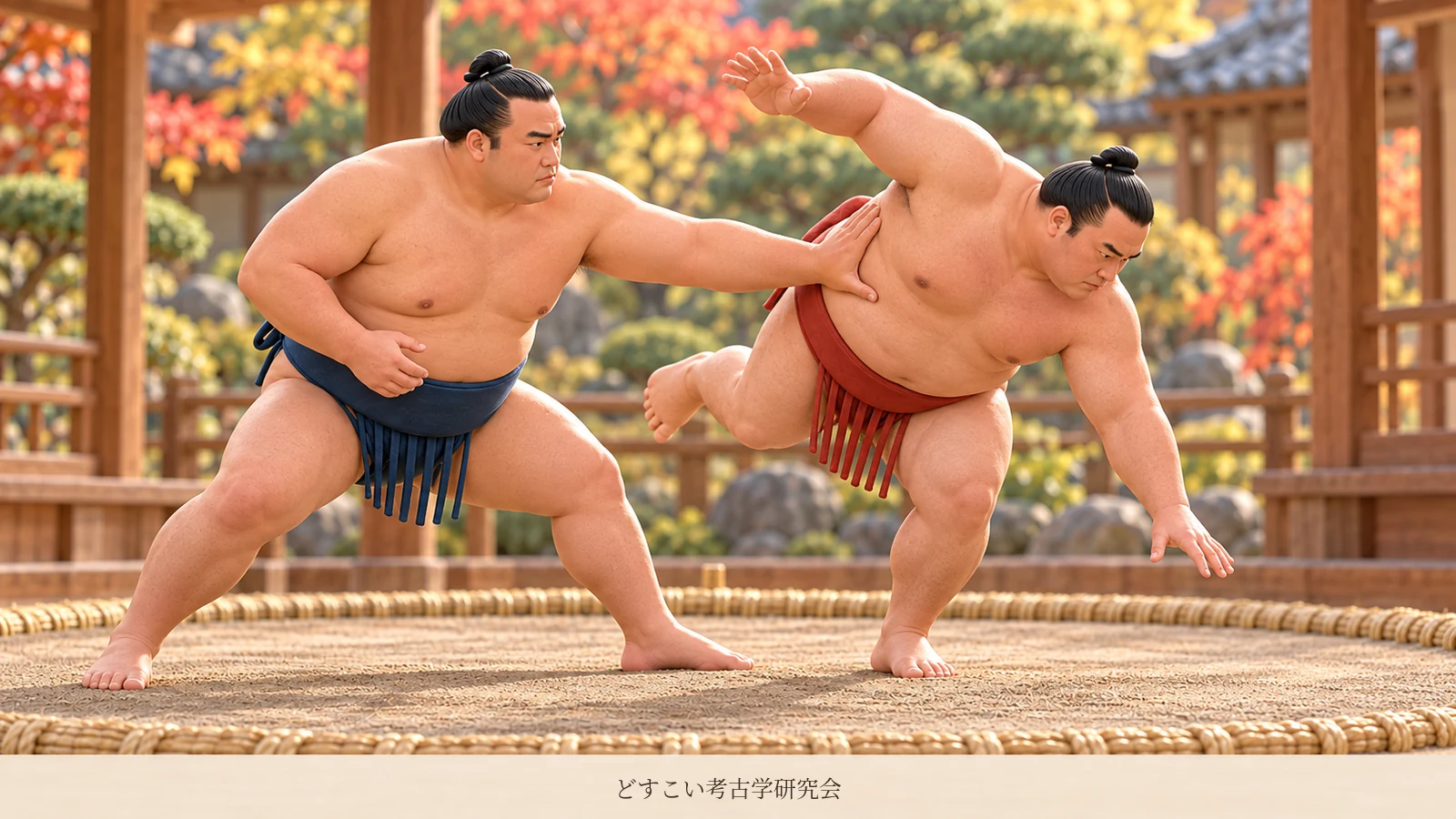
For tsukiotoshi, the winner places one hand in a *hazu* shape at the opponent’s armpit or flank, opens his own body, tilts the opponent’s centre of gravity and presses him diagonally down. Despite the shared *tsuki* sound, this is not tsukidashi’s strong palm thrusts to the chest or shoulders that send an opponent outside. In the next bout, watch whether one palm reaches the side of the torso as the winner opens away.
An advancing wrestler suddenly tips as if the floor had acquired a slope. The announcement says “tsukiotoshi,” yet the finish did not look like the thrusting attack a newcomer might expect from *tsuki*. The name becomes much clearer when you give your eyes a new coordinate: not the centre of the chest, but the space beneath the arm and along the flank.
Four parts of the official definition
The Japan Sumo Association describes tsukiotoshi as a sequence:
- One hand forms a *hazu* shape.
- That hand contacts the opponent beneath the armpit or at the flank.
- The winner opens his own body while tilting the opponent’s centre of gravity.
- He presses diagonally down to complete the fall.
Hazu refers to a Y-like hand position made by opening the thumb away from the other four fingers. Individual fingers may be invisible from your seat, but the hand’s destination can still be readable. Look for one palm at the side of the torso and a winning body that moves off the direct line.
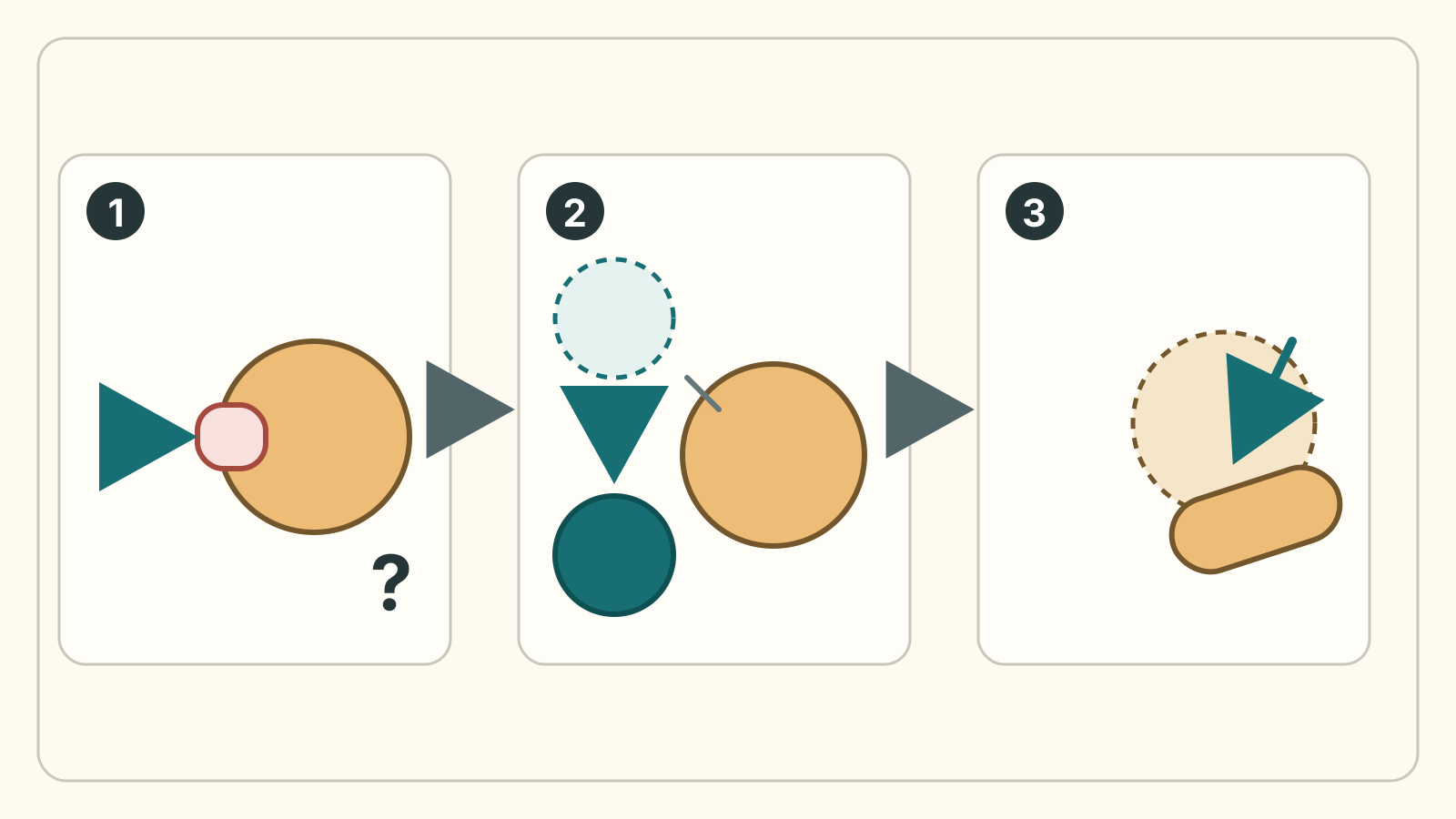
Detailed description of this diagram
Card 1 places a red contact band at the side of the gold opponent token, encoding only the underarm-or-flank relation. A question mark preserves that the diagram does not select one of the two cited regions. Card 2 moves a blue winner token off the line and adds a separate short tilt cue at the gold token. Card 3 uses a horizontal gold token and diagonal-down arrow for the categorical down state. Contact band, diagonal and arrows encode no hand shape, anatomy, exact target, centre of mass, physical angle, force, sidestep, causality or fall path.
Graphic: SUMO ARCHAEOLOGY CLUB · Figure source 1 · Figure source 2 · Figure source 3
Tsukiotoshi vs tsukidashi
The Association defines tsukidashi as strongly thrusting with the palms at the opponent’s chest, shoulders or similar targets until he goes outside the ring. Its explanation also emphasises sharp forward footwork behind the hands.
Tsukiotoshi instead works from one hazu hand at the armpit or flank, opens the body, changes the opponent’s balance and presses diagonally down. Shared syllables do not mean shared finishing geometry. Ask “front or side?” and then “out or down?” before allowing the English word “thrust” to decide the picture for you.
Tsukiotoshi vs hatakikomi
Hatakikomi can also involve opening away from an advancing opponent and causing a forward fall. In the official description, however, the opponent is coming in low and one or both hands slap down at the shoulder, back or arm.
For tsukiotoshi, the positive clues are the hazu hand beneath the arm or at the flank and the diagonal pressure that tilts the centre. For hatakikomi, look for the downward slap against the advancing upper body. The final pose may be almost identical. Rewind to contact location and hand direction rather than judging from where the loser’s palms landed.
Tsukiotoshi vs makiotoshi
Makiotoshi belongs beside tsukiotoshi on the Association’s twisting-technique list. Its official explanation says the winner uses the opponent’s forward reaction, takes no belt grip, encloses the body with his inserted inside arm and twists sideways as if wrapping the opponent in.
In tsukiotoshi, one hazu palm works at the armpit or flank. In makiotoshi, the inside arm comes from below and wraps the body. If you can see the elbow, ask whether the arm remains a hand-led contact at the side or travels beneath and around the torso.
Some angles will not answer. A careful “hidden from this view” is better than attaching a confident label to an invisible arm.
One thing to watch in the next bout
When one wrestler advances, choose a single palm on the defending side. Does it strike strongly at the chest or shoulder and keep driving forwards? Does it slap down at the back or upper body? Or does it find the armpit or flank while the winner opens and the opponent tilts diagonally?
That last picture is your tsukiotoshi prediction. If the announcement names something else, you now know where to replay: the small patch between armpit and waist. A bout once dominated by two entire bodies can be transformed by one palm at the side. The technique is not only a way to fall; it is a lesson in how little contact may be needed to change the direction of a large moving centre.
Sources
- Japan Sumo Association, kimarite explanation for tsukiotoshi (checked 2 September 2026)
- Japan Sumo Association, kimarite explanation for tsukidashi (checked 2 September 2026)
- Japan Sumo Association, kimarite explanation for hatakikomi (checked 2 September 2026)
- Japan Sumo Association, kimarite explanation for makiotoshi (checked 2 September 2026)
Source links used for verification
Each link was used for the corresponding claim in this article; inclusion is not a blanket endorsement of the whole page.
Article verified:
- Japan Sumo Association kimarite: tsukiotoshiPrimary source (as checked for this article)
- Japan Sumo Association kimarite: tsukidashiPrimary source (as checked for this article)
- Japan Sumo Association kimarite: hatakikomiPrimary source (as checked for this article)
- Japan Sumo Association kimarite: makiotoshiPrimary source (as checked for this article)