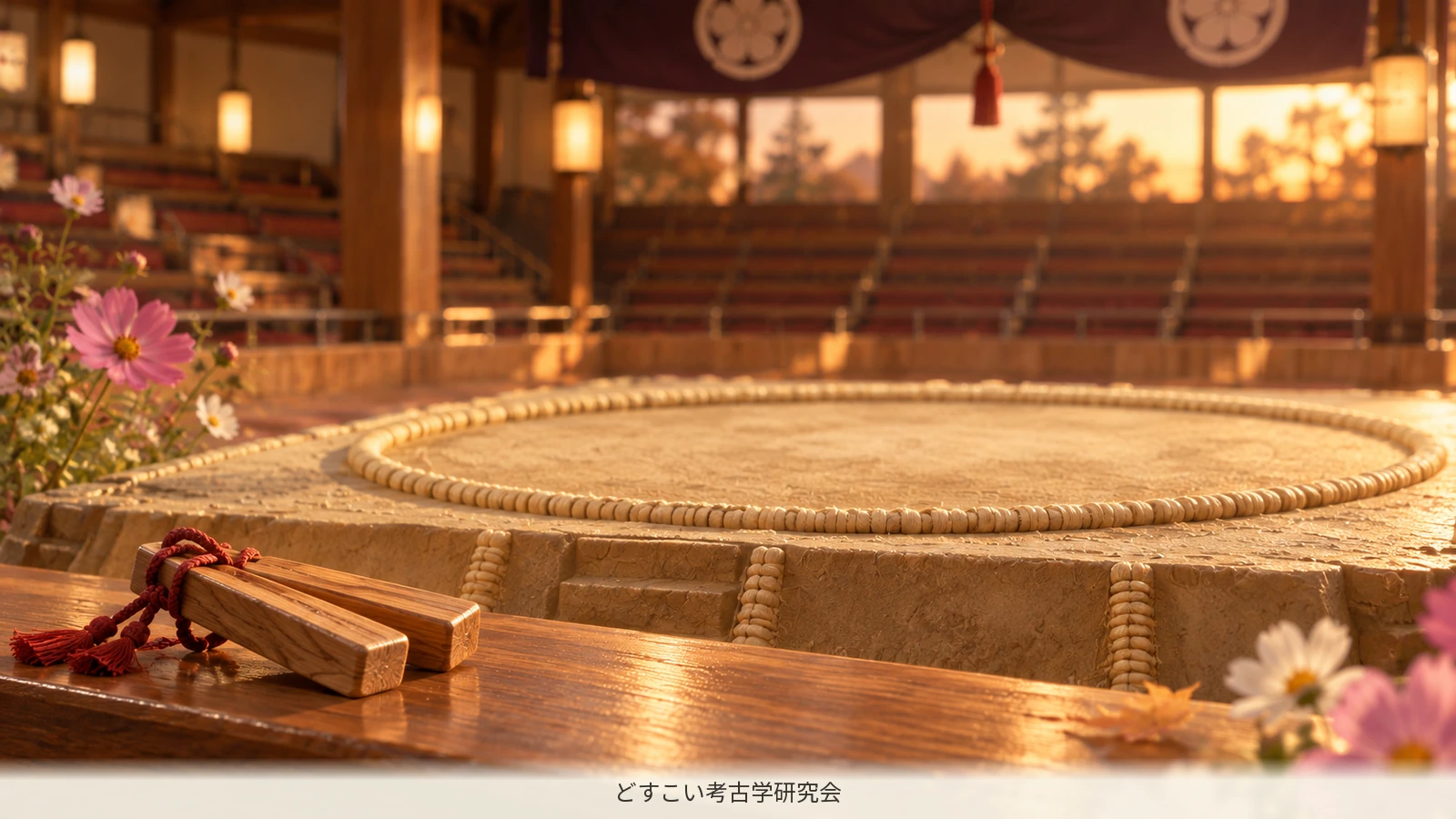
Yumitori-shiki is performed immediately after the final scheduled bout of the day. A designated wrestler receives a bow from the senior referee and executes a formal sequence of movements. The Japan Sumo Association describes it as a dance expressing the final bout winner’s joy on his behalf. It is not an unrelated encore: the result you just watched determines how the ceremony begins.
Crowds start moving as soon as the last winner is announced. If your schedule allows, stay through the ceremony and look for the side from which the bow performer climbs onto the dohyo. East or west is not assigned by the date. It preserves the direction of the winner who has just left.
Detailed description of this diagram
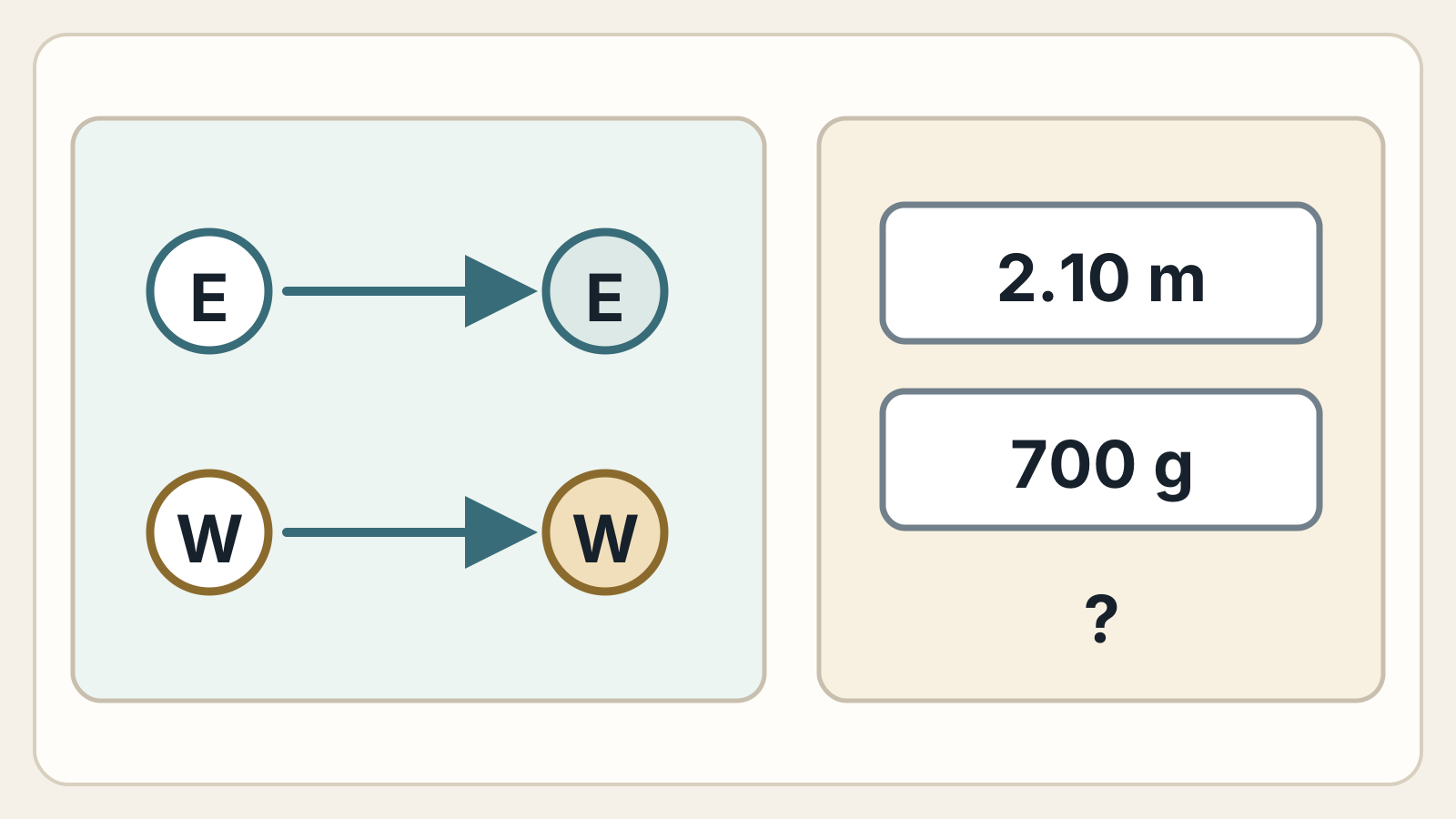
E to E and W to W show that the final-bout winner’s side determines both the performer’s entry side and the direction of his first bow-drawing movement. The diagram’s left and right positions do not represent the ring’s actual orientation. The separate figures, about 2.10 m and 700 g, are the bow’s length and weight as given by the Association.
Graphic: SUMO ARCHAEOLOGY CLUB · Figure source 1 · Figure source 2 · Figure source 3
He enters from the winner’s side
The performer watches the final bout from the far side of the ring. If the east wrestler wins, he enters from the east; if the west wrestler wins, he enters from the west. The bow action that looks rather like drawing a line through the clay is called “pulling the bow”, and the Association says he performs it first towards the winner’s side as well.
This is the easiest way into a ceremony whose full choreography can initially look complicated. Remember only the final winner’s side. Then confirm that the next wrestler appears there and makes the first low movement there. The bout and ceremony click together without a glossary.
The bow is taller than many people
According to an Association explainer, the bow is approximately 2.10 metres long and weighs about 700 grams. The order of the ceremony is prescribed, but the number of times the bow is twirled in the air is not fixed. The Association says the aerial twirling is intended to dispel harmful influences from the air.
From a distant seat the bow may look like a light line. Its length becomes clearer when you compare its tip with the performer’s body. Rather than counting rotations, trace one full arc. The speed, pause and control belong to this wrestler’s performance even within the fixed sequence.
A lower-division wrestler may wear a topknot and ceremonial apron
The role is generally filled by a wrestler ranked in makushita or below, often from a stable or group connected with a yokozuna. For this duty he wears the formal oicho topknot and a kesho-mawashi, even though the oicho is normally a visual marker of salaried status.
This can be an unexpectedly good way to discover someone outside the televised divisions. The man with the bow is not an anonymous stage attendant; he trains, appears on the rankings sheet and has his own bouts. If his name catches your attention, look for it in the early programme on another day. A ceremony at the very end can send your curiosity all the way back to the morning’s sumo.
If the bow falls, it is not picked up by hand
The Association describes a rare contingency with an unforgettable rule. If the wrestler drops the bow on the dohyo, he must not put a hand on the clay to retrieve it. He places it on the top of his foot, flicks it upwards and catches it. If the bow has gone outside the ring, a caller returns it to the dohyo before the same foot-lift is used.
This is not a reason to hope for an error. On an ordinary day, simply watch the performer complete the sequence without dropping the bow. The contingency reveals the principle behind the choreography: because the performer stands in for the winner, he avoids taking the losing posture of touching down with a hand.
The history is presented as tradition, not a settled origin
The Association’s own feature says the origin is uncertain. It reports a tradition of winners dancing with bows from the Heian period and presents a famous 1791 shogunal viewing: after defeating Onogawa, Tanikaze is said to have swung a bow in all four directions, an act treated as a model for the modern ceremony.
That does not make 1791 a proven birth date for yumitori-shiki. The responsible—and more interesting—version preserves the source’s uncertainty. We can watch the current sequence precisely while leaving room to ask how its strands of court, warrior and professional-sumo practice came together.
The final wooden claps close the day
At the end of yumitori-shiki, a caller strikes wooden clappers. This is agari-gi, which the Association identifies as the moment of uchi-dashi: the formal close of the day’s programme. The finishing time can vary with the programme, so check the guidance for your visit.
Your one observation next time is the winner’s side. Follow the performer from that side, through the first low bow movement, one high arc and the last wooden sound. What looked like a flourish after the real action becomes a compact closing narrative: the winner is represented, the air is cleared, and a single crack of wood places a full stop after a day of sumo.
Sources
- Japan Sumo Association, Sumo Quiz No. 16 on yumitori-shiki, published 24 January 2022 (checked 7 October 2026)
- Japan Sumo Association, Sumo Quiz No. 1046 on the bow and performer, published 19 November 2024 (checked 7 October 2026)
- Japan Sumo Association, Sumo Quiz No. 1399 on entering from the winner’s side, published 7 November 2025 (checked 7 October 2026)
- Japan Sumo Association, Sumo Quiz No. 955 on beginning from the winner’s side, published 20 August 2024 (checked 7 October 2026)
- Japan Sumo Association, Sumo Quiz No. 622 on agari-gi, published 22 September 2023 (checked 7 October 2026)
Source links used for verification
Article verified:
- Japan Sumo Association Sumo Quiz No. 16: yumitori-shikiPrimary source (as checked for this article)
- Japan Sumo Association Sumo Quiz No. 1046: the bow and performerPrimary source (as checked for this article)
- Japan Sumo Association Sumo Quiz No. 1399: entering from the winner's sidePrimary source (as checked for this article)
- Japan Sumo Association Sumo Quiz No. 955: which side comes firstPrimary source (as checked for this article)
- Japan Sumo Association Sumo Quiz No. 622: the closing agari-giPrimary source (as checked for this article)