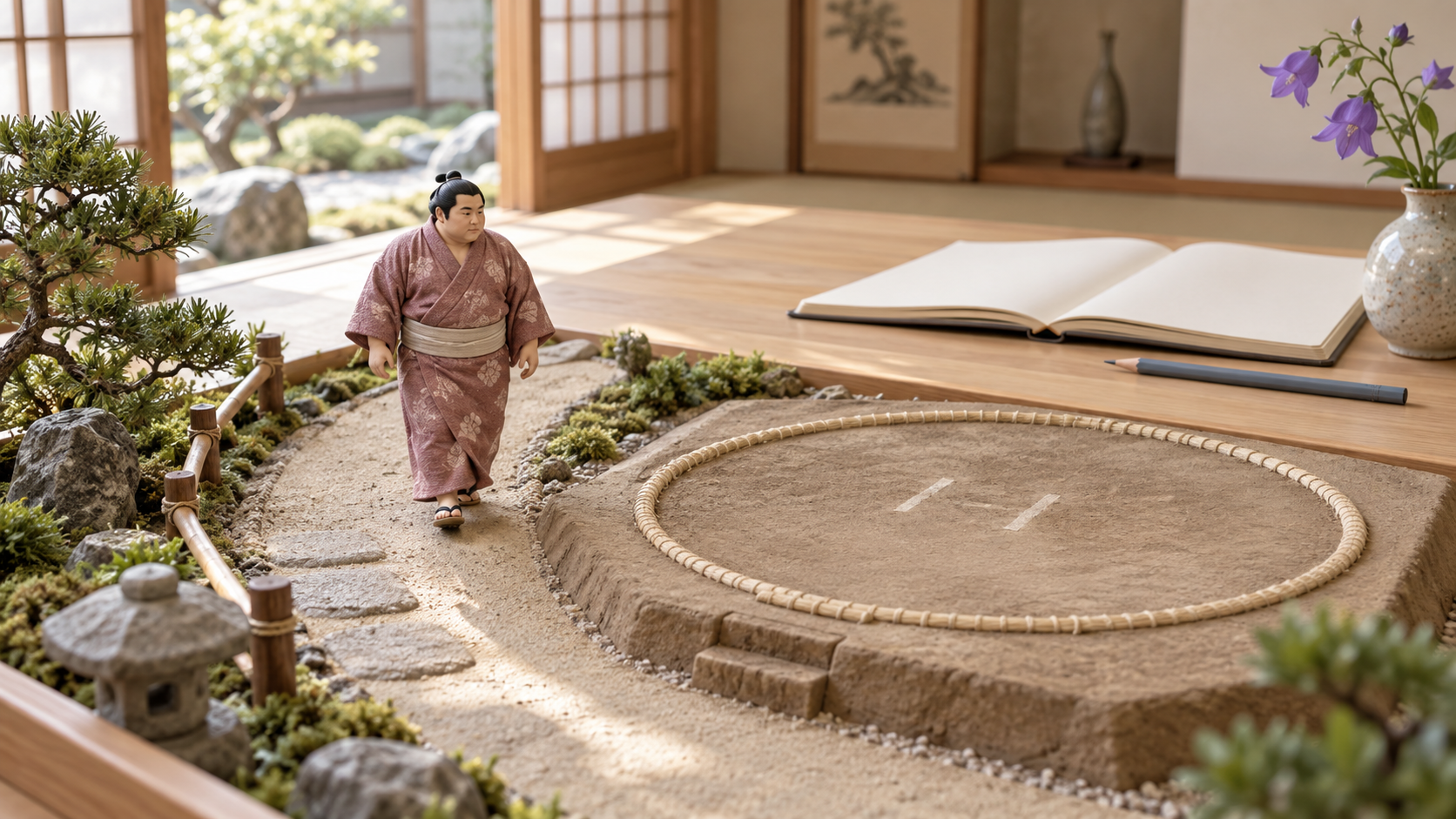
When following a comparatively smaller wrestler, do not turn every day into a tale of a little man confronting a giant. Verify height and weight through the official profile and keep those numbers in the fact column. In the observation column, watch the angle at the tachiai, the first step, the moment he leaves the opponent’s centre line, and the choice at the edge. Size is one condition, not the whole explanation of a result.
“Small” is not a rank
There is no official banzuke division called small-bodied. The label depends on the era and the comparison. If you use it, date the official profile you checked and treat listed measurements as information that can be updated. Do not infer a wrestler’s complete ability or only possible style from his body.
For day one, record the listed measurements of both wrestlers and the official outcome. Then resist the shortcut of writing “overcame the size difference” after a win or “lost because of size” after a loss. What happened in the bout belongs in a separate observational field.
Four details for each day
- Line of contact: did the wrestlers meet squarely, or did an angle appear?
- First step: did the tracked wrestler move forward, sideways or backward?
- Use of level: did the posture visibly become lower? Leave blank if the view is unclear.
- Edge choice: did he remain, circle, attack first or choose another visible movement?
Compliments such as “quick” and “clever” can become stereotypes when they explain all fifteen days in advance. Replace them with a modest statement that another viewer could inspect: “His second step moved outside the opponent’s right side.” The same wrestler may push squarely one day, seek the belt the next and receive the initial force on another.
Compare the pairing, not only the measurements
Add one detail about the opponent’s preferred opening, arm position or initial direction. The comparison is not there to manufacture a big-versus-small plot. It helps you see which part of the ring and which line the two wrestlers contested in the opening seconds.
The more an article begins with measurements, the more I want the actual notebook to move away from them. The ring remains the same size, yet half a step away from the opponent’s centre can make its space look entirely different. If the same angle appears several times over fifteen days, you will have a precise little moment to anticipate next tournament.
Review after the tournament
Select the most frequent first direction, one moment when the centre line changed, and one bout that the size difference could not explain. Do not predict development, limits, promotion or retirement from measurements alone.
What One Bout Cannot Tell Us
One bout shows a movement sequence and an official result. Do not infer personality, emotion, injury, fatigue or the next strategy from a single moment. Record the visible cue in plain language, compare multiple days, and wait for an official announcement. Inner feelings remain unknown without the person’s attributed words.
Sources
- Japan Sumo Association, wrestler search, banzuke, and daily bouts and results, checked September 3, 2026. Measurements, rank and official outcome are used as separate records.
Source links used for verification
Each link was used for the corresponding claim in this article; inclusion is not a blanket endorsement of the whole page.
Article verified:
- Japan Sumo Association wrestler searchPrimary source (as checked for this article)
- Japan Sumo Association banzukePrimary source (as checked for this article)
- Japan Sumo Association daily bouts and resultsPrimary source (as checked for this article)