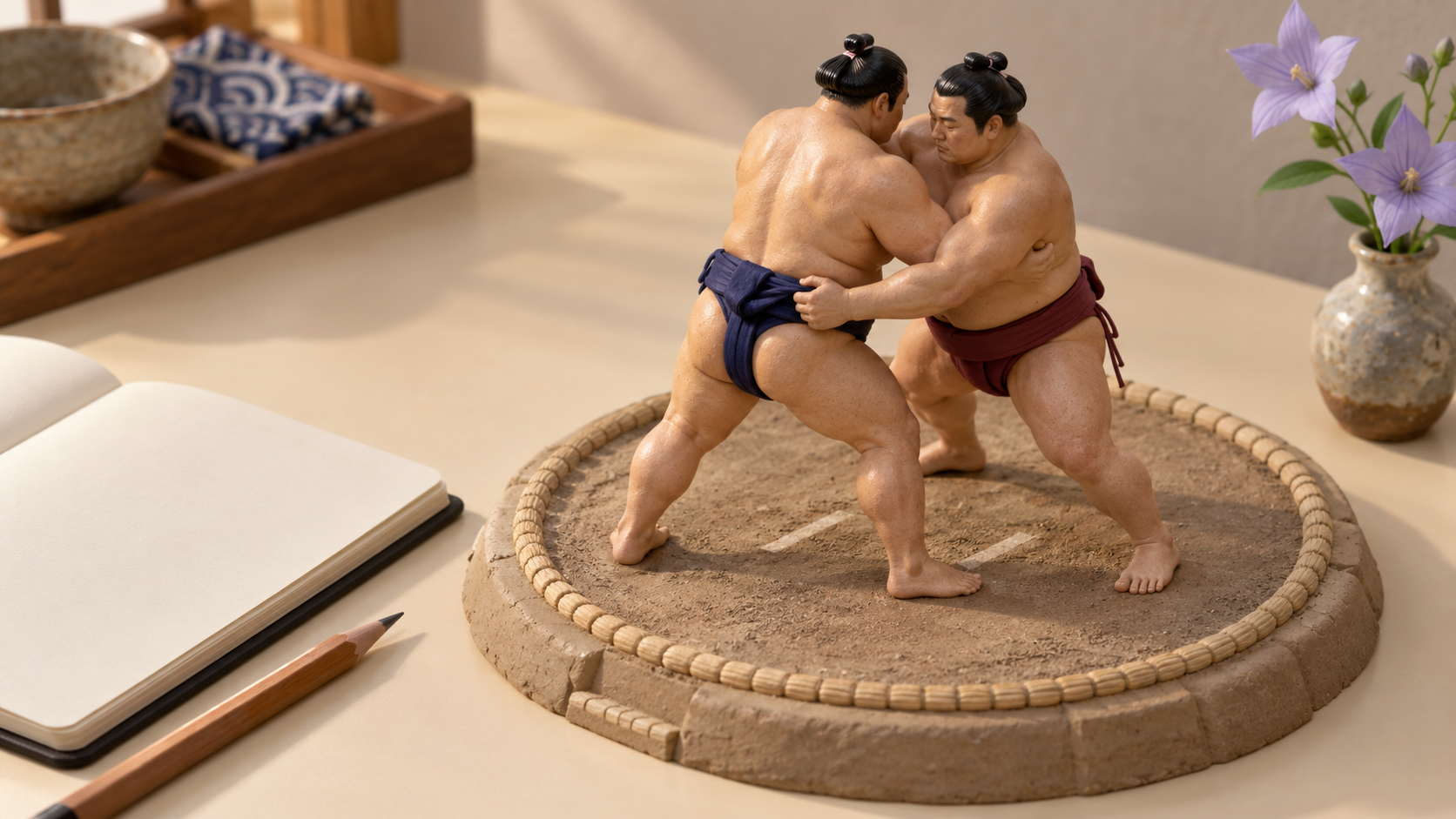
When following a belt-oriented wrestler, do not turn every day into a quiz about whether he reached right-hand or left-hand yotsu. Record the first hand to enter inside, the first hand to reach the mawashi, and the decision made when the preferred grip disappeared. The official kimarite names the finish. Your notebook can preserve the route that produced it, including the days on which the wrestler never obtained his familiar position.
Classify less during the first three days
In right-hand yotsu, each wrestler’s right arm is inside and the left reaches outside; left-hand yotsu reverses that relationship. Real bouts do not always settle immediately into a clean diagram. An ottsuke, thrust, arm pull or grip change may come first.
Begin with ordinary descriptions: “right hand inside,” “left hand outside,” or “neither hand reached the belt.” Check the Japan Sumo Association’s official result after writing that line. Do not reason backwards that every yorikiri must have used the preferred yotsu, or that an uwatenage means the outside grip existed from the tachiai. A result is a verified ending, not a complete transcript.
Give each day five small fields
- The first hand that entered inside after contact
- The location of the first visible belt grip
- The moment an opponent broke, changed or escaped the position
- The official winning technique
- One detail to revisit tomorrow
If the camera does not reveal the hands, write “not visible.” That honest gap can redirect your attention to foot direction or the distance between the chests. If a commentator identifies a grip, keep the attributed explanation separate from your visual note.
The days without a grip matter most
No wrestler reaches an ideal position in every bout. An opponent may keep distance, attack continuously or block the inside arm. Instead of dismissing the contest as “not grappling,” locate the moment when your wrestler stopped trying to form the grip. Did he continue forward, pull, circle or reset his hands higher on the body?
I often become more interested in the hand that missed the mawashi than in the successful grip. For half a second it seems to have nowhere to go; then it lands at the armpit, shoulder or chest. Find that correction on three separate days and a “preferred style” stops looking like a fixed label. It becomes a route the opponent can close and the wrestler has to rebuild.
Summarise after fifteen days
Count separately the days when the first inside hand succeeded, the full preferred grip appeared and the wrestler chose to fight at distance. State the number of observable bouts and exclude views that were unclear. Do not turn a small sample into “he always does this.” Carry the same question into the next tournament and see whether the route changes.
What One Bout Cannot Tell Us
One bout shows a movement sequence and an official result. Do not infer personality, emotion, injury, fatigue or the next strategy from a single moment. Record the visible cue in plain language, compare multiple days, and wait for an official announcement. Inner feelings remain unknown without the person’s attributed words.
Sources
- Japan Sumo Association, official winning techniques and daily bouts and results, checked September 3, 2026. They support the verified finish; the guide deliberately labels intermediate observations as the viewer’s notes.
Source links used for verification
Each link was used for the corresponding claim in this article; inclusion is not a blanket endorsement of the whole page.
Article verified:
- Japan Sumo Association official winning techniquesPrimary source (as checked for this article)
- Japan Sumo Association daily bouts and resultsPrimary source (as checked for this article)