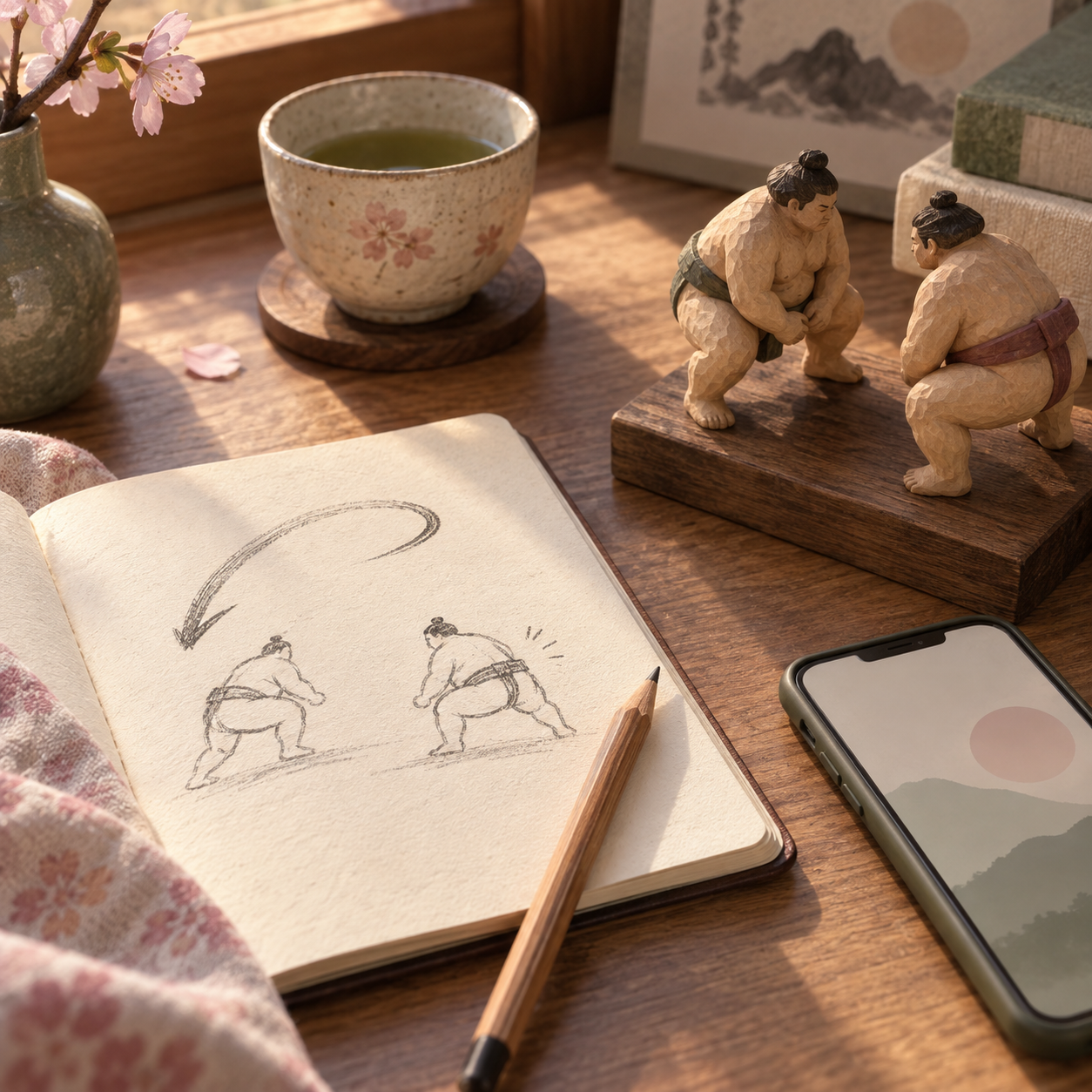
Before searching, write one plain sentence about what appeared to happen. Then check the Japan Sumo Association bout result and finally open its guide to the 82 kimarite. This is not an official mandatory sequence; it is a viewing method for keeping your observation separate from the recorded label.
The official bout page displays opponent, outcome and kimarite, while the official guide supplies categories and explanations.
One kimarite label does not replay the entire bout. A result recorded as *yorikiri* can leave separate questions about the first visible grip, pauses in movement and direction at the edge.
1. Keep one sentence in ordinary language
Do not force technical Japanese into the first note. Write “drove through the chest,” “right hand reached for the belt,” “opponent moved sideways,” or “the final step went outside.” An arrow or question mark is useful too. Do not erase this first impression after learning the result.
The sentence creates questions beyond correct or incorrect. If you expected oshidashi but the result is yorikiri, when did a belt grip appear? If it looked like a general throw but the record says uwatedashinage, what direction did the pulling hand create? Now a replay has a purpose.
2. Use the official bout result
Treat the JSA result page as the reference for opponent, outcome and kimarite, and retain its URL and your check time. A caption on a social clip or a commentator’s first call is not the official page.
These two sources do not tell us the update time or correction history for a displayed result. If the page later looks different, record both check times rather than asserting a correction without a dated notice.
Do not call an unfamiliar-looking technique a foul or a spectacular rarity from its English nickname. Receive the official result first, then examine the Association’s category and explanation.
3. Read one neighbouring technique
The Japan Sumo Association lists 82 winning techniques and five additional outcomes called non-techniques. The five non-techniques are separate from the 82.
Start with the name that caught your attention in the official kimarite guide. Its categories, such as basic techniques and throws, can help you find a second entry to compare. That small comparison may give you one more detail to watch next time.
For *yorikiri* and *oshidashi*, compare the Association’s individual explanations rather than relying on their English nicknames. This article does not reduce either entry to a necessary-and-sufficient one-line test; the official detail pages are the next stop.
Preserve a space for “not visible”
A distant seat, short replay or overlapping bodies may hide the relevant contact. Write, “Official result: X; this contact was not visible from this view.”
When the same kimarite appears again, carry only one question into it: foot, hip or hand position. The moment one becomes visible, the list of 82 stops being a glossary and turns into a map for watching bodies move.
If the answer is not available yet
If the official result is not available, keep the plain-language note and mark the kimarite “official result not yet confirmed.” If the result is available but contact was hidden, retain both facts: “Official result: X; contact not visible from this view.”
If a dated official correction is later confirmed, retain the original check time and update the label with that source. A visible difference without such confirmation remains two time-stamped observations, not proof of why the page changed.
Updated October 1, 2026: checked the distinction between the 82 kimarite and five non-techniques, and the link to the official guide.
Sources
- Japan Sumo Association, official guide to the 82 kimarite, checked September 3, 2026, for technique groups and explanations.
- Japan Sumo Association, official bout results, checked the same date as the reference for opponents, outcomes and recorded kimarite.
Source links used for verification
Each link was used for the corresponding claim in this article; inclusion is not a blanket endorsement of the whole page.
Article verified:
- Japan Sumo Association official 82 kimarite guidePrimary source (as checked for this article)
- Japan Sumo Association official bout resultsPrimary source (as checked for this article)