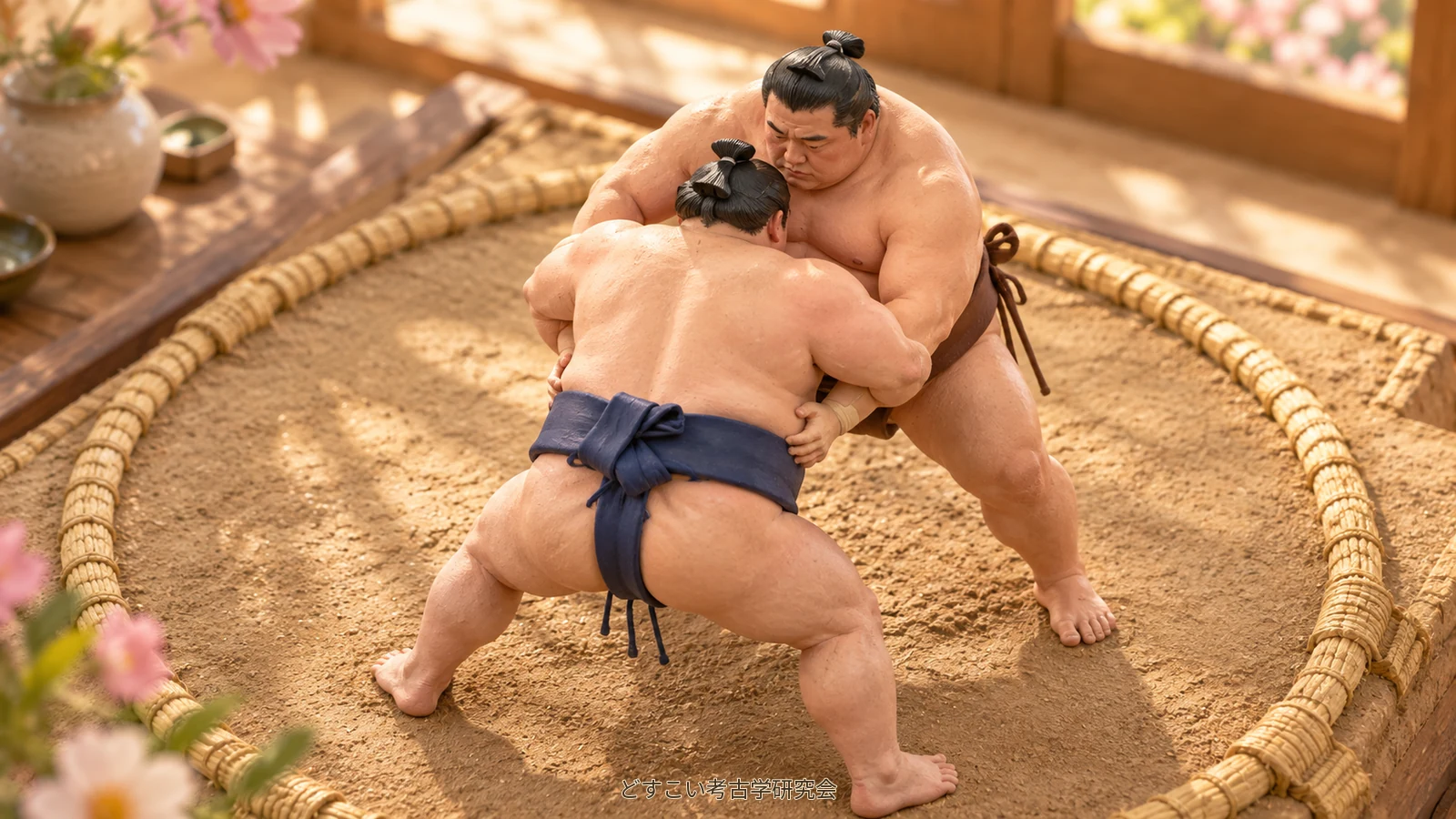
Morozashi is a position in which one wrestler has inserted both arms beneath the opponent’s arms, one into each armpit. *Moro* conveys “both”: instead of one inside arm in a standard right- or left-yotsu position, there are two. The official definition identifies arm position; it does not guarantee two belt grips or the eventual winner.
Look for the elbows rather than assuming two hidden belt grips. If the view is blocked, “not visible” is a better answer than a guess.
When two large torsos meet, the interesting space seems to disappear. The official photograph for morozashi points attention to exactly that hidden space. Are one wrestler’s two elbows both near the centre, with the opponent’s elbows outside them? The position can become legible before either wrestler’s name is known.
Both arms are inserted under the opponent’s arms
The Japan Sumo Association defines morozashi as an attacking position made by placing both the left and right arms under the opponent’s armpits. This separates it from migi-yotsu or hidari-yotsu, where each wrestler normally has one arm inside and one outside.
Hands can vanish behind the belt or body, so demanding a clear view of two grips makes the task unnecessarily hard. Start with elbows. If one wrestler has both elbows inside the opponent’s two arms, you have found the essential geometry described by the official source.
That definition does not require you to claim that both hands have already secured deep belt grips. From the inside, a wrestler may work the arms upward, stay close, drive, reach for the mawashi or set up a later action. Morozashi names the position; the official kimarite announced after the bout names how the contest was finally won.
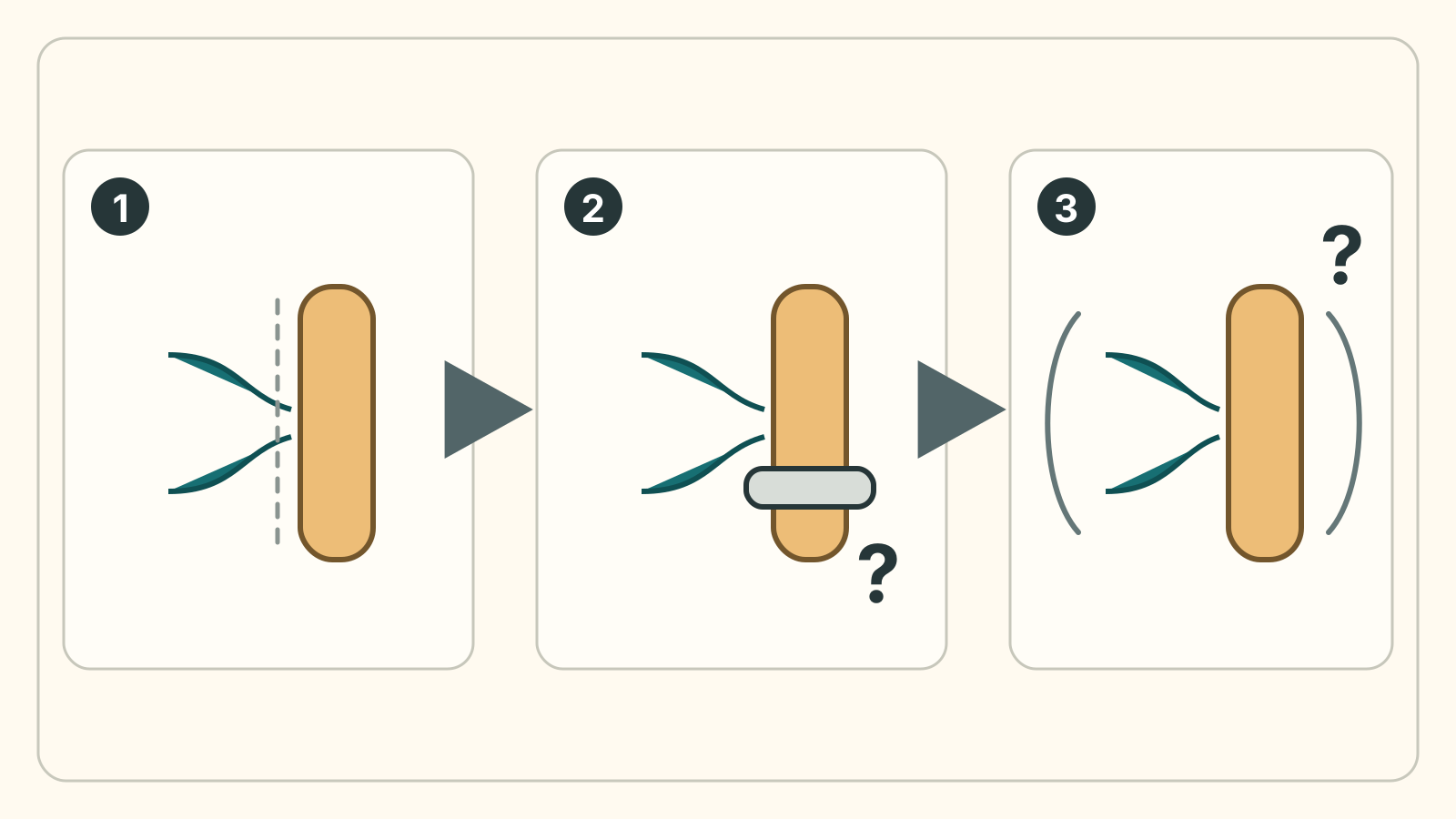
Detailed description of this diagram
Card 1 routes two blue relation paths inside a gold opponent-role bar, encoding only two inside arms. Card 2 adds a grey belt-like band and question mark so the image does not assert that both hands hold the mawashi. Card 3 adds outside brackets for the documented possibility of a kannuki response. Bars, band and brackets encode no armpit, arm, elbow, hand, joint lock, pressure, pain, strength, outcome or execution method.
Graphic: SUMO ARCHAEOLOGY CLUB · Figure source 1 · Figure source 2
The second inside arm is the moment to watch
Rather than waiting for a fully formed pose, follow how it develops. One arm enters first. The opposite shoulder then moves closer and the second arm searches beneath the other armpit. Does it slip inside, or does the opponent close that route?
This makes even a failed attempt interesting. If the second arm never enters, you have still seen the contest for the inside. If it does enter, keep watching rather than looking away to celebrate a vocabulary answer. The feet and the opponent’s arms are already preparing the next part.
The outside wrestler may use kannuki
The Association describes *kannuki* as a technique used when an opponent has morozashi: the wrestler on the outside clamps around both of the inserted elbows, applying pressure from outside to restrict their movement. It may also be described as “locking” the arms.
The same arrangement therefore carries two viewpoints. From the middle, you can see morozashi. From outside, you may see the beginning of a kannuki response. This is why “inside equals winner” is too simple. A position offers possibilities, not a guaranteed result.
Avoid diagnosing the strength or safety of a hold from a distant camera angle. The useful observation is narrower: do the outside arms appear to enclose the opponent’s elbows? If the contact is hidden, leave it unknown and let the official decision and announced kimarite supply the result.
One second at the centre of the next bout
At the next close engagement, move your attention from faces to the small gap between the chests. Choose one wrestler. Is one elbow inside, or are both? When the second arrives, glance outward: what is the opponent doing with the two arms that now sit outside?
A long clinch can look like a pause between the exciting moments. Morozashi changes that reading. The second elbow tries to enter; two outside arms may close; feet begin to drive while the upper bodies appear almost still. The biggest bodies in the arena can make their smallest positional change in a space barely visible on screen. Finding it once is enough to make the next close bout feel alive.
Sources
- Japan Sumo Association, Sumo Quiz Nos. 303 and 894 (accessed September 3, 2026)
Source links used for verification
Each link was used for the corresponding claim in this article; inclusion is not a blanket endorsement of the whole page.
Article verified:
- Japan Sumo Association Sumo Quiz No.303: the morozashi positionPrimary source (as checked for this article)
- Japan Sumo Association Sumo Quiz No.894: the kannuki positionPrimary source (as checked for this article)