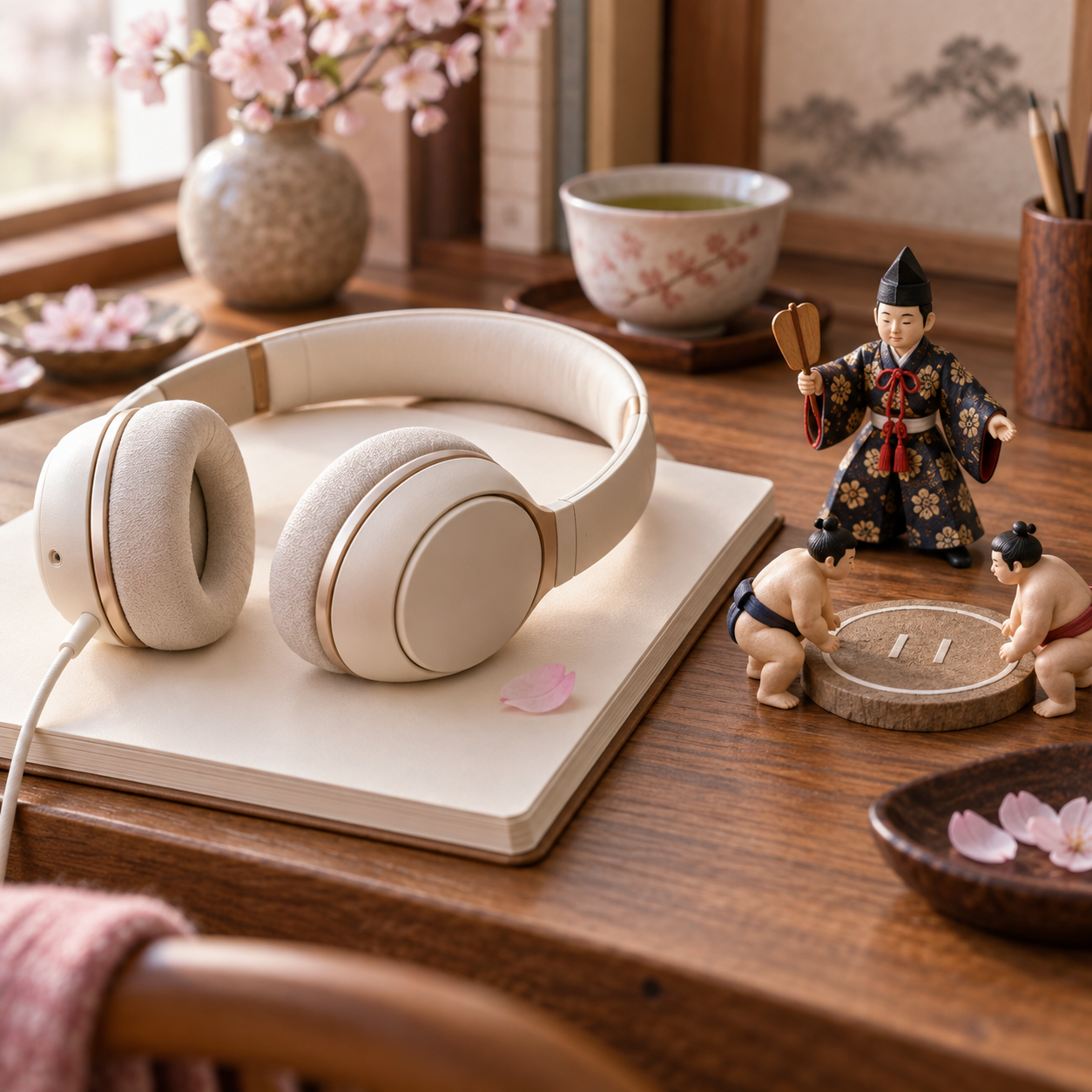
The referee’s *hakkeyoi* is not the equivalent of “go.” The Japan Sumo Association says it may be used before the tachiai or when the wrestlers stop moving during the bout. *Nokotta, nokotta* is called while they are moving and the contest remains undecided. On your next bout, do not translate every syllable. Watch the feet when the call changes, and the action will begin to sound organised rather than mysterious.
For an overseas viewer, the familiar chant can seem like one long starting formula: “hakkeyoi, nokotta.” Sumo has no starter’s pistol, however. The wrestlers create the tachiai by matching their timing, so the gyoji’s voice does a different job from an official releasing runners from blocks.
Hakkeyoi encourages action
In its official explanation, the Association connects *hakkiyoi*—the Japanese page writes it はっきよい—with *hakki yoyo*, an expression of vigorous spirit. The page also notes that other origin theories exist, so it is best treated as the Association’s interpretation rather than an uncontested linguistic proof.
The useful viewing point is simpler. The call is not confined to the beginning. A gyoji can use it when two wrestlers have locked into a belt grip and their motion has stalled. If the broadcast picture suddenly looks still, listen and then watch one hip or one planted foot. The next movement often begins there.
Nokotta means the decision is still alive
The Association explains *nokotta* as indicating that both wrestlers remain in the contest and the result has not been decided. It is heard while they are moving. It is not a command that awards points, nor is it another word for the start.
This becomes wonderfully clear at the tawara, the ring’s straw-bale boundary. A heel can hover close to the outside while the other wrestler presses forward. The crowd may react before you can see the contact. As long as the contest continues, the repeated call carries you through those fractions of a second.
Miiatte belongs to the preparation
You may also hear *miiatte* during shikiri. A literal-minded viewer might take the scene as an instruction to stare aggressively. The Association says the call prompts the wrestlers to match their breathing and make a clean, instantaneous tachiai.
The three calls therefore reveal different conditions: *miiatte* helps build the shared start; *hakkeyoi* urges action; *nokotta* follows action while no result has been reached. They are not a fixed soundtrack that must occur the same number of times in every contest. The state of the two bodies comes first, and the voice responds to it.
One listening exercise for television, streaming or the arena
Commentary and crowd noise may cover some calls. That does not make you a poor viewer. Choose a single bout and try this:
- Wait for a moment when the wrestlers’ feet appear to stop.
- If you hear *hakkeyoi*, follow one waist or foot as motion restarts.
- When *nokotta* continues, watch the shrinking space between a heel and the boundary.
Do not use the voice to invent a wrestler’s thoughts. You only need three observations: stopped, moving, not yet decided. A contest that lasted five seconds now has internal chapters.
In the next bout, listen for the instant when *nokotta* ends. The gunbai may point to the winner a heartbeat later, but the sound has already helped you find the boundary between struggle and result. Once you hear that shape, sumo no longer feels like an unexplained collision.
Sources
- Japan Sumo Association quizzes No.241 and No.1016 (verified 3 September 2026).
Source links used for verification
Each link was used for the corresponding claim in this article; inclusion is not a blanket endorsement of the whole page.
Article verified:
- Japan Sumo Association quiz No.241: hakkiyoi and nokottaHistorical primary source (record from that period)
- Japan Sumo Association quiz No.1016: miiatteHistorical primary source (record from that period)