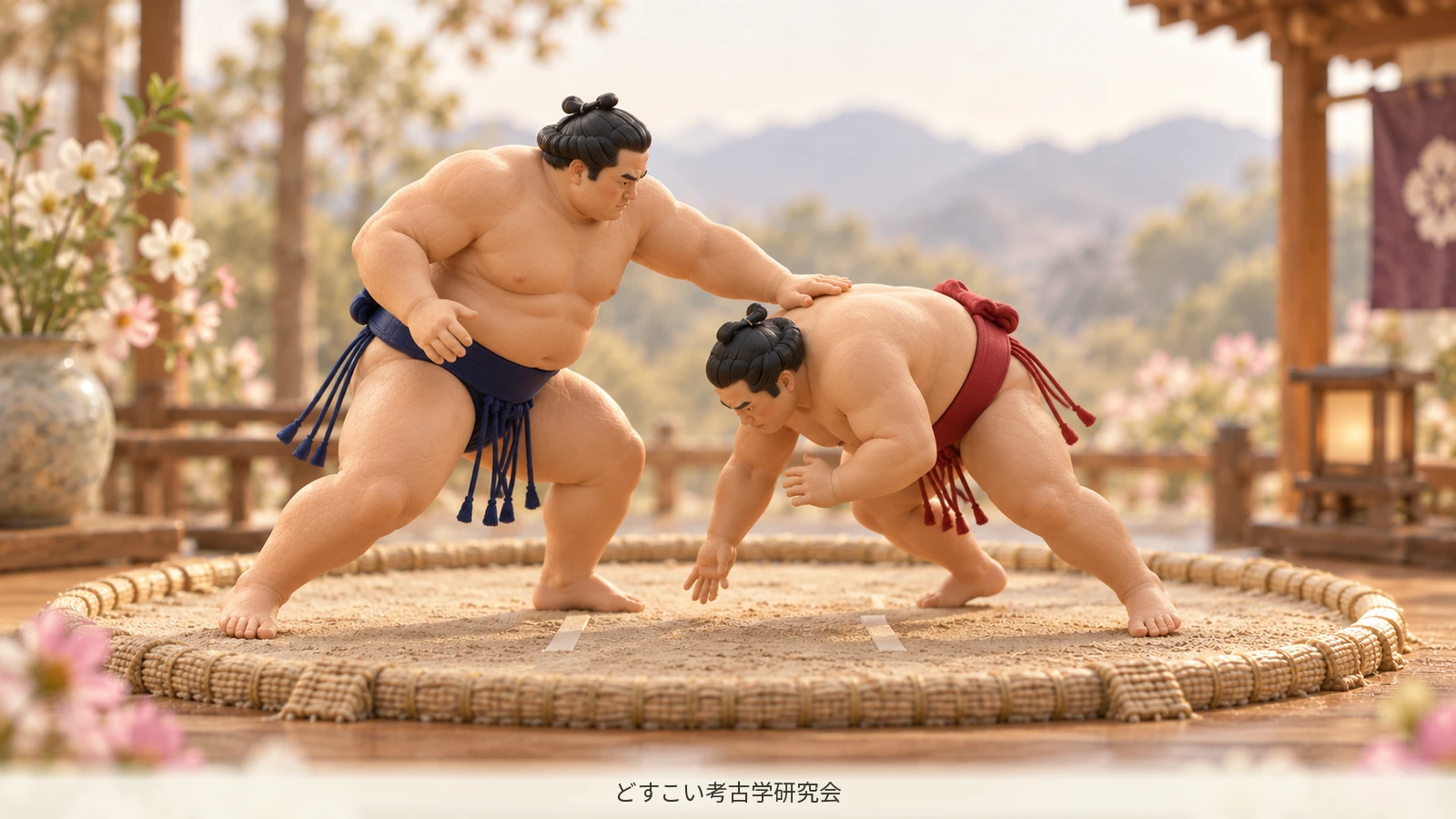
Hatakikomi is a slap-down: as a low, charging opponent advances, the winner opens his body and uses one or both hands to slap down at the shoulder, back or arm. Before calling it brave, cautious or cheap, watch the losing wrestler’s final two steps. Did his feet continue beneath his forward-moving body, and when did the winner leave the line of attack? The answer often explains the fall.
A wrestler surges forwards, touches the clay and turns a confident cheer into a disappointed gasp. If that was the person you were supporting, hatakikomi can feel frustratingly abrupt. Let the feeling stay—but then look at the feet. What first appeared to be an escape becomes a sequence worth investigating. Footage alone does not prove the force, cause, intention or a wrestler’s physical condition.
The official definition contains three actions
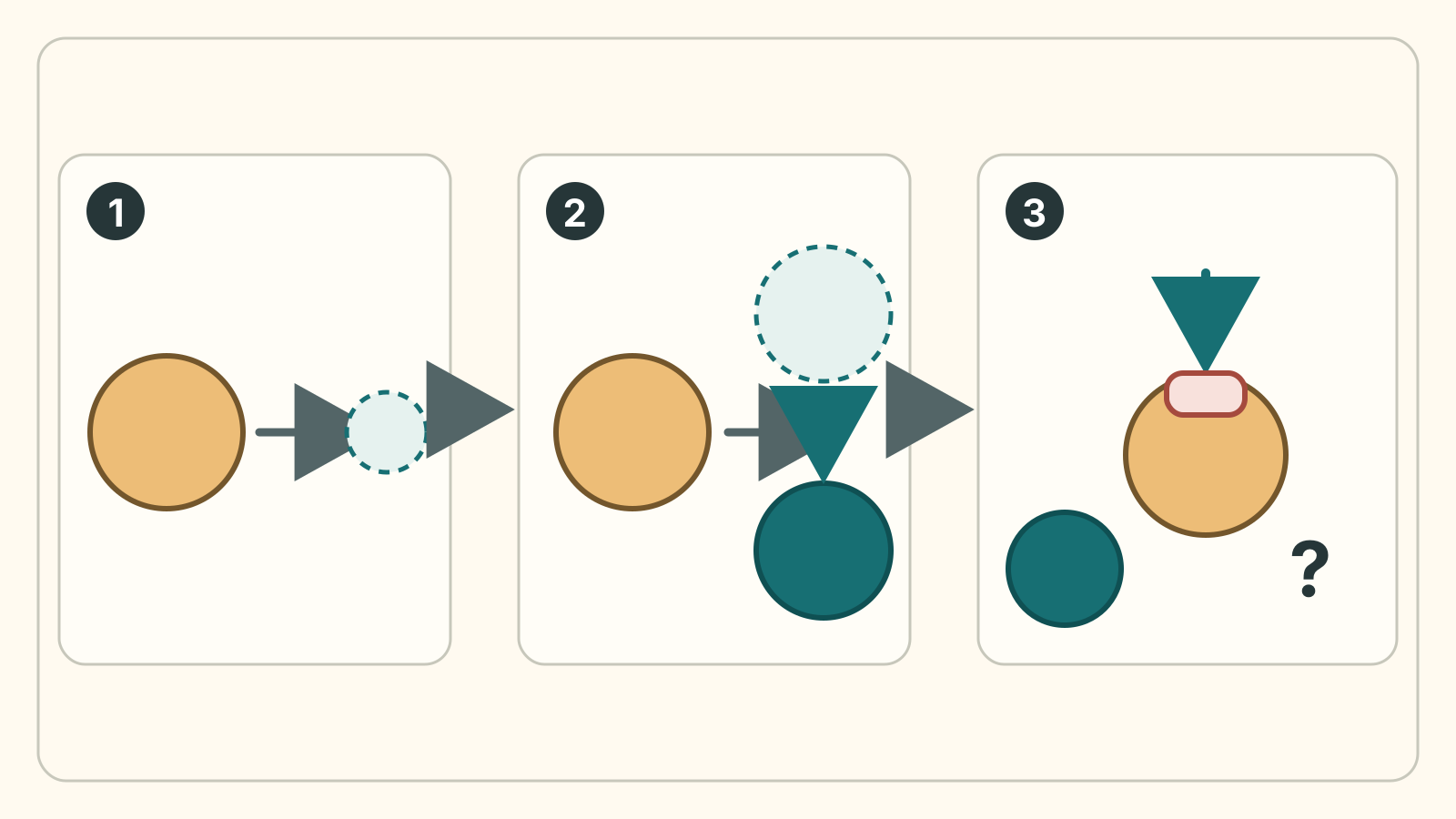
The Japan Sumo Association’s explanation can be read as a short sequence:
- The opponent advances in a low posture.
- The defender opens his own body away from the line of force.
- One or both hands strike down at the opponent’s shoulder, back or arm, causing him to fall forwards.
The official description is more specific than merely touching the back: the winner opens the body and uses a hand action at the shoulder, back or arm to bring the opponent forwards. It does not quantify force or establish which missed step caused the fall.
Detailed description of this diagram
Card 1 gives the gold opponent token a forward arrow, symbolising the official low-advance condition without drawing a body angle. Card 2 retains the opponent's advance line and moves the blue winner token away from it, marking only the order of opening the body. Card 3 places a downward arrow and red contact cue over the gold token, abstracting the official action at shoulder, back or arm. A question mark keeps the actual loss of balance and official classification unresolved. Tokens and arrows reproduce no posture, footwork, contact point, timing, force or fall mechanics.
Graphic: SUMO ARCHAEOLOGY CLUB · Figure source 1 · Figure source 2
The missed step can be more revealing than the hand
On a successful slap-down, the loser’s torso may appear to continue beyond his feet. A head may drop, hips may rise or the next foot may not be visible beneath him in time. Those are replay observations, not proof that one foot movement caused the official result.
Try following the aggressor’s last two steps in the next bout. Were they short enough to maintain balance? Did the arms reach farther ahead than the feet? Did the body begin to fall before the palm made obvious contact? Hatakikomi lets a beginner study attacking posture, not only defensive cleverness.
“Henka” and “hatakikomi” are not interchangeable labels
Viewers use *henka* for a sidestep at the initial charge, or tachiai. It is not one of the official kimarite names. A tachiai sidestep can lead to hatakikomi, but hatakikomi can also happen after a frontal collision and several seconds of ordinary fighting.
You therefore cannot work backwards from the announced kimarite and conclude that the winner avoided the opening contact. Ask when the body opened and how the forward pressure developed. It is completely possible to dislike a tactical choice while still describing the physical sequence accurately.
It ranks third in the current official sample
The Association’s current display covers 190,450 bouts from January 2013 through the final day of July 2026. Hatakikomi appears 15,677 times, or 8.2 percent, and ranks third. It is not an obscure trick: only oshidashi and yorikiri appear above it on that table.
That frequency also reveals a built-in tension in pushing sumo. Forward pressure wins bouts, but uncontrolled forward weight can be redirected. The attacker must keep moving the feet beneath the body even while driving the opponent backwards.
One thing to watch in the next bout
Choose the wrestler who is advancing and follow the height of his head and hips. If his head drops, is there still room for the opponent to move sideways? If his arms extend, does another foot arrive beneath them? A failed slap-down may become an oshidashi for the pursuer; a successful one may place a hand on the clay in an instant.
Hatakikomi reverses the noise of the arena, but it is rarely without a cause. Rewatch the final two steps of the bout that annoyed you. That tiny investigation turns a sudden fall into a question worth carrying into the next day of the tournament.
Similar Motion Does Not Set the Official Technique
A hand action or fall may look similar while the recorded kimarite differs according to the decisive action, sequence of balance loss and whether a body part touched down or crossed the ring first. Do not settle the difference between a similar technique, non-technique or foul from one camera angle; use the official result for that bout. A schematic marks viewing cues, not a substitute judges’ decision.
Evidence limits and event-day fallback
Confirmed fact: The Japan Sumo Association defines hatakikomi as opening the body against a low-advancing opponent and using one or both hands at the shoulder, back or arm to slap the opponent down. Displayed counts belong to the stated rolling period.
What remains unknown: A single view may hide soles, contact, the decisive sequence or which part touched first. Footwork cause, force, intention, fatigue, pain and injury cannot be established from appearance.
Reasoned inference: Following low advance, movement off the line and the downward hand action in sequence can focus a replay. Confidence is medium; these cues are not a necessary-and-sufficient judging test.
Editorial suggestion: Watch the final two steps, then keep observation separate from a hypothesis about how they mattered. This is not an official call, coaching or physical assessment.
Fallback: If feet, hand or touch order are hidden, do not name the technique or infer henka intent. Record ‘not visible’ and use the official bout result/kimarite.
Sources
- Japan Sumo Association, kimarite explanation for hatakikomi (checked 2 September 2026)
- Japan Sumo Association, list of 82 kimarite (checked 2 September 2026)
Source links used for verification
Each link was used for the corresponding claim in this article; inclusion is not a blanket endorsement of the whole page.
Article verified:
- Japan Sumo Association kimarite: hatakikomiPrimary source (as checked for this article)
- Japan Sumo Association list of 82 kimaritePrimary source (as checked for this article)