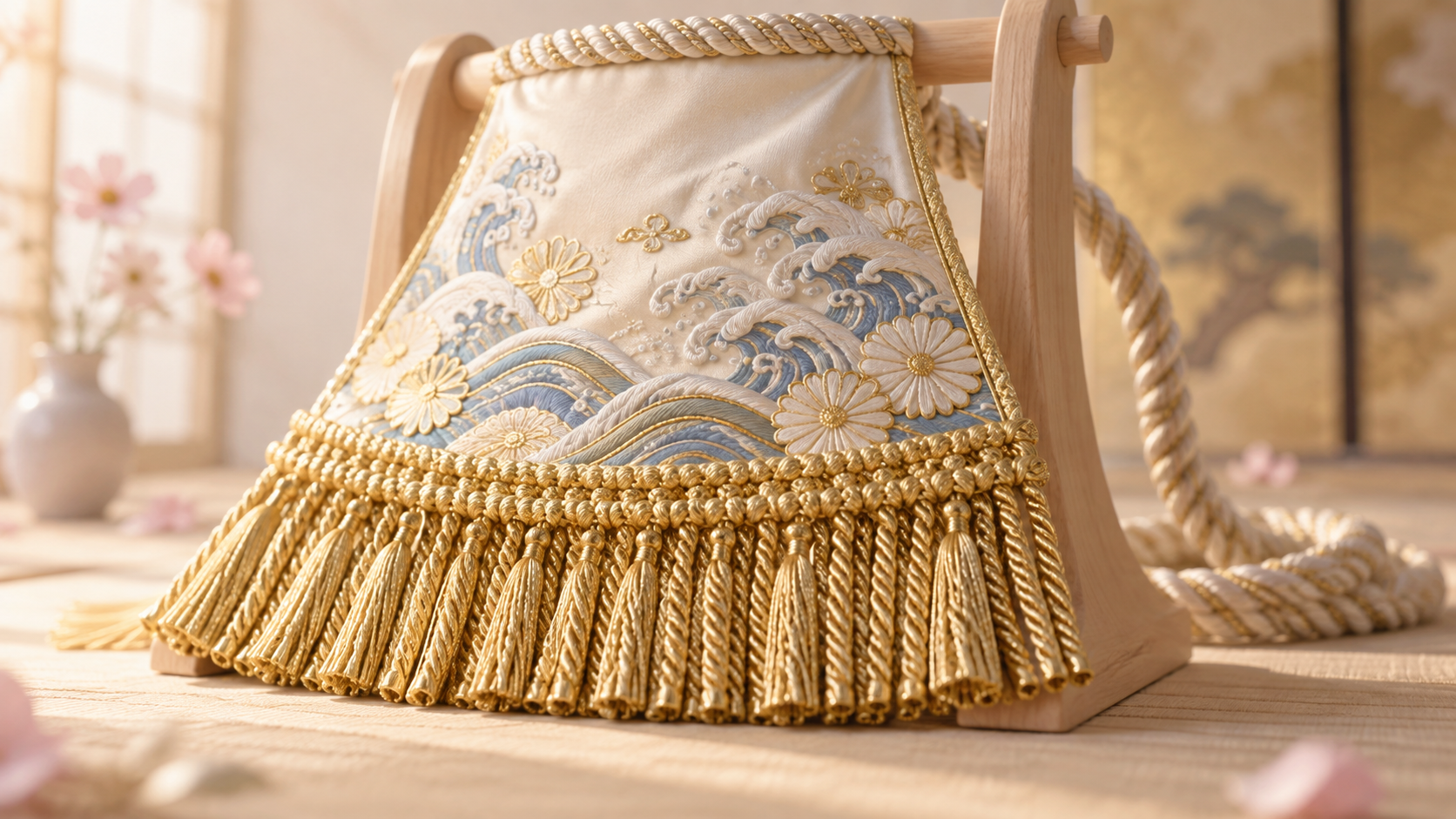
A kesho-mawashi is the richly decorated ceremonial apron worn by wrestlers in the juryo and makuuchi divisions during their ring-entry processions. It is not their competition belt. According to the Japan Sumo Association, the belt-and-apron piece is about seven metres long and, depending on the wrestler, weighs roughly six to eight kilograms. The fringe below the front panel has its own name: baren.
Dozens of embroidered designs can appear at once, which makes a first ring entry feel like a test you forgot to study for. It is not. Choose one apron whose colour catches you, then look at its lowest edge. The moment that “decorative fringe” becomes a named detail, the whole procession starts to resolve into individual objects—and individual wrestlers.
Detailed description of this diagram
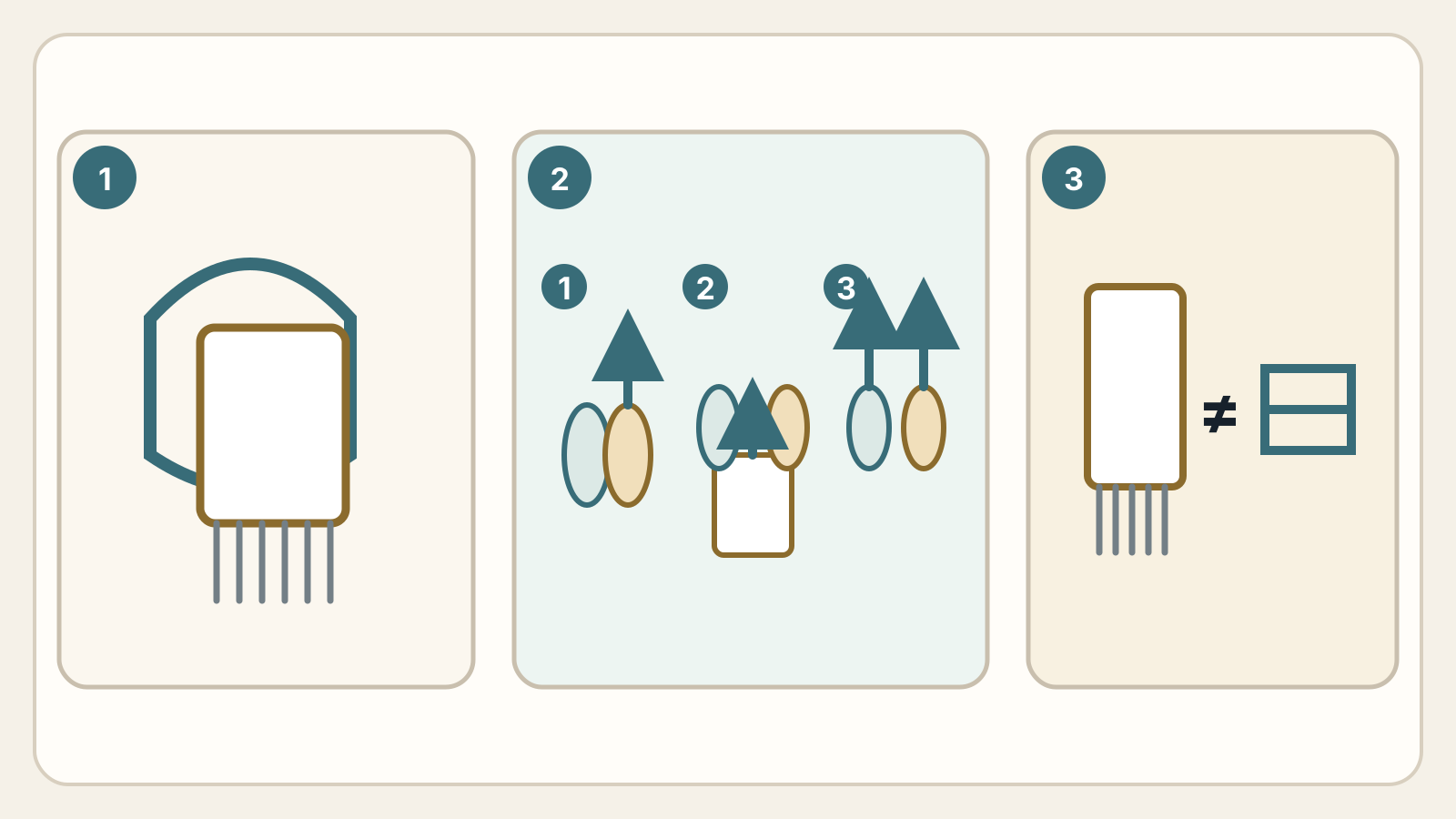
The left card loops a long blank band behind a blank front-panel rectangle and adds fringe tokens below, preserving only the one-band and baren topology. Three small states in the centre card use abstract hand tokens for one clap plus right hand raised, a slight two-hand panel lift, and both hands raised. The right card separates an undecorated apron token from a simple belt token with a not-equal sign, meaning ceremonial and competition categories differ. It depicts no wrestler, body fit, tying, embroidery, motif, donor, sponsor, logo, textile, exact purple, dimension, weight distribution, drape, lift height, speed or real shimekomi/sagari form.
Graphic: SUMO ARCHAEOLOGY CLUB · Figure source 1 · Figure source 2 · Figure source 3 · Figure source 4
It is one long belt, not a panel clipped to the waist
From the front, a kesho-mawashi can look like a heavy board hanging from a hidden strap. The Association explains that the part wrapped around the body and the apron are a continuous band. Examples use Hakata weaving or Nishijin tapestry weaving. The front is backed with ornate brocade and decorated with embroidery using gold, silver and other threads.
The seven-metre length and six-to-eight-kilogram weight are approximate figures, not a rule that makes every apron identical. The official text itself says the weight varies by wrestler. That qualification matters: a responsible guide should help you picture the object without turning an estimate into an exact specification for every example.
The lower fringe is called baren
The tasselled decoration below the embroidered front panel is the *baren*. One colour has a rank restriction. The Association says purple baren may be used by yokozuna and ozeki, while wrestlers ranked sekiwake or below may not use purple for this fringe.
That does not mean you should invent a story for every motif. Some designs have well-documented donors, local references or personal meanings; others do not have a public explanation readily available. “I wonder what that is” is a perfectly good response. Let the unanswered picture lead you to one wrestler’s name instead of presenting an attractive guess as fact.
Watch the apron move during the shared gestures
Once all the wrestlers face inward, they perform a compact sequence. The Association describes a single clap followed by the right hand being raised, a slight lift of the kesho-mawashi with both hands, and then both hands being raised. It says these actions are understood as abbreviated forms of *chiri-chozu*, *sandan-gamae* and a leg stamp respectively.
The small lift of the apron is therefore more than a pose for photographers. After choosing your design, wait for both hands to touch and raise it. A row of separate colours suddenly breathes in the same rhythm. Even if you cannot hear every name in the arena announcement, you can follow that movement.
The ceremonial apron disappears before the bout
During actual competition, a salaried wrestler wears a silk *shimekomi*, the familiar firm mawashi, with *sagari* strings tucked at the front. The embroidered kesho-mawashi belongs to ring entry. Seeing the same wrestler return in a plain-coloured competition belt can be surprisingly satisfying: you have recognised a person across two very different visual identities.
This is one reason to arrive before the top-division bouts rather than treating ring entry as background. The Association’s Tokyo schedule for September 2026 lists juryo ring entry at approximately 2:15 p.m. and makuuchi ring entry at approximately 3:40 p.m., with slightly earlier estimates on opening day. These are Tokyo-specific, approximate times for that tournament—not universal promises. Check the current venue schedule.
One thing to look for next time
Pick one front panel, then follow it down to the baren. If that fringe is purple, check the wrestler’s rank rather than assuming from memory. If it is another colour, try to retain one shape from the embroidery and one name from the caller.
Later, when that wrestler walks back in wearing a shimekomi, you may recognise him before reading the on-screen graphic. A mass introduction has become the beginning of one person’s bout. The kesho-mawashi is spectacular craftsmanship, but its best gift to a newcomer may be simpler: it gives the eye somewhere to stop, and curiosity someone to follow for the next fifteen days.
Keep More Than One Interpretation Open
We separate what the official or collection source establishes from our observation. A ritual, object or posture may have another interpretation or theory across periods, regions and explainers. When primary evidence does not establish a single origin or meaning, we leave it unknown or contested rather than turn visual resemblance into historical fact.
Evidence limits and event-day fallback
Confirmed fact: Association explainers say juryo-and-above wrestlers use kesho-mawashi for ring entry; belt and front panel form one band, about seven metres long and roughly six to eight kilograms depending on the wrestler. Baren, its purple restriction and one account of the gestures are documented.
What remains unknown: Exact size, weight, material, motif provenance, donor, perceived colour and a unique origin for each gesture may be unavailable for an individual object. A Tokyo approximate time does not promise another venue or date.
Reasoned inference: Following one fringe and then the competition shimekomi can help a newcomer find the same wrestler. Confidence is medium; colour alone does not guarantee identity/rank or motif meaning.
Editorial suggestion: Cross-check fringe colour with the official banzuke and leave a motif open unless the wrestler, stable, donor or another attributable source explains it. This is not textile authentication or an official interpretation.
Fallback: If colour, motif or time is unclear, do not invent a label; return to the live banzuke/programme and documented provenance. If ring entry is missed, resume with the visible difference from the competition belt.
Sources
- Japan Sumo Association, Sumo Quiz No. 352 on kesho-mawashi construction and baren, published 26 December 2022 (checked 2 September 2026)
- Japan Sumo Association, Sumo Quiz No. 680 on purple baren, published 19 November 2023 (checked 2 September 2026)
- Japan Sumo Association, Sumo Quiz No. 912 on juryo and makuuchi ring-entry gestures, published 8 July 2024 (checked 2 September 2026)
- Japan Sumo Association, Sumo Quiz No. 318 on shimekomi and sagari, published 22 November 2022 (checked 2 September 2026)
- Japan Sumo Association, September 2026 Tokyo dohyo schedule (checked 2 September 2026)
Source links used for verification
Each link was used for the corresponding claim in this article; inclusion is not a blanket endorsement of the whole page.
Article verified:
- Japan Sumo Association Sumo Quiz No. 352: kesho-mawashi and barenPrimary source (as checked for this article)
- Japan Sumo Association Sumo Quiz No. 680: purple barenPrimary source (as checked for this article)
- Japan Sumo Association Sumo Quiz No. 912: ring-entry gesturesPrimary source (as checked for this article)
- Japan Sumo Association Sumo Quiz No. 318: shimekomi and sagariPrimary source (as checked for this article)
- Japan Sumo Association: September 2026 Tokyo dohyo schedulePrimary source (as checked for this article)