Learn one signed way out, then replace your plan with live instructions.
When you reach your seat, take one minute to identify the direction of the nearest marked exit and the route back to the concourse. In an earthquake or other emergency, do not race independently for a door: protect yourself, listen to arena announcements and follow staff instructions. Keep aisles, stairs, entrances, exits and evacuation passages clear throughout the day.
Visitors naturally locate the restroom and food counters before thinking about an emergency exit. You do not need to memorise a building plan or spend the tournament expecting danger. Simply knowing which way you would leave your section turns an unfamiliar arena into a place you can navigate more calmly.
What the official spectator contract says
The Japan Sumo Association’s current contract prohibits occupying a seat other than the one on the ticket and watching from aisles, stairs, entrances, exits, evacuation routes or other non-seating areas. Those spaces are not alternative viewpoints. They must remain available for movement.
The contract also requires spectators to follow instructions given by the organiser and its staff. After the competition, visitors must leave promptly as directed. During an emergency, the current announcement and staff direction matter more than a route remembered from an old online diagram.
Check three directions on arrival
After finding the seat, identify the path you used, the nearest visible exit sign and whether another signed direction is available. Do not open emergency doors or enter restricted areas as an experiment. If no sign is visible from the seat, ask an attendant during a break in the action: “Nearest emergency exit?” A pointing gesture and your section number may be enough if language is difficult.
An older seating map can help you understand the arena, but it cannot guarantee that a door, temporary barrier or operational route is unchanged for September 2026. We do not publish a past diagram as a current evacuation promise. Signs, announcements and staff on the day are the primary source.
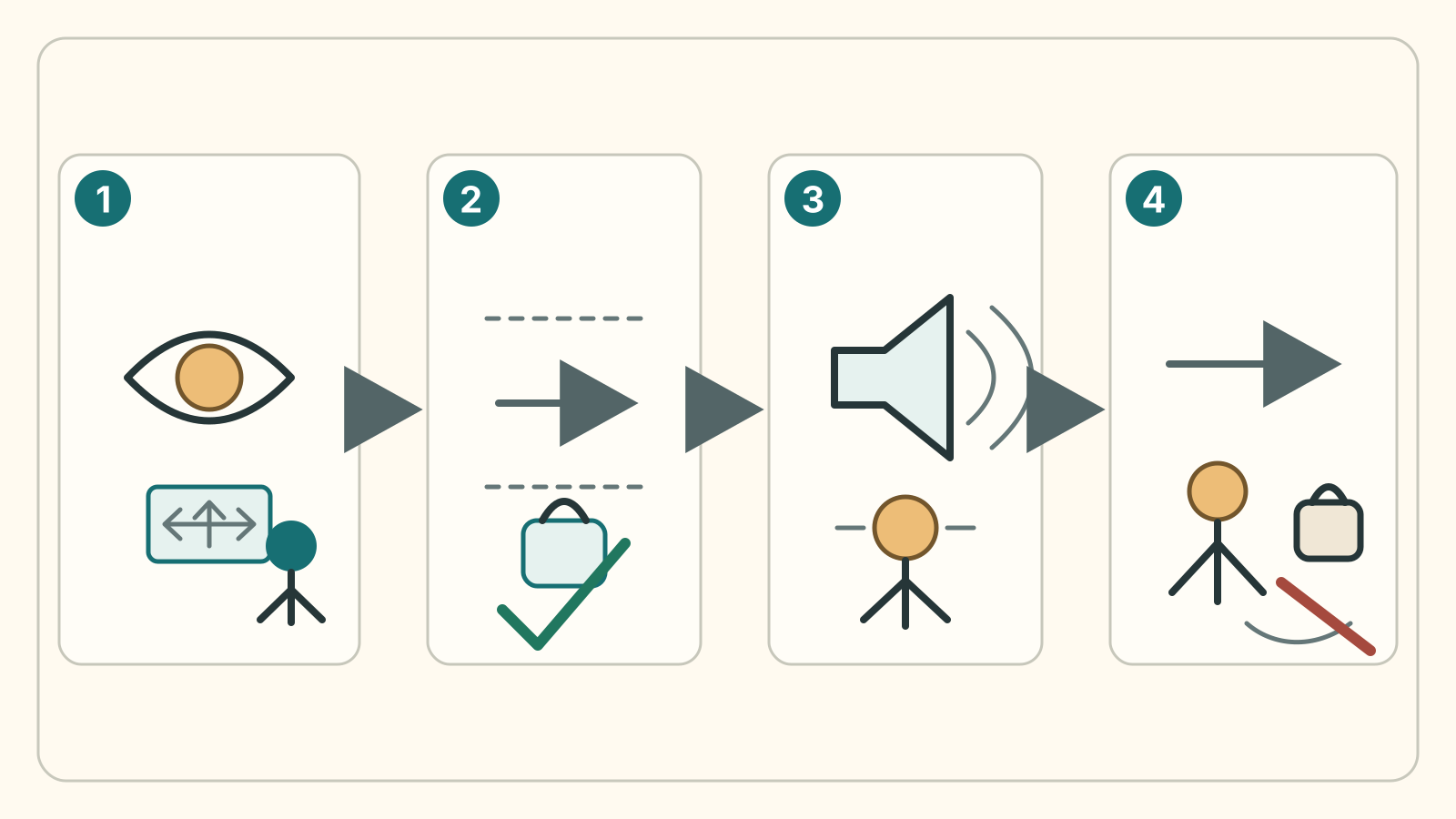
Detailed description of this diagram
Four cards run from left to right. Card 1 uses an eye, a generic four-arrow sign and an abstract attendant to represent checking current signs and staff location on arrival. The arrows do not point to real Kokugikan directions. Card 2 puts a movement arrow between two dashed lines and a checked small bag outside them, meaning not to place belongings in passages or evacuation circulation. The line spacing is not an aisle width or seat layout. Card 3 combines a generic announcement symbol and attendant, meaning to receive live announcements and staff guidance during an incident; it prescribes no disaster-specific body movement. Card 4 shows an abstract forward arrow and crosses a curved return movement toward a bag, meaning not to reverse through the flow for belongings. It gives no actual evacuation direction and promises no usable exit, stair, lift operation, assembly point, assistance or priority evacuation. Live official instructions always override the diagram.
Graphic: SUMO ARCHAEOLOGY CLUB · Figure source 1 · Figure source 2 · Figure source 3
Do not create a second hazard after a warning
During an earthquake or alarm, a sudden rush into a narrow aisle or staircase can make movement more dangerous. Attend first to immediate physical safety and possible falling objects, then listen. The correct action can vary with the location and type of emergency, so this article does not prescribe one rigid sequence beyond following the organiser’s live instructions.
Tamari seating carries an additional physical risk because a wrestler or official may fall from the dohyo. The Association warns that this area is particularly hazardous and prohibits reaching towards wrestlers or officials. In ordinary conditions and emergencies alike, do not move towards the ring or cross a boundary marked as restricted.
Wheelchair users should not assume automatic priority
The Association’s detailed wheelchair conditions say that general and wheelchair spectator routes are mixed and that priority evacuation guidance is not necessarily guaranteed during an emergency or congestion. They normally pair one wheelchair user with one companion for guidance and safety.
This is a reason to prepare together, not a reason to avoid attending. On arrival, the pair can identify the exit direction and ask staff whom to approach if assistance is needed. A personal requirement is easier to discuss before the arena is at its busiest. We do not promise a fixed accessible evacuation route that the official current material does not provide.
Keep your own footprint small
Check that a bag does not extend into an aisle or across the boundary of a masu box. Pack so that leaving does not require sorting several loose objects. Do not plan to return against the flow for a possession during an evacuation.
Once this minute of preparation is complete, let it recede. On the dohyo, wrestlers, referees and yobidashi share precise positions and routes without turning the ritual into anxiety. Knowing your own route can work the same way: it creates enough confidence to return your full attention to the next bout.
An emergency note for people with different needs
With a child, agree to stay together and never have the child search alone after separation. A wheelchair or cane user, or a person in pain, should not assume the normal return route remains usable, a lift is operating or priority movement is automatic; receive the live announcement and staff direction. If sound, displays or Japanese are difficult, a companion should combine visible instructions, nearby staff and announcements instead of relying on one channel.
Do not move against the flow to recover a bag, search for family or reach the ordinary meeting point. Set communication and a post-evacuation meeting principle the night before, to be used only within an area the organiser identifies as safe. This article cannot freeze the evacuation destination, exit or lift status because the event determines them.
The correct action changes with the hazard and the body. This is not an instruction to use one particular door; it is editorial preparation for receiving current official direction instead of following a crowd by inference. When life or health is at risk, continuing the programme and recovering belongings come later.
Sources
- Japan Sumo Association, spectator contract terms (checked 2 September 2026)
- Japan Sumo Association, detailed ticket and spectator rules (checked 2 September 2026)
- Japan Sumo Association, September 2026 Tokyo spectator notice (checked 2 September 2026)
Source links used for verification
Each link was used for the corresponding claim in this article; inclusion is not a blanket endorsement of the whole page.
Article verified:
- Japan Sumo Association spectator contract termsPrimary source (as checked for this article)
- Japan Sumo Association detailed ticket and spectator rulesPrimary source (as checked for this article)
- Japan Sumo Association September 2026 Tokyo spectator noticePrimary source (as checked for this article)