Kotenage is made by wrapping the opponent’s inserted inside arm from the outside and pressing down over it into a throw. The winner does not take a mawashi grip for this technique. That is the practical difference from uwatenage: both can show a winning arm outside the opponent’s arm, but uwatenage throws from an outside belt grip. In the next bout, look before anybody turns—did the outside hand reach the belt, or did the whole arm close around the opponent’s arm?
When two wrestlers settle into a clinch, their arms can look like one thick knot. Then one body tips, the arena calls “kotenage,” and the important connection has already disappeared under the fall. The technique becomes easier to read when you stop waiting for the dramatic part. One wrestler chose an arm rather than the belt several moments earlier.
First find the inserted arm
An inserted arm, or *sashite*, travels inside and beneath the opponent’s armpit. The Japan Sumo Association defines kotenage by what happens to that arm: the winner encloses it from the outside and presses down over it to throw.
The official explanation also describes the technique as a counter when an opponent has inserted an arm and is advancing in close. It specifically says the winner throws without taking the mawashi. For a beginner, that negative clue is valuable. Find the outside elbow and ask what it surrounds.
You do not have to identify every finger. Does the winner’s outer arm form a visible loop around the opponent’s upper arm? Does his hand fail to settle on the belt before the throwing action begins? Prepare the answer while the wrestlers are still upright, because the grip is much harder to see once they turn.
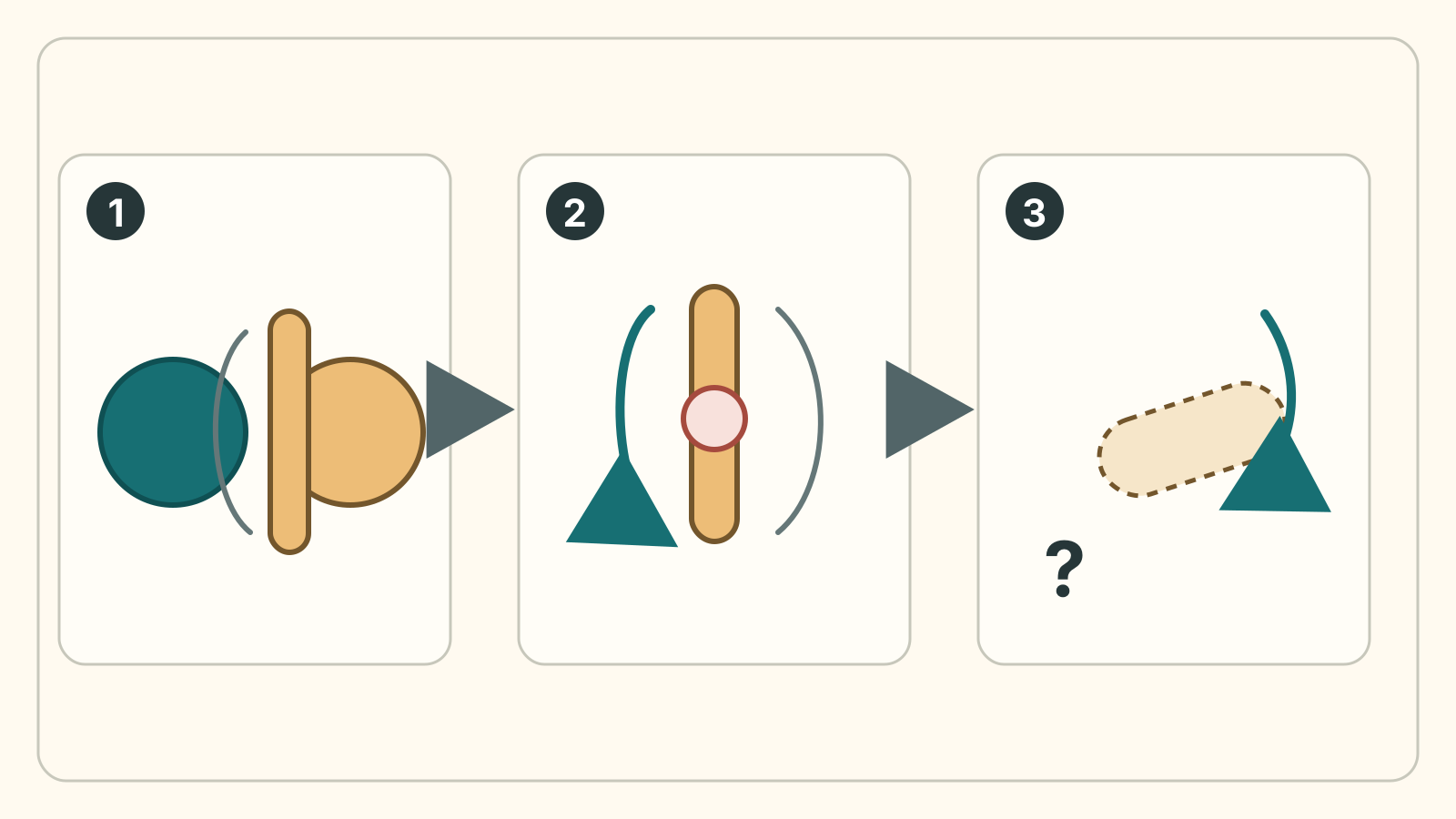
Detailed description of this diagram
Card 1 uses one vertical gold bar as the opponent's inserted-arm role and places the blue winner token outside it. Card 2 surrounds the same bar with two abstract curves and adds a contact marker and downward cue for the press-from-above relation. Card 3 uses a horizontal gold token and curved arrow for the categorical thrown state. The bar, brackets, contact and curve encode no arm, elbow, shoulder, hand, joint lock, pressure, injury mechanism, belt location, throwing angle or execution method.
Graphic: SUMO ARCHAEOLOGY CLUB · Figure source 1 · Figure source 2 · Figure source 3
Kotenage vs uwatenage: arm or belt?
The Association defines uwatenage as taking the mawashi over the opponent’s inserted arm and throwing from that upper, outside grip. The outer shoulder and elbow may therefore occupy a position that resembles the start of kotenage.
The object held is the separating clue. If the outside hand reaches down and secures the mawashi, uwatenage becomes the relevant model. If the winner does not hold the belt and instead wraps the opponent’s inserted arm from outside, think kotenage.
“Outside arm equals uwatenage” is too quick. Use a two-part reading: where did the arm travel, and what did it finally control?
Kotenage vs sukuinage: whose inside arm works?
Sukuinage also appears on the official list without a belt grip, but its arm path is the opposite one to watch. The winner turns up his own inserted arm beneath the opponent’s armpit and throws as if scooping from below.
Kotenage controls the opponent’s inserted arm from outside. Sukuinage works with the winner’s own inserted arm from inside. If there is no clear belt grip, look at the winning elbow: is it tucked through the opponent’s armpit, or outside and closing around the arm that came through?
This distinction gives “no belt” two different pictures instead of one vague category.
Do not diagnose an injury from the technique name
Because kotenage visibly controls an arm, a viewer may worry about pain or injury. The kimarite announcement does not diagnose either. A broadcast angle cannot establish what a wrestler felt, whether an injury occurred or what the winner intended.
Keep the facts separate. We can identify the official movement: the inserted arm was wrapped from outside and pressed into the throw. Any consequential health claim should wait for a verifiable statement from the wrestler, his stable, the Association or another responsible source. Care for the athlete is not improved by turning a frightening frame into an unsupported diagnosis.
One thing to watch in the next bout
As soon as the wrestlers clinch, choose one outside arm. Follow its hand for only a second. If it drops to the mawashi, store “belt grip.” If the arm closes around the opponent’s inserted arm instead, store “arm control.” Then return to the whole bout and listen for the finish.
Kotenage may never come. That does not waste the observation. You might see the opponent withdraw the inserted arm, removing the possible grip, or see the outside hand win the belt instead. A technique name has taken you backwards from the throw to a quieter contest: can one arm enter, can the other contain it, and which connection survives long enough to decide the bout?
Sources
- Japan Sumo Association, kimarite explanation for kotenage (checked 2 September 2026)
- Japan Sumo Association, kimarite explanation for uwatenage (checked 2 September 2026)
- Japan Sumo Association, kimarite explanation for sukuinage (checked 2 September 2026)
Source links used for verification
Each link was used for the corresponding claim in this article; inclusion is not a blanket endorsement of the whole page.
Article verified:
- Japan Sumo Association kimarite: kotenagePrimary source (as checked for this article)
- Japan Sumo Association kimarite: uwatenagePrimary source (as checked for this article)
- Japan Sumo Association kimarite: sukuinagePrimary source (as checked for this article)