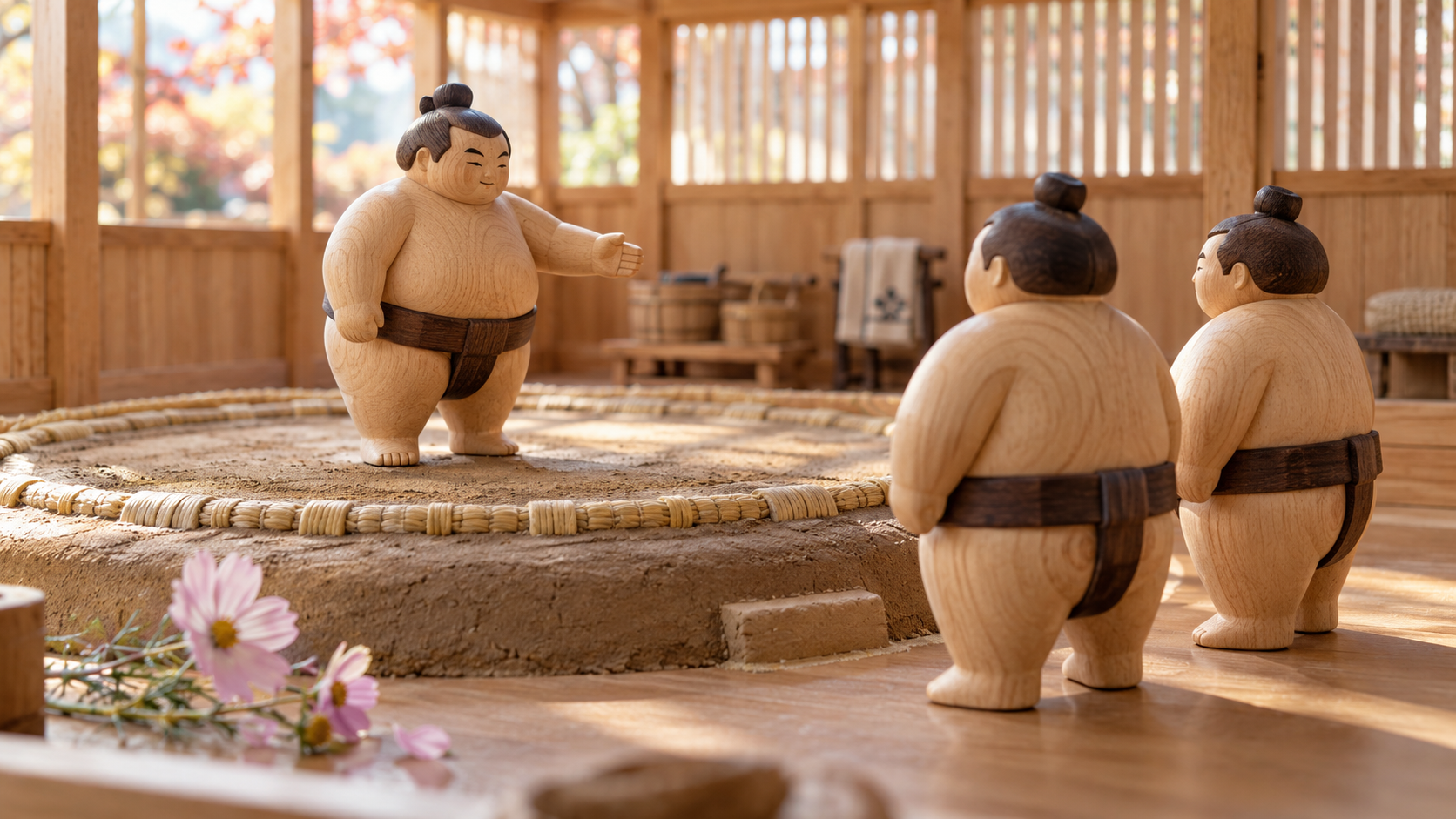
Moshiai is a winner-stays-on form of practice. The winner remains in the ring and selects the next opponent. The Japan Sumo Association explains that choosing an opponent is called kau, “buying,” while being chosen is ureru, “selling.” Watch the seconds after a bout: who steps forward, who calls, and where the winner looks.
A stable practice session can suddenly become noisy as wrestlers call “ore da” or “mae.” To a visitor without context, the moment may sound like an argument. The Association’s explanation shows something more structured: wrestlers are trying to be selected for the next practice bout. With one ring and many candidates, losing or staying quiet may mean receiving only a few bouts.
The contest continues outside the ring
The winner can remain and accumulate practice. Everyone else must be ready to enter. That makes the edge of the dohyo worth watching.
One wrestler may step forward while still breathing hard. Another adjusts the mawashi but keeps the winner in view. Someone who does not shout much may nevertheless be ready in exactly the right place. Once you know the selection rule, the interval between bouts stops looking like empty time.
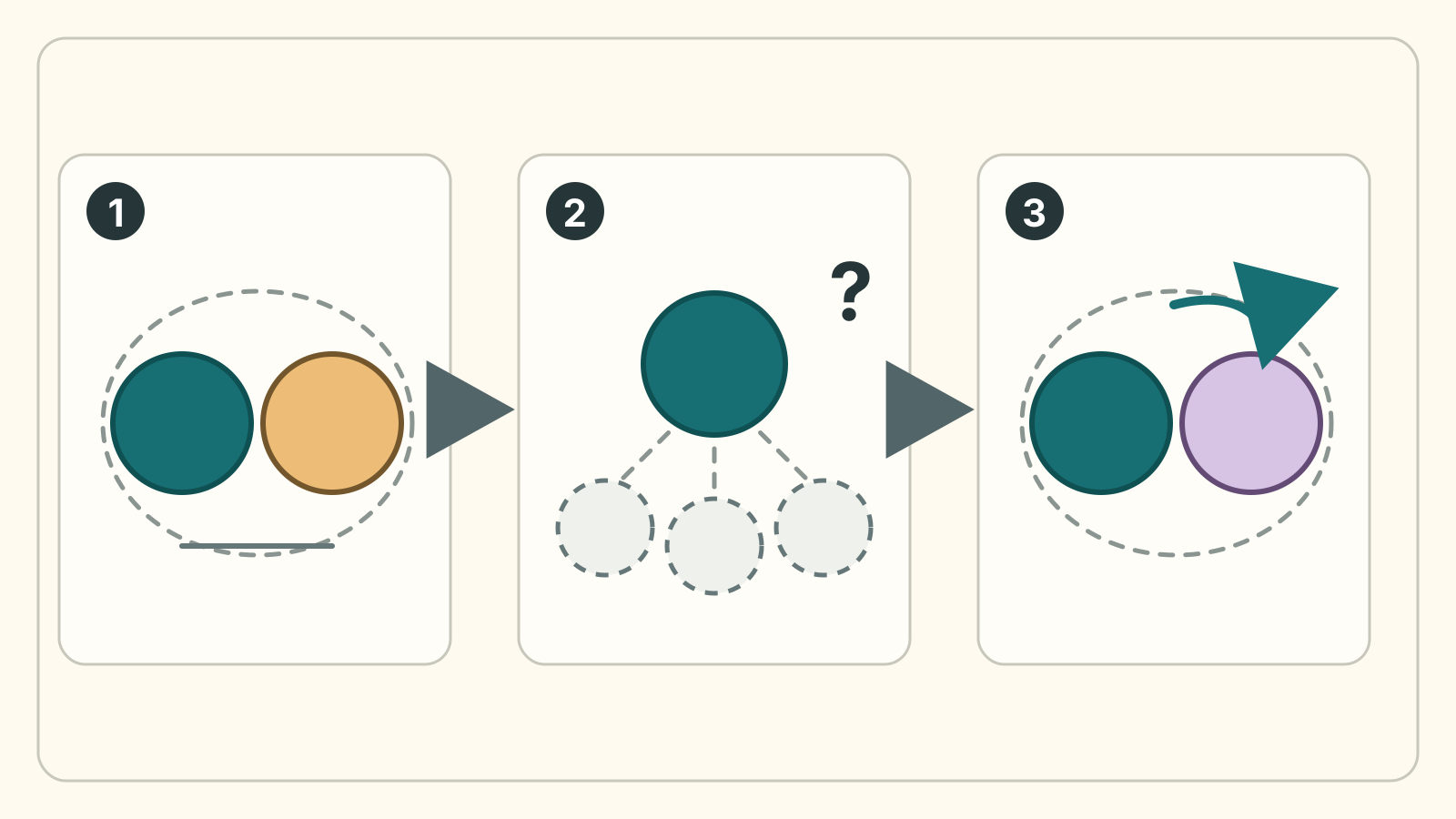
Detailed description of this diagram
Card 1 places blue and gold tokens inside an abstract ring boundary. Card 2 keeps the blue winner token and adds three dashed candidate tokens plus a question mark. Card 3 places the winner with one selected purple token back inside the boundary. Three candidate symbols are not a real headcount; placement and arrows encode no queue, hierarchy, popularity, voice level, selection reason, outcome, practice volume, intensity or fatigue.
Graphic: SUMO ARCHAEOLOGY CLUB · Figure source 1 · Figure source 2
“Selling” is not a popularity ranking
Do not turn one selection into a story about friendship, status or a coach’s approval. The cited sources do not disclose why an individual was selected or how rank, body type, preferred style, the day’s task, coach instruction or relationships affected it. One morning or video cannot fill that gap.
For the same reason, a long winning sequence does not prove future tournament form. What is confirmed is the pairing and result of that practice exchange. Its purpose, the wrestler’s physical condition and whether a weakness was being tested remain unknown unless a responsible participant explains them.
Observe without joining the noise
Stable entry, photography and conversation rules vary. Attend only when permission is clear, remain in the designated area and avoid movement that interrupts concentration. The calls belong to the wrestlers competing for practice, not to spectators encouraging a selection.
For your first moshiai sequence, ignore the winner for five seconds and follow one wrestler who wants to be chosen next. Watch the feet approach the clay, the hand rise or the eyes lock onto the winner. The next bout begins before either man crouches. That small discovery can make quiet morning practice feel as tense as a tournament charge.
Observation note
- Winner remaining in the ring
- First wrestler to step forward
- Visual or spoken selection signal
- Breathing and posture during a consecutive run
- Unknown reasons kept separate from confirmed facts
Evidence limits and event-day fallback
Confirmed fact: Association explainers describe moshiai as winner-stays practice: the winner remains and names the next opponent; choosing is kau (‘buying’) and being chosen is ureru (‘selling’).
What remains unknown: One day’s reason for selection, coach instruction, relationships, evaluation, training aim, fatigue, pain and injury are not visible facts. Stable entry, photography, conversation and viewing position require current permission.
Reasoned inference: Separating calls, position and an explicit selection in time can reduce invented stories. Confidence is medium; gaze alone does not establish selection or intent.
Editorial suggestion: Attend only with clear permission, stay in the designated place and separate observed action from a reason hypothesis. This is neither a stable rule, training instruction nor physical assessment.
Fallback: If visit or photography terms are not explicit, do not enter or record; ask through the stable’s official channel. If selection is hidden, record ‘reason unknown’ without filling in relationships or form.
Sources
- Japan Sumo Association, quizzes No.1199 and No.953, checked September 3, 2026. They describe the winner-stays-on format and the terms for choosing and being chosen.
Source links used for verification
Each link was used for the corresponding claim in this article; inclusion is not a blanket endorsement of the whole page.
Article verified:
- Japan Sumo Association quiz No.1199 on moshiaiPrimary source (as checked for this article)
- Japan Sumo Association quiz No.953 on moshiaiPrimary source (as checked for this article)