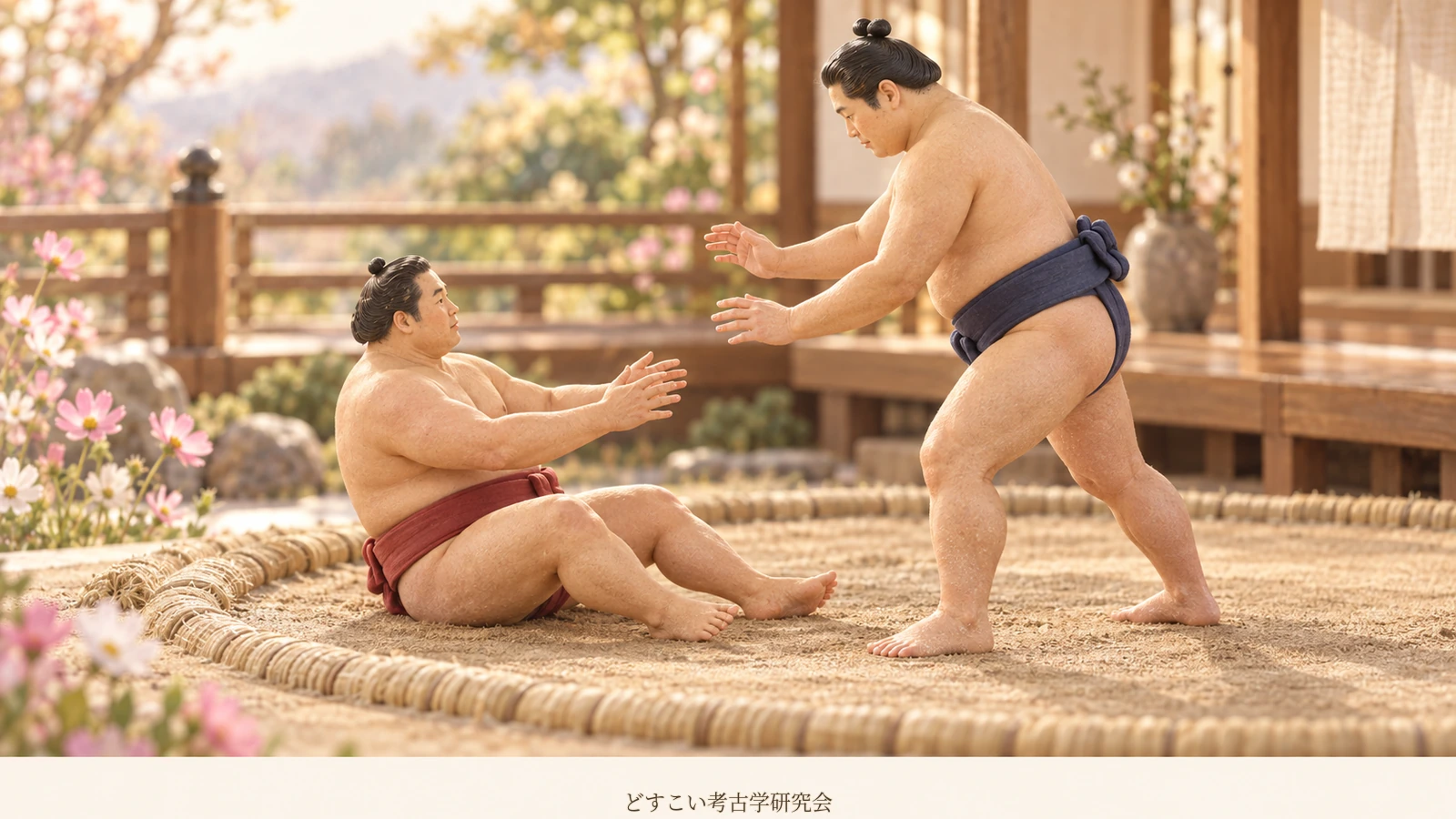
The hand action begins in the same family: one or both hands push with a *hazu* shape. If the opponent is forced outside without falling, the finish is oshidashi, a push-out. If that pushing action knocks him down, it is oshitaoshi, a push-down. Do not use “inside the ring means oshitaoshi; outside means oshidashi.” The Japan Sumo Association explicitly says oshitaoshi can be completed inside or outside the ring.
At the straw bales, a wrestler may lean backwards and fall beyond the boundary. Freeze the final frame and everything seems to be outside, so “push-out” feels like the obvious English label. The still image is missing the important part. Rewind one second: did the wrestler cross upright, or did the push take away his support and send his body down?
Both begin with a hazu push
The Association defines oshidashi by the *hazu* hand position. The thumb is opened away from the other four fingers to form a Y-like shape; one or both hands press at the chest or beneath the arms and push the opponent outside.
Oshitaoshi also uses one or both hands in that hazu position to push the opponent’s body. The hands therefore do not separate these techniques at the start. They may be two possible endings of the same forward attack. The distinction appears in what the pressure makes the opponent do.
Oshitaoshi is not restricted to a fall inside the ring
The official oshitaoshi explanation includes an unusually helpful clarification: the location can be inside or outside the ring. If the hazu push knocks the opponent down, the technique can be oshitaoshi even when his fall carries him beyond the tawara. If he remains standing and is simply sent outside, it is oshidashi.
That is why a final photograph cannot always settle your own kimarite prediction. In the official descriptions, the useful distinction is whether the opponent went out upright or was pushed down. An arena seat or broadcast angle may still hide a hand, foot or the movement immediately before the fall. If your prediction differs from the announcement, review the moving sequence and check the official result instead of inferring the label from one landing frame.
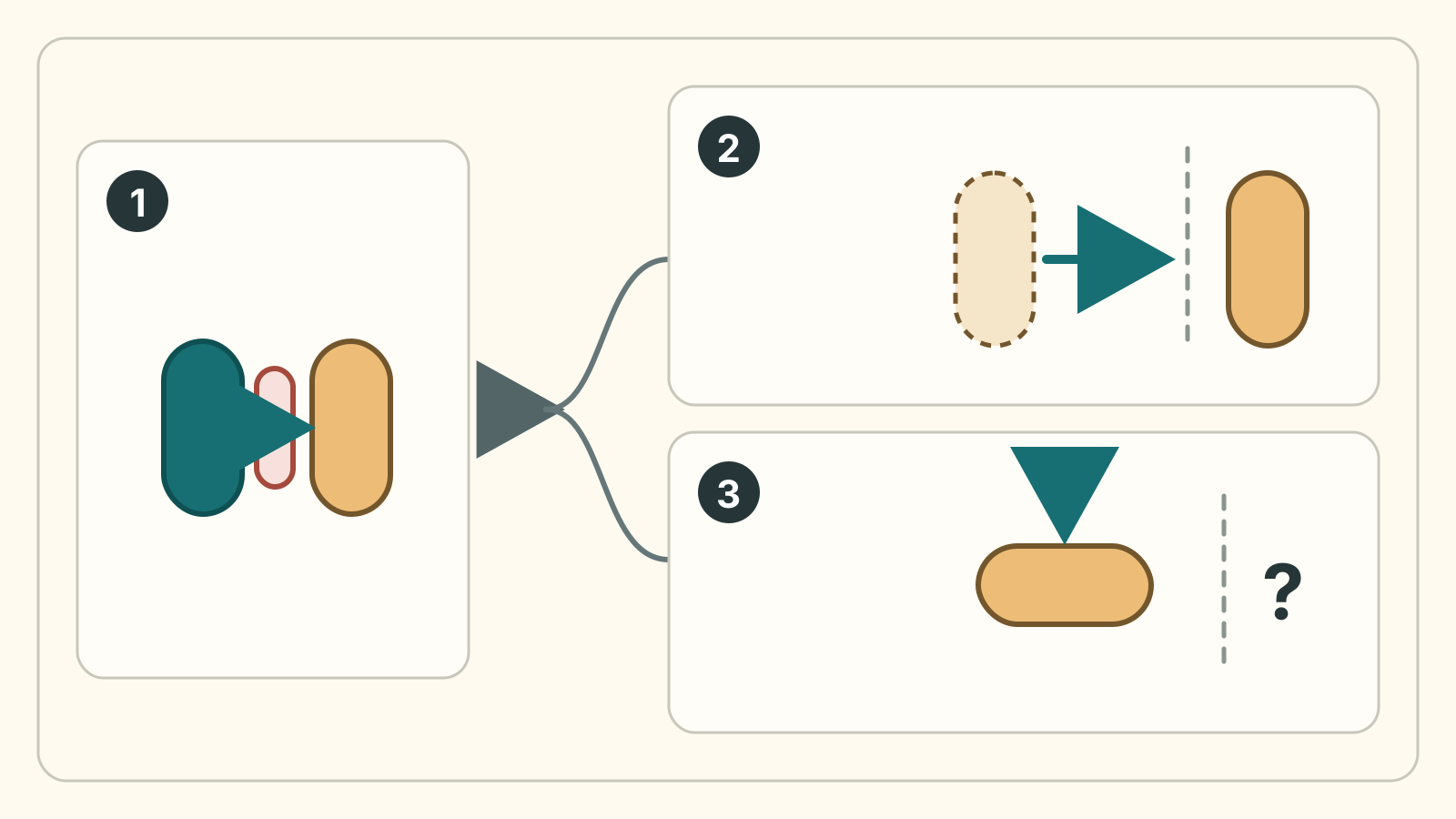
Detailed description of this diagram
Card 1 uses upright blue and gold capsules, a red contact bar and a pressure arrow for the shared hazu-push action. The upper branch, card 2, moves an upright gold token beyond an abstract dashed boundary, representing oshidashi without a fall. The lower branch, card 3, rotates the gold token horizontally to mark only a down state. A nearby dashed line and question mark keep its inside-or-outside position unresolved because the official oshitaoshi definition permits either. Token orientation is a categorical marker, not human posture, fall path, first contact or judging angle.
Graphic: SUMO ARCHAEOLOGY CLUB · Figure source 1 · Figure source 2 · Figure source 3
A fall does not make every finish oshitaoshi
Tsukitaoshi, commonly translated as thrust-down, is a close neighbour. The Association describes it as strongly thrusting with the palms and making the opponent fall, whether inside or outside the ring. Oshitaoshi uses the hazu pushing action; tsukitaoshi uses a strong thrusting action.
A beginner can therefore use two questions in order:
- Did the opponent remain standing as he went out, or did the decisive pressure knock him down?
- If he fell, did the winner appear to push through a hazu contact or strike in with a strong palm thrust?
This will not turn every camera angle into an officiating angle. It simply gives similar Japanese names different moving pictures.
Watch the losing wrestler’s chest at the edge
The winner’s hands attract attention, but the opponent’s torso may provide the clearer clue. As he reaches the boundary, does his chest stay upright while his feet move backwards across it? Or does the upper body tip away from the base of the feet under the continued push?
The official name does not say merely that the loser happened to slip. It identifies the winner’s pushing action as the cause of the downing. Follow both parts: the attacking hands and the body they displace. That relationship matters more than the patch of clay on which the loser finally arrives.
One thing to watch in the next bout
When the wrestlers approach the tawara, leave the winner’s hands for a moment and follow the opponent’s chest. If it remains vertical through the boundary, predict oshidashi. If the push makes the whole body tilt and fall, predict oshitaoshi. Then listen to the announcement and replay only the final second if needed.
A wrong prediction is productive here. It tells you exactly which second and which posture to study. What once looked like a generic “he was pushed out” can split into two finishes: one wrestler is transported beyond the line, while another loses the last structure keeping him upright. The boundary has not changed, but your view of the struggle around it has.
Sources
- Japan Sumo Association, kimarite explanation for oshitaoshi (checked 2 September 2026)
- Japan Sumo Association, kimarite explanation for oshidashi (checked 2 September 2026)
- Japan Sumo Association, kimarite explanation for tsukitaoshi (checked 2 September 2026)
Source links used for verification
Each link was used for the corresponding claim in this article; inclusion is not a blanket endorsement of the whole page.
Article verified:
- Japan Sumo Association kimarite: oshitaoshiPrimary source (as checked for this article)
- Japan Sumo Association kimarite: oshidashiPrimary source (as checked for this article)
- Japan Sumo Association kimarite: tsukitaoshiPrimary source (as checked for this article)