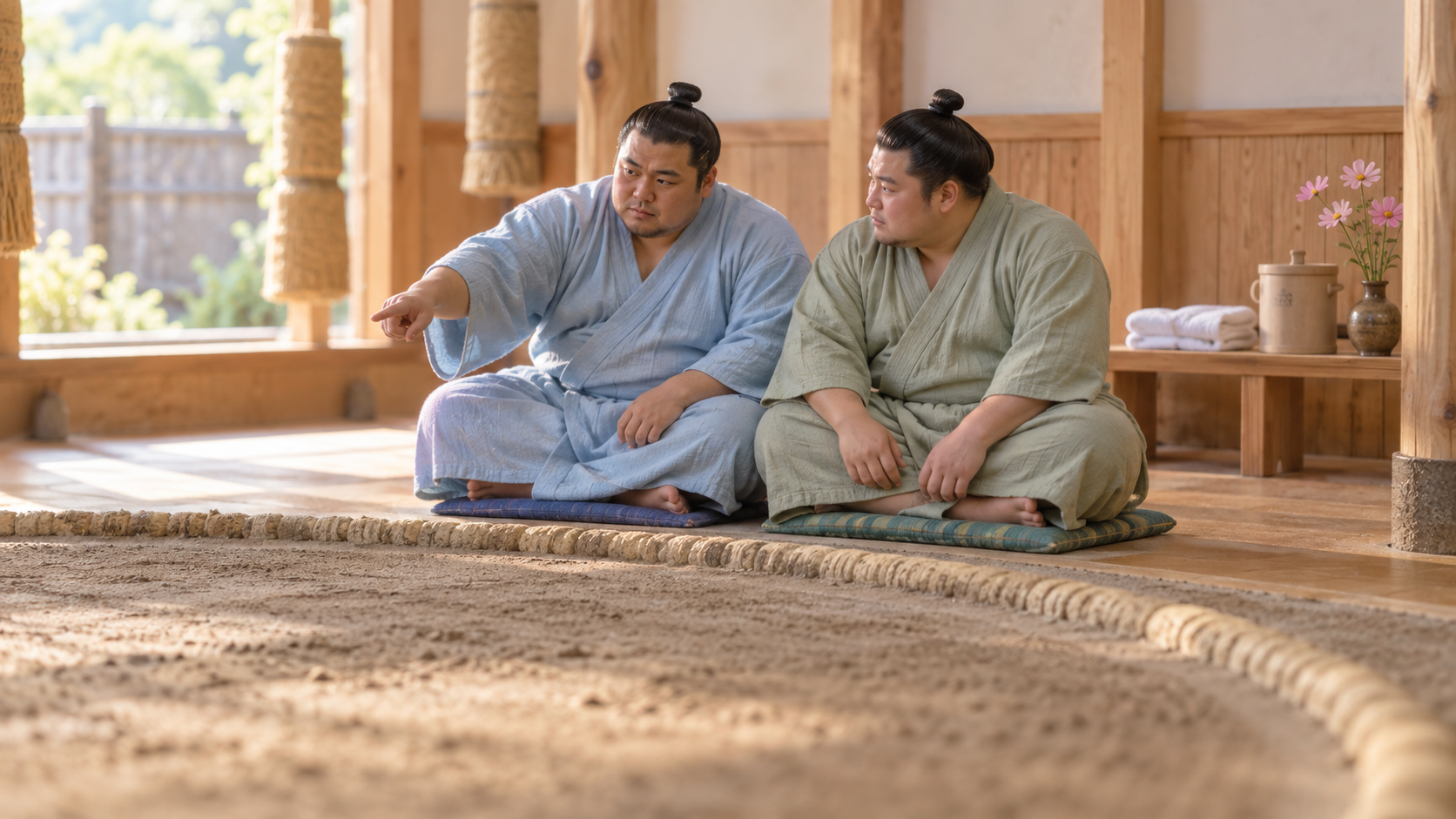
Twenty bouts of “three-bout practice”? The name sanban geiko does not set a limit of three. It means repeated practice between the same two wrestlers, and a sequence can sometimes run to 20 or 30 bouts.
The interesting question is what happens next. Can the same hand reach the belt again? With the pairing unchanged, you can compare the first contact and the route each arm takes. It is one way to enjoy morning practice at a regional tour, too.
How it differs from moshiai
In moshiai, the winner remains and selects the next opponent. In sanban geiko, the same two wrestlers continue against each other for many bouts. The result can change without a new opponent entering.
The Association explains that the large practice volume helps develop a wrestler’s underlying strength. That does not give spectators a formula for how many bouts are required or permit us to declare two wrestlers exactly equal. Coaches and wrestlers determine the pairing, purpose and end point.
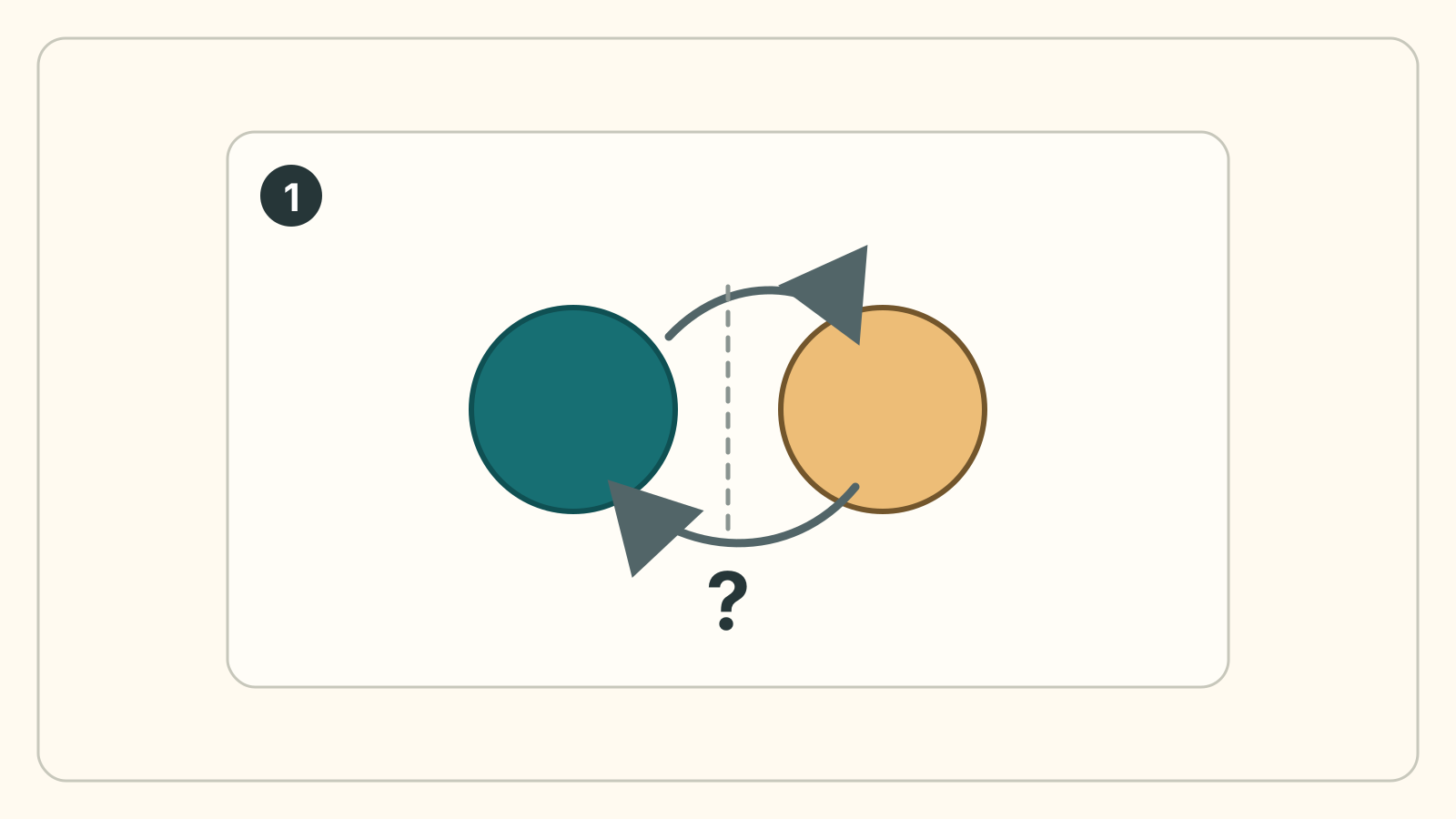
Detailed description of this diagram
Blue and gold tokens are joined by arrows in both directions, showing the same two wrestlers repeating their bouts. A question mark leaves the number of bouts open. Token size and arrows do not represent a difference in ability or movement speed.
Graphic: SUMO ARCHAEOLOGY CLUB · Figure source
What changes in the next bout?
Start with one detail rather than trying to follow everything. Choose something you can compare with the previous bout:
- Where the bodies or hands first meet at the tachiai
- Which hand reaches the mawashi, or the angle of a pushing arm
- Where a wrestler sends the hand that was blocked in the previous bout
The wrestler who entered lower in the first bout may alter the angle in the second. A man whose inside grip was blocked may touch the opponent’s elbow earlier next time. A list of wins and losses would erase those corrections.
Fatigue is not a simple character test
Movement changes as repetitions accumulate. Do not label visible exhaustion as weak spirit, or continued participation as proof of future tournament success. Body size, previous workload, injuries and the day’s training objective are not fully visible to an observer. Describe the movement you saw without turning it into a medical or moral diagnosis.
Give the wrestlers room to concentrate. For viewing positions and photography, follow the event organizer’s guidance at a tour or the host stable’s instructions during a stable visit.
Follow the same two wrestlers for only three bouts. They may appear to know everything about each other’s preferred position, yet a new answer still appears. That is the addictive depth of repeated practice: familiarity does not end invention.
Observation note
- Sanban does not impose a three-bout limit
- The same pairing continues
- First point of contact
- Adjustment from the previous bout
- Observed fatigue kept separate from personality claims
Source
- Japan Sumo Association, quizzes No.633 and No.1309: the definition of sanban geiko and examples of 20 or 30 bouts. Rechecked October 6, 2026.
- Japan Sumo Association, quiz No.1199: the winner selecting the next opponent in moshiai. Checked October 6, 2026.
Source links used for verification
Each link was used for the corresponding claim in this article; inclusion is not a blanket endorsement of the whole page.
Article verified: