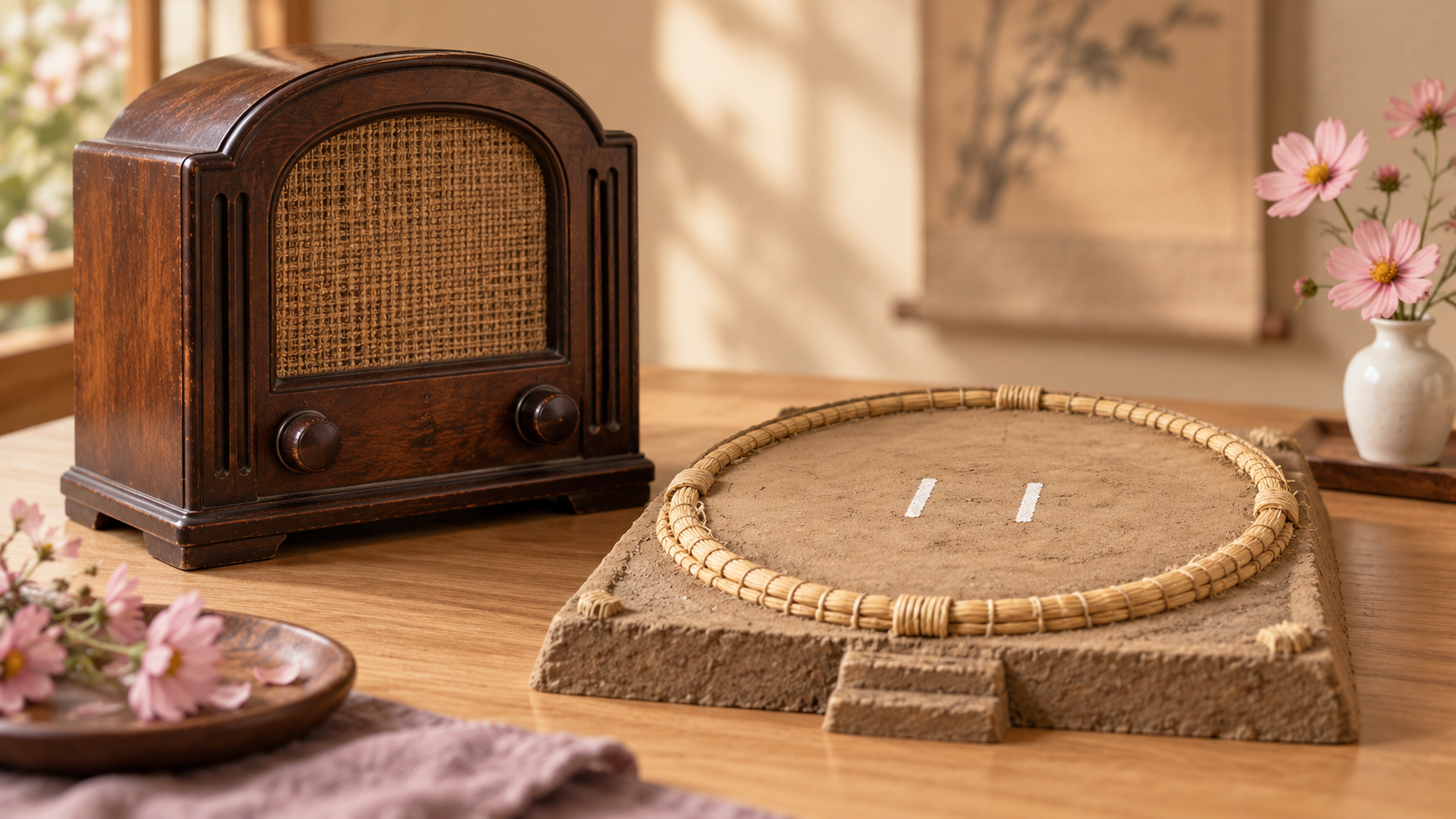
The two white marks at the centre of a professional sumo ring are the *shikiri-sen*, or shikiri lines. They are 70 centimetres apart; each line is 6 centimetres wide, 90 centimetres long and painted in white enamel. They look timeless beside the clay and straw, but the Japan Sumo Association dates their introduction to 1928, when radio broadcasting also brought a time limit to pre-bout preparation. A technology with no picture helped create one of the dohyo’s most recognisable visual features.
Draw a sumo ring from memory and you will probably add the two lines without thinking. They are easy to mistake for a timeless part of the design. The Association’s historical photograph instead shows two wrestlers crouching almost head to head on a ring with no white marks. Remove two short lines and the familiar arena suddenly belongs to another age.
They are limits, not fixed starting blocks
A wrestler may not move forward beyond the line on his side when performing the repeated pre-bout crouch called *shikiri*. He may, however, set himself farther back. The two lines therefore do not work like blocks that force both sprinters to place their feet in one identical position.
This is a useful correction for a first-time international viewer. The explosive first contact, or *tachiai*, can look as if a referee fires an invisible starting pistol. The selected sources do not establish an unseen signal based on ‘timing and breathing’ for this paragraph. They establish the closest preparation positions marked by the lines; the marks do not operate like starting blocks or a starting pistol.
Watch one wrestler’s fists rather than both faces. Does he crouch immediately behind his line, or leave a little more clay between his hands and the enamel? Does that distance change during the repeated preparations? You do not need to turn the answer into tactical analysis. Simply noticing that one common line allows different positions gives the quiet interval depth.
Seventy centimetres is a small modern space
The published specifications used here are a 70-centimetre gap and lines 6 centimetres wide and 90 centimetres long. The source bound to this paragraph does not give the contest-circle diameter, so this article does not calculate their proportion to the circle. Television framing is not used as a ruler.
Perspective makes a photograph a poor ruler. The measurements here are the Association’s stated specifications, not proportions estimated from a camera image. We use the historical photograph only for observable features—the absent lines and close crouching position—not to calculate an undocumented distance or date.
Their material is revealing too. The Association specifies white enamel paint. The marks are not ancient cords, sacred paper or a pattern pressed into the soil. Modern paint lies beside rice-straw bales and beneath a roof derived from shrine architecture. The dohyo is not a museum object frozen in one century. It carries additions from different periods in plain sight.
Before the lines, preparation could move forward
The Association explains that sumo once had neither shikiri lines nor a formal time limit for preparation. Wrestlers could repeat the process until their breathing matched. They might edge progressively closer and eventually crouch with their heads touching. The official account also says that some preparations lasted more than an hour.
That final detail is an example, not permission to claim that every old bout involved an hour of waiting. Historical explanations need the same care as current rankings: keep the scope attached to the source. What the material clearly changes is our picture of the old start. Without a line, the space between two wrestlers was itself negotiable.
Radio reorganised a visible part of the ring
Japanese radio broadcasts of professional sumo began in 1928. The Association says that the need to finish all bouts within broadcast time led to a preparation time limit. The shikiri lines were instituted at the same time. Their purpose was not simply to give east and west mathematically equal decoration. Keeping the wrestlers sufficiently apart made it easier for them to launch rather than becoming stuck head to head through repeated false starts.
The chain of effects is wonderfully concrete. A broadcast required a workable schedule. A schedule required bounded preparation. Bounded preparation required a reliable separation. That separation was painted onto the clay. Radio is an audio medium, yet its legacy is visible every time a camera looks down on the dohyo.
This does not mean that radio single-handedly invented modern sumo, or that no other concern mattered. We are following the explanation supplied by the sport’s governing body for this particular change. It is enough: one small mark connects media history, timing and the bodies of two wrestlers.
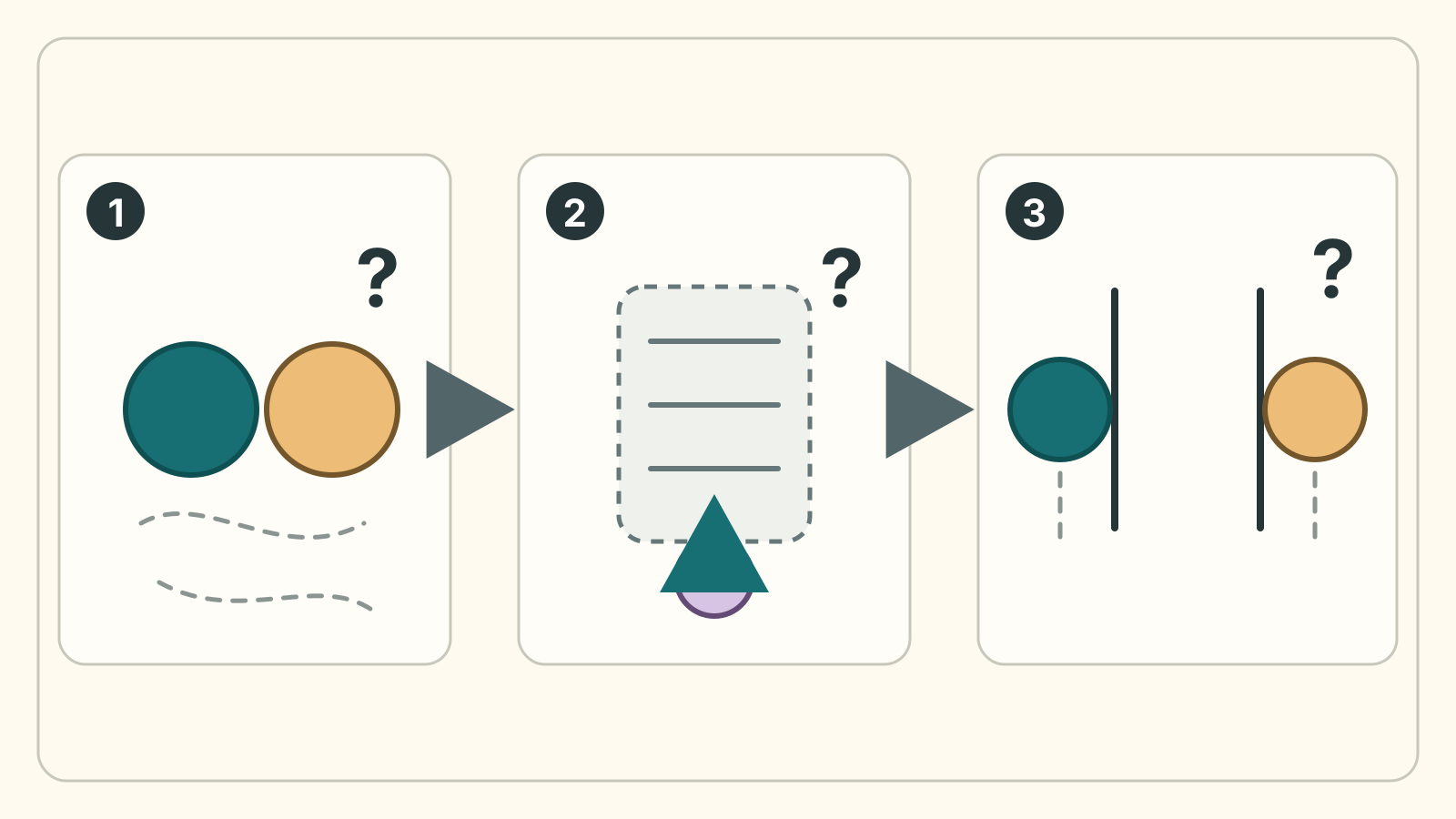
Detailed description of this diagram
Card 1 uses two competitor-role tokens and repeated dashed paths only to mark repeated preparation without the later constraints. Card 2 abstracts a broadcast-time frame and leaves implementation detail open with a question mark. Card 3 shows two categorical limit lines between tokens. Their spacing, length, width and placement are not measurements, a dohyo plan, wrestler positions or movement, and no official photograph or historical bout is copied.
Graphic: SUMO ARCHAEOLOGY CLUB · Figure source 1 · Figure source 2 · Figure source 3 · Figure source 4
Evidence, interpretation and the part still open
The four Association pages cited here support the 1928 timing, the introduction of a time limit and lines together, and the stated purpose of preserving enough separation to rise. They do not establish that broadcasting was the only motive or rule out every other operational concern. “Radio left them there” is our compact interpretation of that documented chain, not a quotation from a 1928 rulebook.
Testing a fuller origin story would require independent contemporary rules, broadcasting records and newspaper evidence. Those have not been established in this article, so we present the Association’s institutional account rather than call it the only possible complete explanation. The unresolved margin is a research lead, not permission to fill the gap with a more dramatic story.
One viewing exercise for the next bout
Before the next tachiai, choose one line. Notice its short length, then follow the wrestler’s fists through one complete shikiri cycle. When he stands and returns, see whether he settles at the same distance. When both men finally launch, notice how quickly the white lines disappear beneath the action and become background again.
They may be background, but they are not empty decoration. Those two pieces of enamel hold the memory of preparations without a clock, wrestlers crouching head to head, and a radio service trying to bring an entire day’s bouts to listeners on time. Sumo often rewards looking at the biggest body in the frame. Here, looking at two little lines makes the whole ring larger.
Sources
- Japan Sumo Association, Sumo Quiz No.341, published 15 December 2022 (checked 3 September 2026)
- Japan Sumo Association, Sumo Quiz No.383, published 26 January 2023 (checked 3 September 2026)
- Japan Sumo Association, Sumo Quiz No.1091, published 3 January 2025 (checked 3 September 2026)
- Japan Sumo Association, Sumo Quiz No.1101, published 13 January 2025 (checked 3 September 2026)
Source links used for verification
Each link was used for the corresponding claim in this article; inclusion is not a blanket endorsement of the whole page.
Article verified:
- Japan Sumo Association Sumo Quiz No.341: shikiri lines and radioHistorical primary source (record from that period)
- Japan Sumo Association Sumo Quiz No.383: dimensions of the shikiri linesPrimary source (as checked for this article)
- Japan Sumo Association Sumo Quiz No.1091: where a wrestler may crouchPrimary source (as checked for this article)
- Japan Sumo Association Sumo Quiz No.1101: why the lines were introducedHistorical primary source (record from that period)