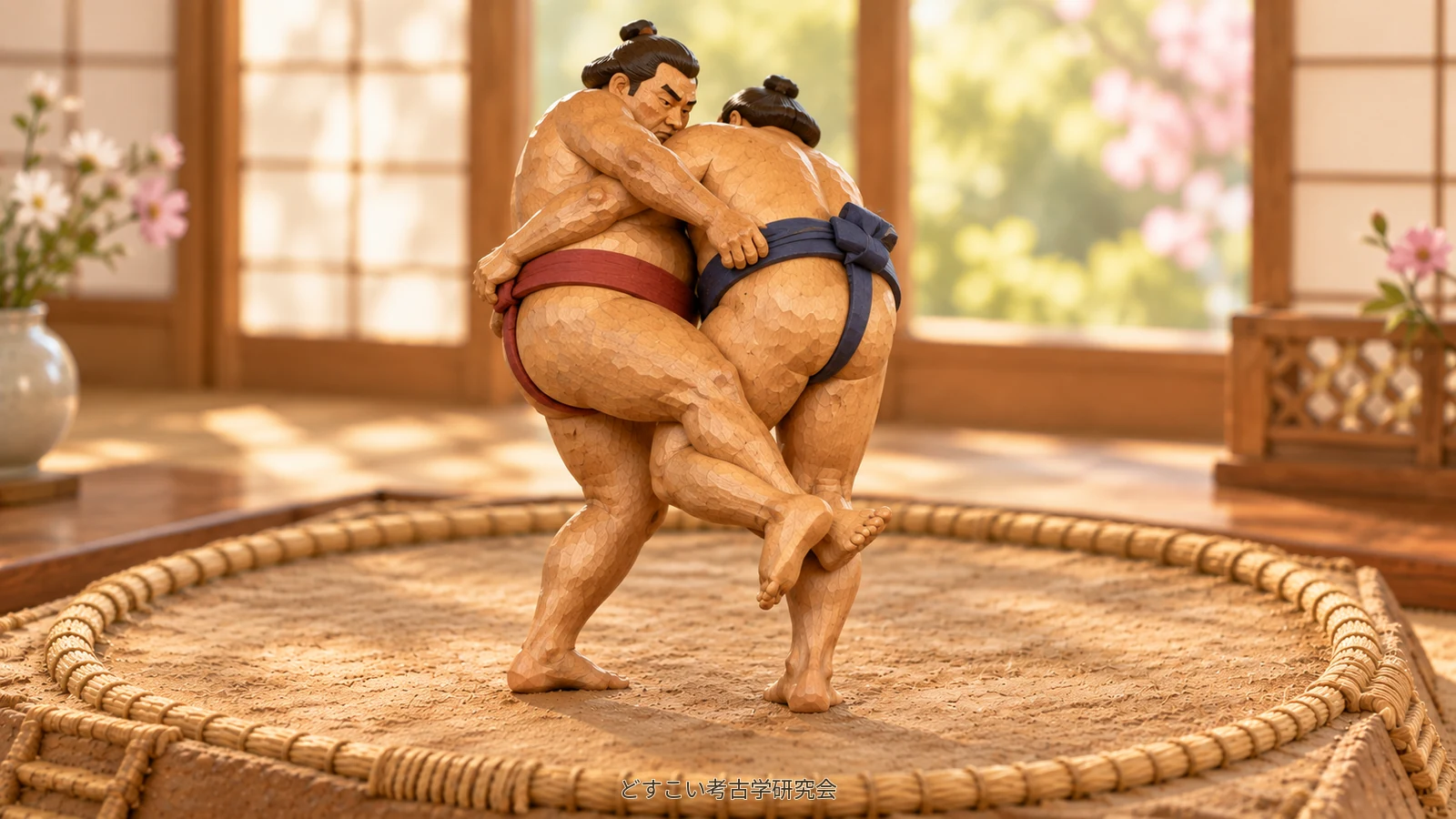
The “outside” in sotogake refers to the outside of the opponent’s leg, not the outside of the ring. The winner uses his right foot against the opponent’s left leg, or his left against the opponent’s right, hooks around that leg from outside and pulls it away to topple him backwards. Uchigake attacks the same opposite-leg pairing from inside. In the next bout, follow only one winning foot: did it circle around the target leg or enter between the legs?
The upper bodies appear locked in a heavy belt contest. Below them, an ankle-sized loop forms, and one wrestler is suddenly on his back. Sotogake changes scale. The largest athletes on the dohyo can be decided by the smallest space your eyes were not watching.
Pair opposite feet before thinking left and right
The Japan Sumo Association defines sotogake with mirrored examples: the winner’s right foot attacks the opponent’s left leg, or the winner’s left attacks the opponent’s right. Facing each other, these are the opposing legs that meet across the centre line.
The attacking foot hooks from the outside of that target leg and pulls it, bringing the opponent down backwards. You do not have to narrate four feet at full speed. Pick one foot belonging to the eventual attacker and pair it with the opponent’s leg directly across from it.
The official explanation adds that the hook can work cleanly near the ankle when the opponent’s knee extends during an attempt to lift or throw. Use this as a place to look, not a promise that every sotogake will arrive through one identical setup.
Uchigake uses the inside route
Uchigake keeps the same right-to-left or left-to-right pairing, according to the Association. The difference is that the attacking foot hooks the target leg from its inside, pulls it away and destroys the opponent’s balance into a backward fall.
Imagine the opponent’s target leg as a post. Sotogake travels around the outer side of that post. Uchigake reaches from the side nearer the space between the two legs. Once the wrestlers rotate, “left side of the screen” becomes unreliable. Outside and inside must stay attached to the target leg, not to your television frame.
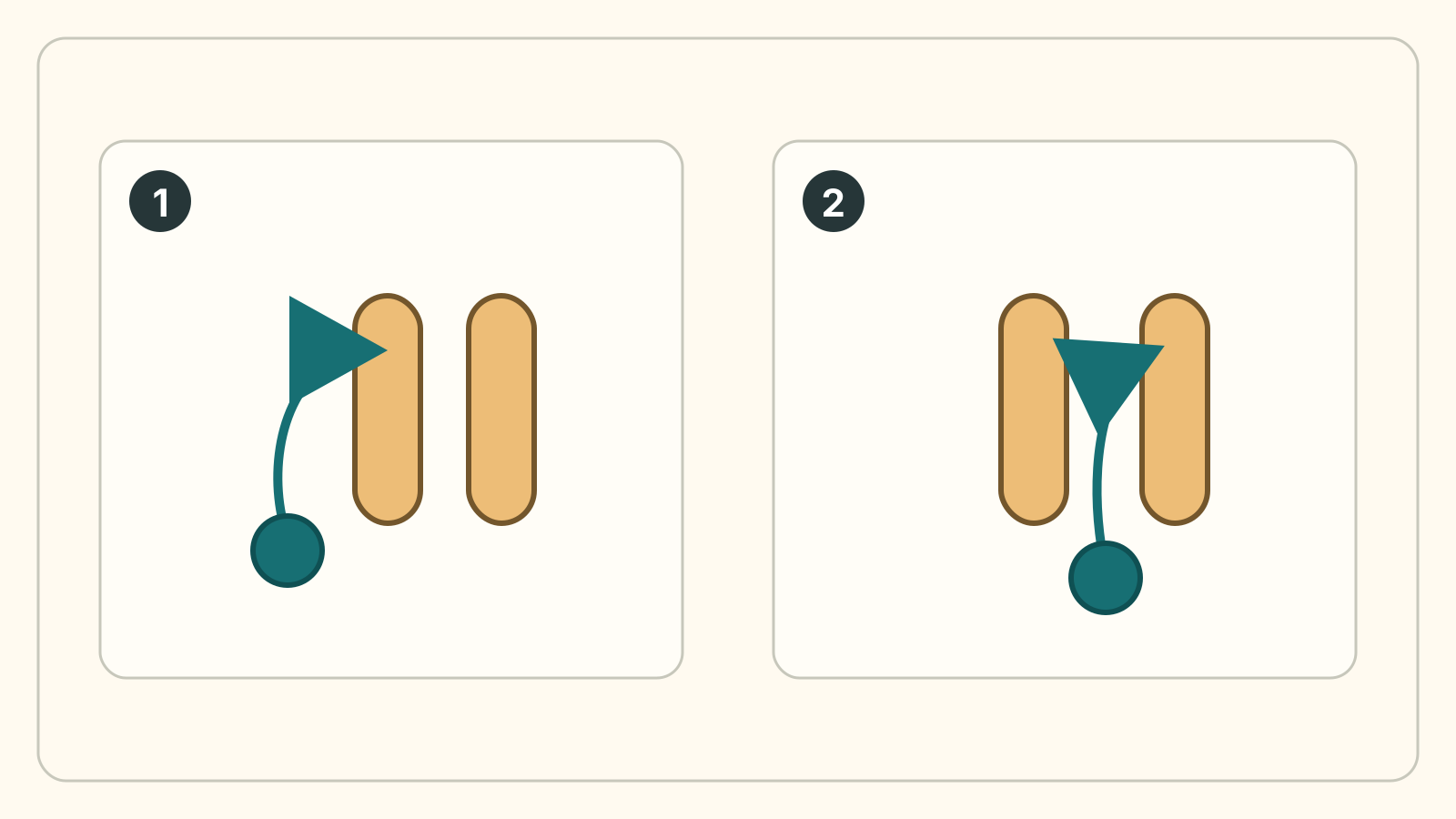
Detailed description of this diagram
Card 1 uses two gold vertical support bars and a blue curved cue from outside the pair towards the selected bar, encoding only the relative outside relation in the official sotogake definition. Card 2 uses the same pair and brings the blue cue from the space between them towards the selected bar, encoding only the relative inside relation in the official uchigake definition. The gold bars do not reproduce legs, thickness or stance, and the blue marker is not a foot or ankle. Curves do not prescribe path, hook height, pull, posture, fall direction or success. Left and right can reverse in a real bout; the visual isolates only outside versus inside of the opposite foot.
Graphic: SUMO ARCHAEOLOGY CLUB · Figure source 1 · Figure source 2 · Figure source 3
It does not mean “near the outside of the dohyo”
The Japanese characters can tempt a newcomer to connect *soto*, outside, with the ring boundary. The official definition uses outside in relation to the leg being hooked. A sotogake can be attempted near the centre or near the tawara; the name’s map remains at ankle level.
This is a useful habit beyond one technique. Whenever a kimarite contains a directional word, ask “outside of what?” before turning it into a visual rule. Here the reference object is not the ring. It is one of the opponent’s legs.
Sotogake vs kakenage
Kakenage also makes a leg conspicuous, but the Association describes another action. During a belt clinch, the winner places one leg into the opponent’s inner thigh and throws while lifting or springing that thigh upwards. It can also counter an outside hook by lifting from inside.
Sotogake circles the opposite lower leg from outside, pulls that leg and topples the opponent backwards. Kakenage enters at the inner thigh and lifts while throwing. “A foot was involved” is only the start. Ask whether the leg was pulled from around the lower outside or raised from the inner thigh.
One thing to watch in the next bout
Once a clinch forms, select one of the winner’s feet and refuse to chase the other three. Does it pass around the outside of the opponent’s opposite leg and hook close to the ankle? If so, store a sotogake prediction. If it enters through the space between the legs, compare what you saw with uchigake instead.
The hook may fail. The opponent may withdraw the foot, shorten his stance or continue with another action. That failed loop is still a discovery. Above, hands negotiate the belt; below, feet negotiate whether a leg is allowed to remain a base. A quiet clinch now has two floors of movement, and the lower one may decide when the whole structure falls.
Sources
- Japan Sumo Association, kimarite explanation for sotogake (checked 2 September 2026)
- Japan Sumo Association, kimarite explanation for uchigake (checked 2 September 2026)
- Japan Sumo Association, kimarite explanation for kakenage (checked 2 September 2026)
Source links used for verification
Each link was used for the corresponding claim in this article; inclusion is not a blanket endorsement of the whole page.
Article verified:
- Japan Sumo Association kimarite: sotogakePrimary source (as checked for this article)
- Japan Sumo Association kimarite: uchigakePrimary source (as checked for this article)
- Japan Sumo Association kimarite: kakenagePrimary source (as checked for this article)