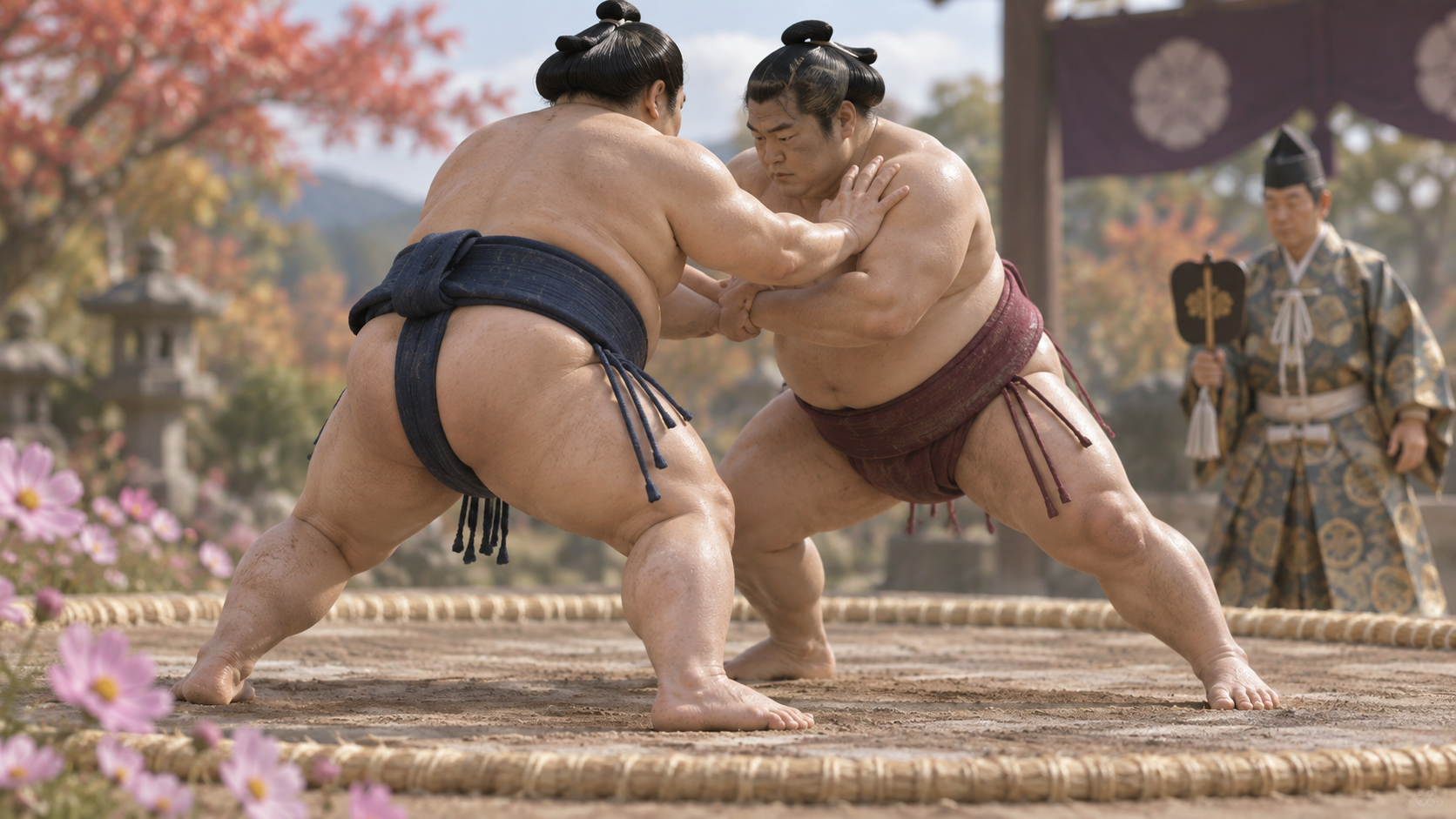
Deliberately grabbing an opponent’s head hair is a forbidden act in professional sumo. It is not a kimarite—a named winning technique. If a hand appears to brush the hair in a replay, however, a spectator should not infer intent or overturn the recorded result from one camera angle. Check the Japan Sumo Association’s official result and any explanation it publishes. In the next bout, try following where a hand near the head travels next.
A visitor can recognise the anxiety even before learning much Japanese: a wrestler’s fingers disappear near an opponent’s topknot, the broadcast slows down, and the question becomes “Was that legal?” Knowing one firm boundary helps. Knowing the limit of what we can conclude from the screen helps just as much.
The official rule refers to deliberately grabbing head hair
Japan Sumo Association Quiz No. 711 lists eight forbidden acts. One is deliberately grabbing an opponent’s head hair. The wording matters. It is safer to say “head hair” than to rewrite the rule as though it applied only to the topknot or only to one tied section of hair.
The word “deliberately” also matters. Professional sumo is a close, fast contest. Hands pass around the head, neck, shoulders and arms while both wrestlers are changing position. A hand being visible near the hair is not, by itself, proof that a spectator can determine purpose or the official consequence.
A foul is not a kimarite
Kimarite are the official labels used to describe how a valid bout was won: for example, a force-out, a throw or a slap-down. A forbidden act belongs to a different part of the rules. Hair pulling should therefore not be learned as an unusual technique with which somebody “wins.”
That distinction also gives an overseas reader a reliable checking order. First look at the Association’s daily result for the winner and the recorded kimarite. If an official account explains a foul, read that as a separate fact. A social-media freeze-frame is not a substitute for the official record.
What to do when a replay looks suspicious
An awkward angle can make fingers appear hooked when the full motion shows them sliding away. A fast replay can hide the moment before contact; a still image can remove the moment after it. Ringside judges, the gyoji and the official process have views and responsibilities that the audience does not share.
It is perfectly reasonable to wonder what happened. The useful pause is between wondering and accusing. If the official result does not provide the detail you hoped for, “I cannot tell from this view” is an honest conclusion. Avoid turning an uncertain hand position into a claim about a wrestler’s character or intent.
Watch the hand’s route, not one alarming frame
On the next bout, continue watching the hand after it passes near the head. Does it return to the shoulder for a push, search under an arm for an inside position, or drop towards the mawashi belt? That route often reveals the legal shape the wrestler is trying to build.
This tiny observation changes the mood. Instead of hunting for wrongdoing, you begin to see how quickly a wrestler must redirect both hands while protecting balance. The forbidden-move rule is still important: it marks a boundary within a violent-looking contest. But learning it can deepen attention without turning every viewer into a remote official.
Sources
- Japan Sumo Association, Quiz No. 711 on forbidden acts, official winning-technique index and daily bout results (checked 3 September 2026).
Source links used for verification
Each link was used for the corresponding claim in this article; inclusion is not a blanket endorsement of the whole page.
Article verified:
- Japan Sumo Association Quiz No.711: forbidden actsHistorical primary source (record from that period)
- Japan Sumo Association official winning techniquesPrimary source (as checked for this article)
- Japan Sumo Association daily bout resultsPrimary source (as checked for this article)