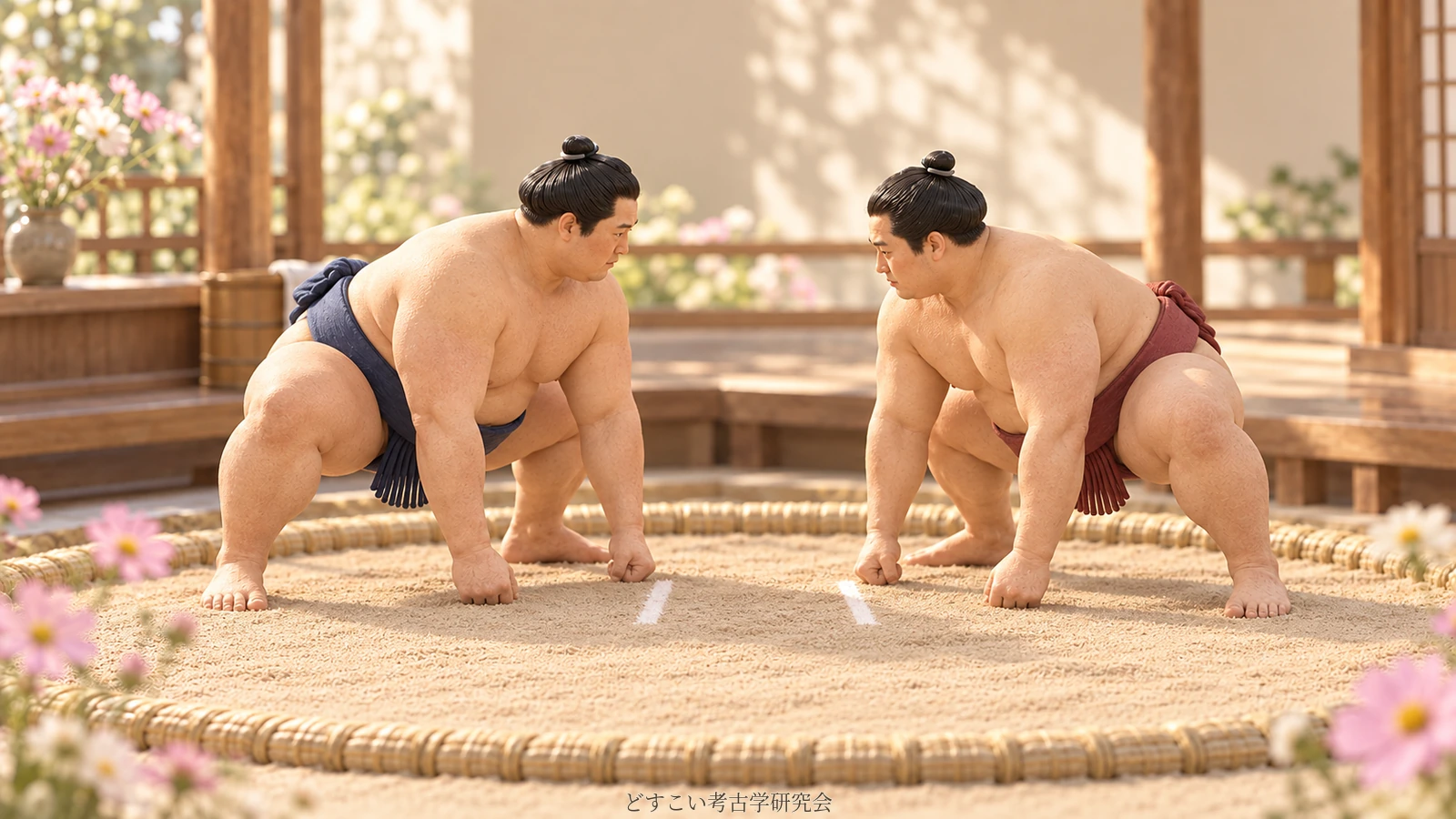
“Putting a hand down” describes two very different moments in professional sumo. Before the bout, both wrestlers touch the dohyo ring to establish the tachiai, the coordinated start. After the bout is live, a wrestler who puts his own hand on the dohyo without force from the opponent may lose by tsukite, an official non-technique. Separate “before the valid start” from “during the contest,” and the apparent contradiction disappears.
For a visitor, this may be the strangest two-second rule change in the arena. The wrestlers must bring their hands down, then suddenly the same floor becomes dangerous to touch. The hands have not changed; time has. That small boundary is a wonderful way into sumo’s rhythm.
Before the bout, hand contact helps make the start
The Japan Sumo Association explains that professional sumo has no third-party starting signal. The two wrestlers put their hands to the dohyo and coordinate their timing to create the tachiai. This contact is not a loss because the valid contest has not begun yet.
If the timing is not matched or the hand contact is considered insufficient, the wrestlers may reset and return to shikiri, their pre-bout preparation. A reset does not award a point. New viewers do not need to judge the exact distance between every fingertip and the clay. Watch both sets of hands and hips gather towards the same instant.
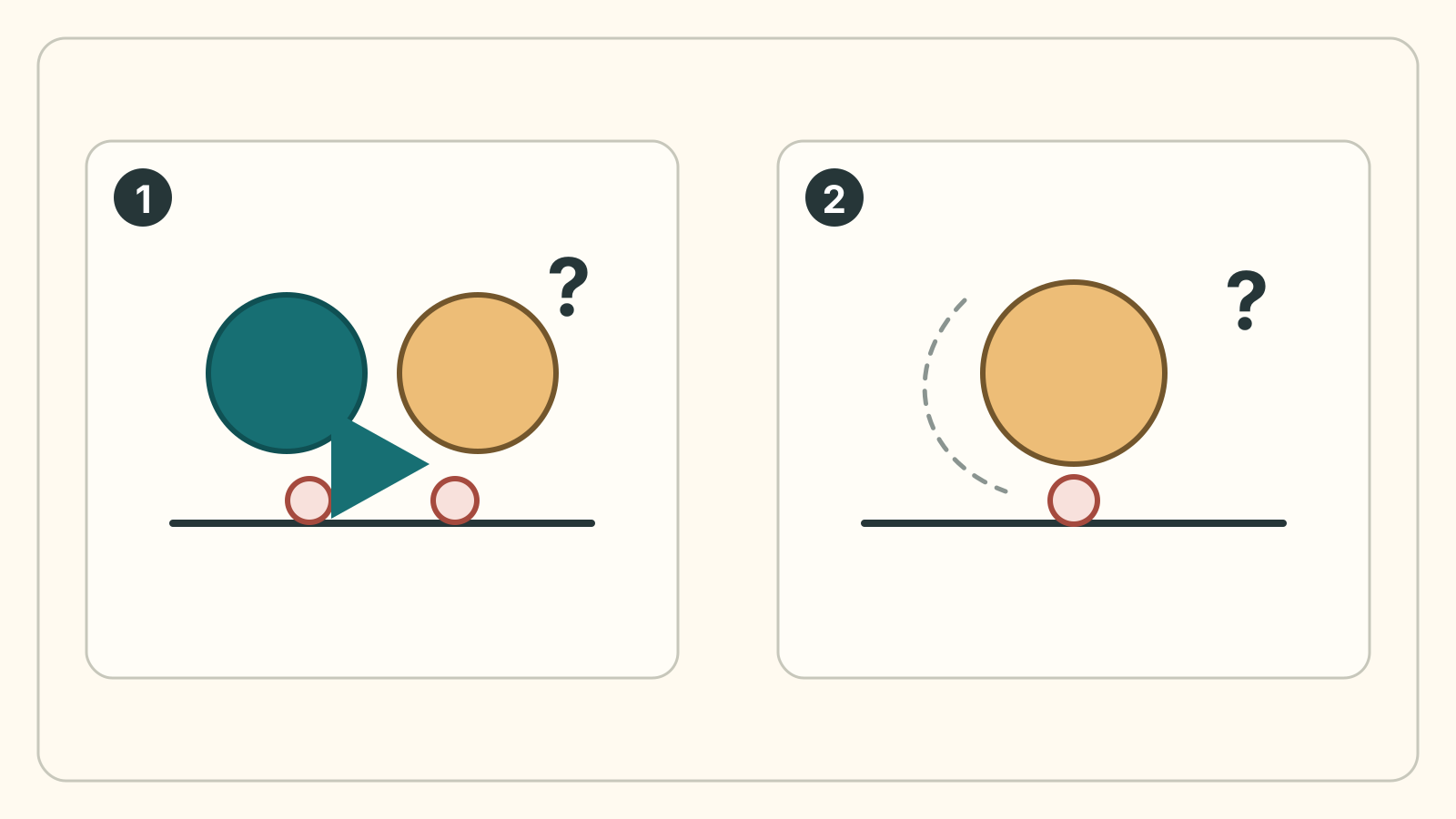
Detailed description of this diagram
Card 1 places two red contact dots on a ground line beneath blue and gold tokens for the mutual pre-start context. A question mark withholds whether hand contact was sufficient, timing matched or tachiai established. Card 2 moves to a post-start context with one gold token, one contact dot and a question mark for the no-opponent-force boundary of a possible tsukite result. The figure encodes no hand count/shape/height, fist, timing, breathing, contact duration, posture, fall, causality, matta test or sufficient judging rule.
Graphic: SUMO ARCHAEOLOGY CLUB · Figure source 1 · Figure source 2 · Figure source 3
During the bout, tsukite is a “non-technique” result
The Association defines tsukite as losing by putting one’s own hand on the dohyo without the opponent applying force. Its official index places it among *hiwaza*, often translated as non-techniques. The label describes a loss caused by one’s own loss of balance rather than a named attacking technique executed by the opponent.
This definition includes an important limit. If the opponent’s force caused the fall, the official winning label may be a different kimarite. A fan should not assign tsukite from a clip merely because a hand was the first body part he or she noticed touching the clay. Use the official daily result for the recorded outcome.
The useful dividing line is whether the tachiai has happened
Do not begin by memorising two definitions. First locate the moment in the bout. Are both wrestlers still crouching, repeating their preparation and waiting to establish the start? Then the hands belong to the tachiai process. Are they already pushing, pulling, gripping or moving their feet after a valid start? Then a hand touching the dohyo can become part of the decision.
If you join a broadcast midway through the sequence, the rest of the body gives clues. Salt, repeated crouches and stillness indicate preparation. Driving feet, changing grips and bodies under load indicate live competition. Context makes the Japanese term much easier to retain.
Watch one hand descend and recover
In the next bout, choose one wrestler. Before the start, watch one hand lower to the clay. After impact, follow that same wrestler’s hand when his balance is threatened. If it dips close to the dohyo and then rises again, look at the feet and hips that made the recovery possible.
The observation is more interesting than trying to call every result before the gyoji. One low horizontal plane helps create the start, then becomes the limit the wrestlers fight not to cross. Once you notice that reversal, a scramble at the edge stops looking like random motion: it becomes a contest to keep every supporting choice alive for one more fraction of a second.
Sources
- Japan Sumo Association, official tsukite definition, winning-technique index and Quiz No. 38 on the tachiai (checked 3 September 2026).
Source links used for verification
Each link was used for the corresponding claim in this article; inclusion is not a blanket endorsement of the whole page.
Article verified:
- Japan Sumo Association: tsukitePrimary source (as checked for this article)
- Japan Sumo Association Quiz No.38: establishing the tachiaiHistorical primary source (record from that period)
- Japan Sumo Association: winning techniques and non-techniquesPrimary source (as checked for this article)