
Japan Sumo Association introductory material gives two basic ways to lose: go outside the ring before the opponent, or touch the dohyo first with anything other than the soles of the feet. These are general principles, not a complete list of specialist exceptions or permission to adjudicate a close finish from one camera angle.
For a first viewing, do not try to name all 82 winning techniques. When the wrestlers reach the edge or begin to fall, look for the first hand, knee or foot that may have created the loss. If it is hidden, wait for the gunbai and official announcement.
One wrestler can drive forward for almost the entire bout and still receive the losing result. Both can tumble from the raised ring, yet the wrestler who appears to land last may not be the winner. Sumo is not scored for pressure, style or time in control. It turns on which losing condition happened first.
Two simple principles come before the technique name
The Japan Sumo Association’s introductory material describes sumo inside a circle 4.55 metres in diameter. A wrestler wins by putting the opponent outside that circle or by causing any part of the opponent other than the soles to touch the dohyo.
A palm brushing the clay can therefore settle the result before the rest of the body falls. A knee or elbow can do the same. At the boundary, the significant moment may be one foot landing outside while two upper bodies are still fighting. You do not have to wait until somebody lies flat.
This is why the shorthand “the standing wrestler wins” is unreliable. The dramatic final pose can happen after the decisive contact. Train your eyes one fraction of a second earlier.
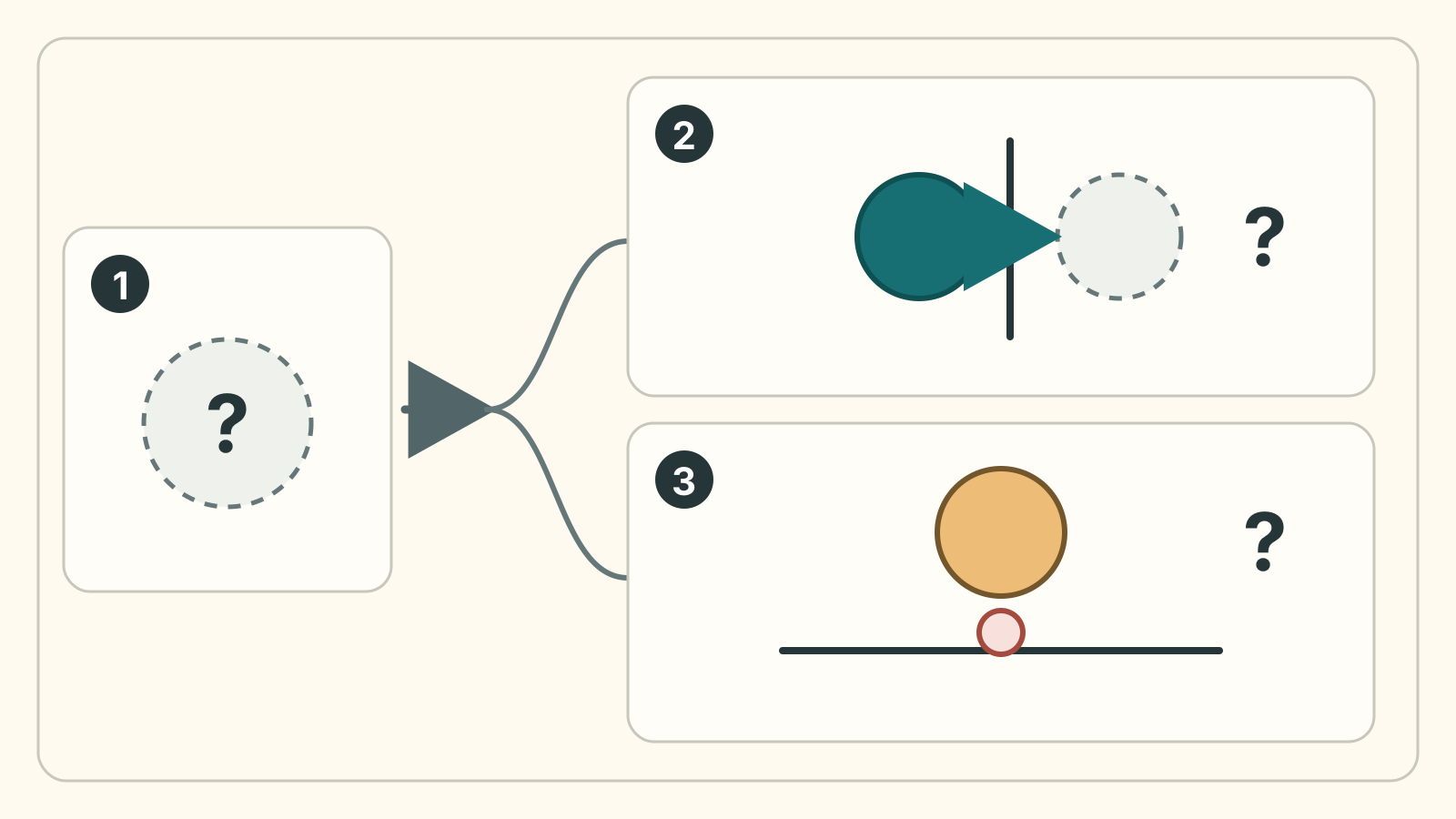
Detailed description of this diagram
Card 1 is a question-mark gate because the figure cannot decide temporal priority or the official result. Upper card 2 moves one token across a generic boundary category. Lower card 3 places a separate contact dot on a ground line for the non-sole-contact category. The lines are not tawara geometry and the dot names no hand, knee, hair or other body part. No exception, dead-body doctrine, clothing, camera test, technique name, winner or sufficient ruling algorithm is encoded.
Graphic: SUMO ARCHAEOLOGY CLUB · Figure source 1 · Figure source 2 · Figure source 3 · Figure source 4
A foot on the straw bale can still be inside
The circular boundary is made from small straw bales embedded in the clay. The Association explains that the outer edge of those bales is the line. Merely placing a foot on top of a bale does not by itself mean the wrestler is out.
That detail creates some of sumo’s finest edge defence. A heel can rise onto a bale while the toes and sole keep working inside the boundary. A wrestler may bend far beyond what looks recoverable without yet losing. The task is not to decide whether the pose looks unstable; it is to see whether the foot has crossed and touched outside.
Outside the bales is a carefully smoothed strip of sand called the *janome*. It helps make evidence of a step or touch easier to see. A mark in the sand is not an automated result, however. The gyoji makes the initial decision, and ringside judges can call a conference when the finish is close.
The attacker can step out first
Forward movement is not a collection of points. If a wrestler drives the opponent to the edge but accidentally steps outside first, the official outcome can be *isamiashi*, often explained in English as a forward step-out. The Association defines it as the attacking wrestler, while crowding the opponent at the edge, going out first through excessive momentum and giving the opponent the win.
This is a useful cure for a common first-viewing assumption: “Surely the wrestler doing all the attacking won.” Not necessarily. If that wrestler met the losing condition first, the earlier dominance does not erase it.
This article does not establish every technical exception or its application to a close finish. Do not adjudicate an edge case from a single camera angle. Learn the general principle, then use the official result and any explanation after a *mono-ii* as the answer.
The gyoji looks for the loser first
An Association feature on gyoji technique makes a striking distinction. Spectators tend to watch who is winning; the gyoji concentrates on who loses first. Once that losing contact is seen, the gunbai is raised towards the other wrestler.
You can borrow a small part of that professional habit. During the opening collision, watch whichever wrestler interests you. As soon as the action reaches the bales, widen your view to include both sets of feet and any hand dropping towards the clay. The question is no longer “Who looks stronger?” It is “What touched first, and where?”
Do not turn that exercise into an accusation when the official decision differs from your view. A body can hide the relevant fingertips; a broadcast may show only one side; and the judges may have additional video information. If a *mono-ii* conference is called, wait for the chief judge’s explanation.
Losing condition and kimarite are different questions
After the bout, an arena announcement gives the winner and the *kimarite*—the winning technique or official outcome. *Oshidashi*, *yorikiri* and *uwatenage* describe how the finish was produced. “Outside first” or “non-sole contact first” identifies the basic loss you were looking for.
You can understand the second question before you can answer the first. That is liberating for an overseas viewer meeting dozens of Japanese terms at once. See the hand touch; confirm the gunbai; then listen for the technique name. Vocabulary arrives after the event rather than blocking it.
Watch one thing in the next bout
When the wrestlers fall or reach the edge, delay your glance towards the celebrating winner. Look low. Find the first palm, knee or foot that reaches a losing place. If you cannot see it, check the gunbai and wait for the announcement. If the judges confer, let the official explanation complete the moment.
Sumo offers enormous bodies, a loud collision and an arena full of ceremony. Yet a contest may turn on a fingertip, a heel or a few disturbed grains of sand. Once you begin looking for that tiny first contact, the sport becomes not only powerful but exquisitely precise.
Sources
- Japan Sumo Association, *Sumo Health Exercises*, quizzes No.1304 and No.355, and the official *isamiashi* guide (verified 3 September 2026).
Source links used for verification
Each link was used for the corresponding claim in this article; inclusion is not a blanket endorsement of the whole page.
Article verified:
- Japan Sumo Association Sumo Health Exercises booklet: basic rulesPrimary source (as checked for this article)
- Japan Sumo Association quiz No.1304: how a gyoji watches the ring edgePrimary source (as checked for this article)
- Japan Sumo Association quiz No.355: the outer edge of the balesPrimary source (as checked for this article)
- Japan Sumo Association official technique guide: isamiashiPrimary source (as checked for this article)