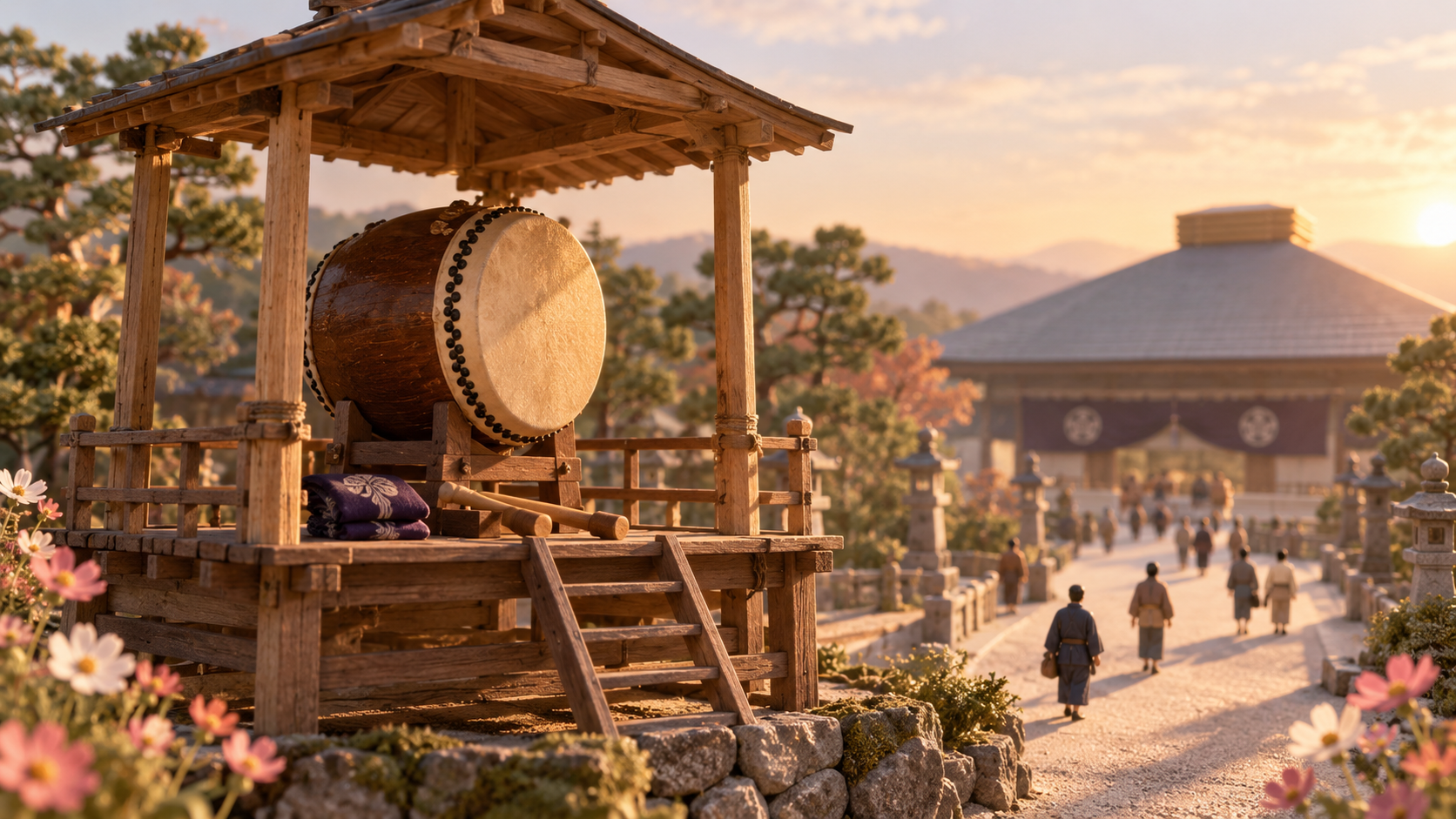
Fure-daiko announces that a grand tournament is about to begin. Yose-daiko is a gathering call. Hane-daiko accompanies the end of an event, dispersing the audience with the message that they should return tomorrow. The same large drum can therefore point towards three different moments. Instead of treating every beat as generic “traditional Japanese atmosphere,” ask one simple question: is this sound announcing, gathering or sending people away?
The names become easier when placed on a timeline. *Fureru* can mean to proclaim or circulate a notice. *Yoseru* means to draw together. *Haneru* is used for ending a performance. You do not need those verbs to enjoy the sound, but they reveal that the drum is moving people as well as air.
Fure-daiko takes the tournament beyond the arena
The Japan Sumo Association describes *fure-daiko* as the commonly used name for drumming that announces a grand tournament on the day before opening day. Its official explainer notes that the label is a customary term rather than a formal one.
At the conclusion of the pre-tournament dohyo ceremony, groups of yobidashi enter with two drums, circle the ring and then go out to carry the announcement into the city. The precise route and public access should not be assumed to be identical at every tournament. Anyone hoping to see it needs current information from the organiser. The stable fact is the direction of the ritual: sound travels from the newly prepared dohyo towards the surrounding community before the first official bout.
This is a useful correction for a visitor who thinks a tournament begins only when a ticket is scanned. The place has already been announced in rhythm. The arena is reaching out before spectators come in.
Yose-daiko is a call towards a centre
On its regional tour page, the Association explains *yose-daiko* in a display of different tower-drum patterns. It connects the call to the era of the *sumo kaisho*, a predecessor of the Association, when it signalled that elders should gather for a consultation. Historical tour reports also caption yose-daiko as a sound announcing that doors are opening.
Those references should not be stretched into a promise that every current tournament and tour stop uses an identical opening sequence. Regional tour programmes vary. The older explanation and the documented examples instead give us a reliable image: this is a call whose name and function point inwards, drawing people together.
If you hear a drum as you approach a tour venue, check the day’s official programme before confidently naming it. Context is part of listening. A correct label without the correct event is less useful than noticing that the sound is organising arrival.
Hane-daiko sends the day outwards again
Hane-daiko sounds when the day’s sumo has finished. The Association explains that the sticks move from inside to outside in a scattering pattern, encouraging the audience to leave. A traditional verbal imitation hears the rhythm as *ten-ten bara-bara*—people dispersing in different directions.
There is warmth inside that ending. The call also means, in effect, “We look forward to seeing you again tomorrow.” For that reason it is not played on the final day of a tournament, and the Association’s tour explanation says it is also omitted for a one-day event. Silence is not a production error. With no tomorrow in that run, the musical sentence changes.
That exception is the easiest fact to carry into a live visit. If you attend both day fourteen and day fifteen, listen after the closing bow ceremony. The absence of yesterday’s sending-off sound can tell you that the tournament itself has reached its boundary.
These are not three interchangeable background tracks
International presentations sometimes compress arena sounds into a general category of “taiko drumming.” That translation names the instrument but removes the message. These patterns belong to a vocabulary of timing and movement.
- Before opening day, fure-daiko carries news outward.
- At a gathering or opening, yose-daiko draws attention inward.
- At the end, hane-daiko sends the crowd out and, when another day remains, invites it back.
This is a listening map, not a test. Other named patterns exist, including *ichiban-daiko*, and tower-drum demonstrations may present several together. Current performance practice depends on the event. Keep the date, venue and official programme attached to what you hear.
Find the yobidashi behind the sound
The yobidashi are often introduced to overseas viewers simply as the men who sing the wrestlers’ names. They also tend the ring, handle equipment and play these drums. The white fan seen during the call and the pair of sticks seen at the drum belong to a much larger working role.
At the next event, choose just one transition. Hear the drum before entering, or wait a moment after the final ceremony. Ask whether the sound is bringing people together or releasing them. A bout is decided within the straw boundary, but a tournament day needs a wider edge. The drum draws that edge in time: before, together, and away again.
Keep More Than One Interpretation Open
We separate what the official or collection source establishes from our observation. A ritual, object or posture may have another interpretation or theory across periods, regions and explainers. When primary evidence does not establish a single origin or meaning, we leave it unknown or contested rather than turn visual resemblance into historical fact.
Sources
- Japan Sumo Association, Sumo Quiz No.614, published 14 September 2023 (checked 3 September 2026)
- Japan Sumo Association, Sumo Quiz No.528, published 20 June 2023 (checked 3 September 2026)
- Japan Sumo Association, “A Day on Tour,” yagura-daiko display section (checked 3 September 2026)
- Japan Sumo Association, 2015 regional tour photo report (checked 3 September 2026)
Source links used for verification
Each link was used for the corresponding claim in this article; inclusion is not a blanket endorsement of the whole page.
Article verified:
- Japan Sumo Association Sumo Quiz No.614: fure-daikoPrimary source (as checked for this article)
- Japan Sumo Association Sumo Quiz No.528: hane-daikoPrimary source (as checked for this article)
- Japan Sumo Association: a day on tour and yagura-daiko patternsPrimary source (as checked for this article)
- Japan Sumo Association 2015 regional tour photo reportHistorical primary source (record from that period)