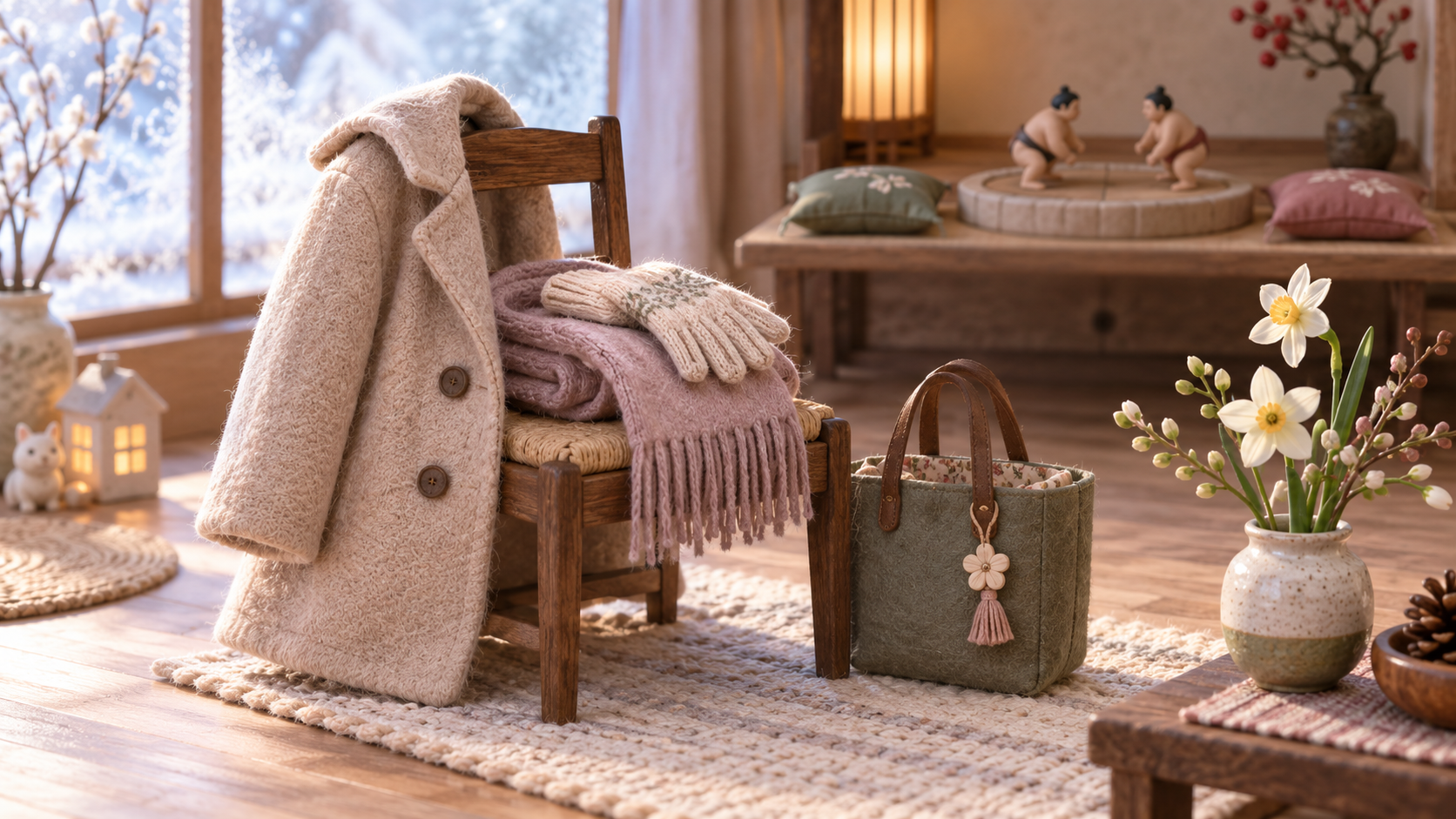
Wear a proper winter coat outdoors, but build the outfit from layers you can remove and fit inside your own bag. Add compact protection for your neck and hands, familiar walking shoes, and clothing that stays comfortable on the floor if you have a masu box. Kokugikan has not published a guaranteed interior temperature for January 2027, so promises that it will be “always warm” or “freezing” are not reliable packing advice.
January sumo begins before you see the dohyo. You walk through cold Ryogoku, enter the arena, remove a layer and feel the building gather energy. Good clothing does not need to become the story; it quietly gives the story back to the wrestlers.
What the official climate normals actually say
The Japan Sumo Association has scheduled the tournament from January 10 through January 24, 2027. The Japan Meteorological Agency’s 1991–2020 Tokyo normals put January 10 at a mean of 5.5°C, a normal high of 9.9°C and a normal low of 1.4°C. On January 24, the corresponding figures are 5.2°C, 9.6°C and 1.1°C.
Those numbers are climate normals, not the 2027 forecast. They tell you the range for planning: the trip to and from the arena may take place in single-digit temperatures, and the evening can feel very different from a sunny midday. Check the JMA forecast again 24 to 48 hours before your ticket date. Snow, rain and wind must come from that current forecast, not from an article written months earlier.
A four-part outfit is enough
- a long-sleeved base layer or comfortable top;
- a cardigan, overshirt or other adjustable middle layer;
- a winter coat for the outdoor journey;
- gloves and a scarf or neck warmer that pack away easily.
One extremely heavy layer gives you fewer choices if the concourse or your seat feels warm. Before buying specialist gear, try what you already own. Remove the coat and see whether everything fits in the bag you will keep with you.
Disposable or reusable hand warmers can help some travellers outdoors. Use them according to their safety instructions and watch for low-temperature burns. They are not evidence about the arena’s heating, and this guide does not make a purchase the price of admission.
A masu box adds a floor-sitting test
A masu box uses cushions on the floor. A stiff coat, tight knees or a long bulky hem may be warm yet uncomfortable once you sit and turn in a shared space. Put on the planned outfit at home and sit on the floor for a few minutes. Check the waist, knees and anything hard that presses against you.
Boots are not presented here as prohibited. The practical question is whether you can walk confidently, remove them without a struggle and keep your space orderly. A foldable coat is also easier to manage than one that occupies a large part of the box.
Chair seats still require an evening plan
Chair seating removes the prolonged floor-sitting issue, but it does not remove the cold journey home. Read the forecast for your departure time, not only the afternoon high. Keep gloves and scarf in one compartment when you take them off; small black accessories are remarkably talented at disappearing under a seat.
If rain or snow is forecast, consider weather-resistant footwear and a compact wet-item bag. A snow column in a climate table is not a prediction for your day. In disruptive weather, check the Association and the operating information of your railway or airline before travelling.
The sixty-second check the night before
- Read the forecast for both arrival and departure.
- Remove the coat and confirm it fits in your bag.
- For a masu box, test the full outfit while sitting on the floor.
- Keep the charged ticket phone accessible rather than buried under layers.
- If snow or strong wind is possible, check transport status as well.
The reward is not merely avoiding cold fingers. Once your own layers stop demanding attention, you may notice the layered silk of a gyoji’s costume, a wrestler’s brightly patterned outer robe, or the breath briefly visible outside before he enters. Winter clothing protects room for those details.
Test cold, heat and floor discomfort separately
Confirmed fact: JMA publishes Tokyo’s January 1991–2020 daily climate normals; normals are not a forecast for your day.
What remains unknown: The day’s temperature, snow, indoor temperature and January handling of coats and shoes in a box remain unconfirmed.
Reasoned inference: Climate normals support preparing for winter, but not estimating the day’s temperature. Confidence is high for season context and low for a date; the forecast and warnings overturn it.
Editorial suggestion: In the intended clothes, sit on the floor, stand, handle shoes and fold the coat. This is neither a venue-size simulation nor a rule; it tests your knees, back and hands.
Fallback: Adjust layers; switch to a chair for floor-sitting difficulty, or choose later, shorter or no travel when movement is unsafe.
Sources
- Japan Meteorological Agency, Tokyo daily January climate normals, 1991–2020 period (checked September 2, 2026).
- Japan Sumo Association, January 2027 Tokyo ticket page; confirmed dates are January 10–24 (checked September 2, 2026).
- Japan Sumo Association, Tokyo venue access page (checked September 2, 2026).
Source links used for verification
Each link was used for the corresponding claim in this article; inclusion is not a blanket endorsement of the whole page.
Article verified:
- Japan Meteorological Agency daily January climate normals for Tokyo, 1991–2020Primary source (as checked for this article)
- Japan Sumo Association January 2027 Tokyo ticket pagePrimary source (as checked for this article)
- Japan Sumo Association Tokyo venue access pagePrimary source (as checked for this article)
- Japan Sumo Association September 2026 seating guide (earlier operation at the same venue)Historical primary source (record from that period)