If you want to stay through the final bout or bow-twirling ceremony, decide before entering whether you will use JR Ryogoku Station’s West Exit or Ryogoku Station on the Toei Oedo Line. The Japan Sumo Association lists walks of about two and five minutes respectively, but those figures do not include post-event crowds. Check your final train and connections on the operators’ current pages, and give companions one precise meeting point.
The bow ceremony gives the tournament day a satisfying final breath. Then many spectators may stand at nearly the same moment; this article does not claim an exact crowd count or wait. Opening a route app for the first time in that flow can erase the calm you just felt. A departure plan is not a reason to leave early; it is what makes staying to the end feel safe.
Write the railway name, not only “Ryogoku”
The official access page identifies JR Sobu Line Ryogoku, West Exit, as the closer listed walk and Toei Oedo Line Ryogoku as another option. They are separate stations. A message saying “meet at Ryogoku” is therefore incomplete.
Choose the line that reduces difficult transfers for your actual destination. Save the railway, station and exit in text as well as on a map. After the event, following the largest crowd without checking can deliver you to the other station.
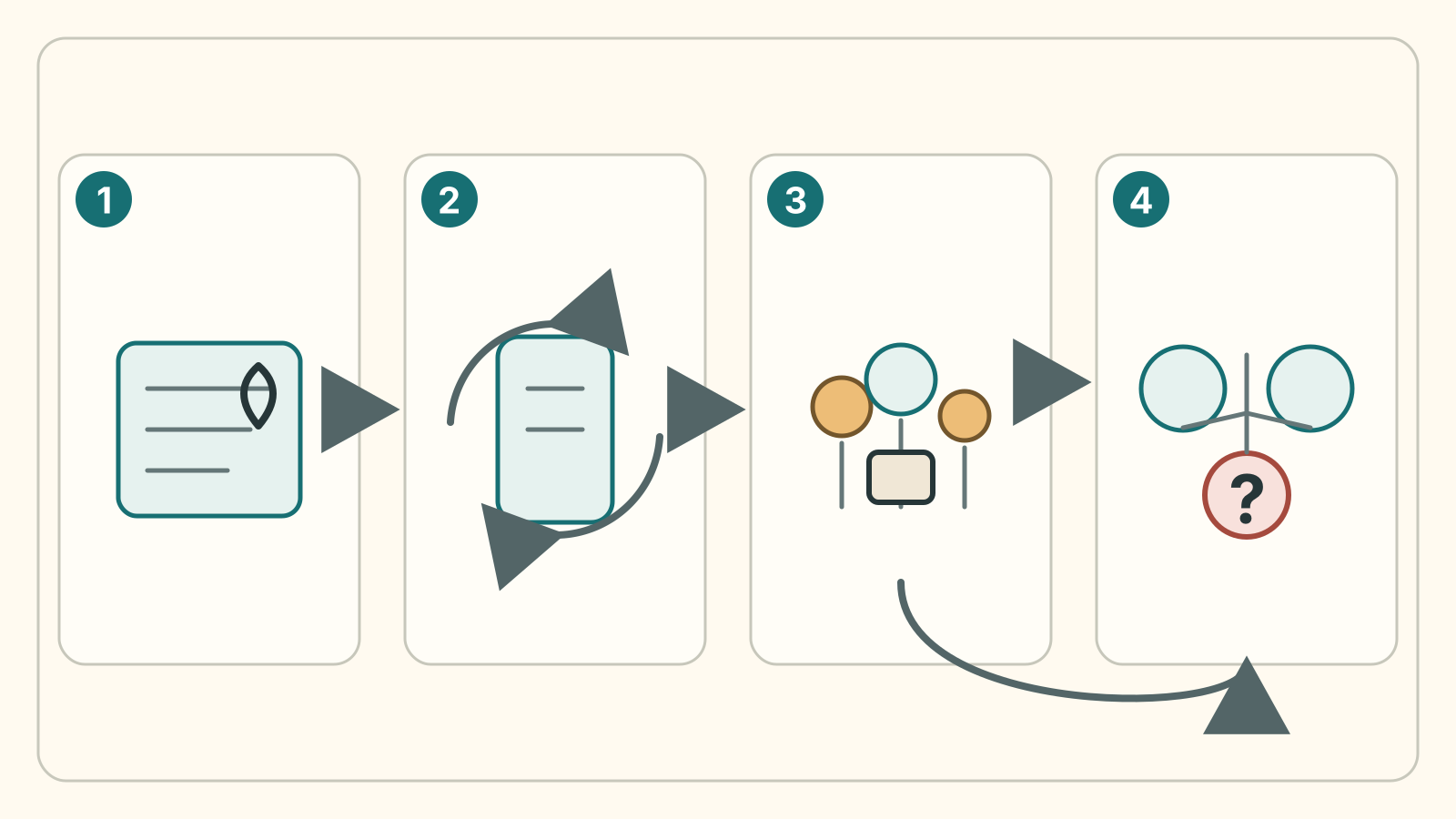
Detailed description of this diagram
Four cards form a decision flow. Card 1 is an abstract destination note for saving the railway operator or line together with the final destination, not only the place name Ryogoku. Card 2 uses refresh arrows and a generic device for checking current official operation before leaving; it is no real app or timetable. Card 3 combines several circles, a bag and condition check for testing whether the plan works for children, luggage, mobility and every companion. The failing branch goes to Card 4, whose multiple candidates and question mark mean choosing a currently verified alternate route, earlier departure, accommodation or other fallback. No map, station position, exit, platform, road, clock value, last train, walking duration, taxi, fare, room availability, crowd or successful arrival is shown.
Graphic: SUMO ARCHAEOLOGY CLUB · Figure source 1 · Figure source 2 · Figure source 3
Never freeze a last-train promise in an article
The Association describes its dohyo times as approximate. When checked on September 4, 2026, the timetable text still retained May-tournament wording, so it is not used for a minute-by-minute September prediction. Bout progress, ceremonies, crowd movement and service disruption all affect when you reach the platform. This guide cannot promise that a named departure will be available on your day. For JR travel, use JR East’s current Ryogoku timetable and disruption information; check the official operator for every connecting line too.
If you have a Shinkansen, airport flight or highway bus the same evening, add a generous buffer. When missing one connection would strand you, do not make both “stay to the very end” and “catch the tight connection” non-negotiable. A nearby night, an earlier departure or a different ticket may protect the trip better than a sprint.
Choose a meeting point while it is still quiet
“At the front” or “at the station” is too broad if corridors and pavements fill. This article cannot predict the queue or mobile signal. On arrival, choose a specific landmark that does not block staff, emergency routes or other spectators. Agree on a time to wait there if mobile service is poor.
Preserve phone battery for the ticket and journey home. A power bank helps, but it is not the whole plan. Keep the hotel name and major transfer written somewhere that does not require a working device. If separated, do not fight against the crowd; return to the last agreed point when safe.
Let the crowd move one bout ahead
Unless your connection is genuinely tight, take a moment to gather your belongings and check around the seat. Rushing the instant the ceremony ends increases contact on steps and narrow rows. Move with staff directions and the established flow.
Outside, recall one shikona or one first step from the day before opening every result page. If the trip home preserves that afterglow rather than becoming only a memory of crowds, the departure plan has done more than navigation. It has protected the last part of the sumo experience.
Sources
- Japan Sumo Association, September 2026 Kokugikan access and dohyo schedule; JR East, Ryogoku Station timetable (checked 3 September 2026). Published walking times are not treated as crowd-inclusive travel times.
Source links used for verification
Each link was used for the corresponding claim in this article; inclusion is not a blanket endorsement of the whole page.
Article verified:
- Japan Sumo Association September 2026 Kokugikan accessPrimary source (as checked for this article)
- Japan Sumo Association Tokyo dohyo schedule (URL and tournament wording conflict)Primary source (conflicting details noted)
- JR East Ryogoku Station timetablePrimary source (as checked for this article)