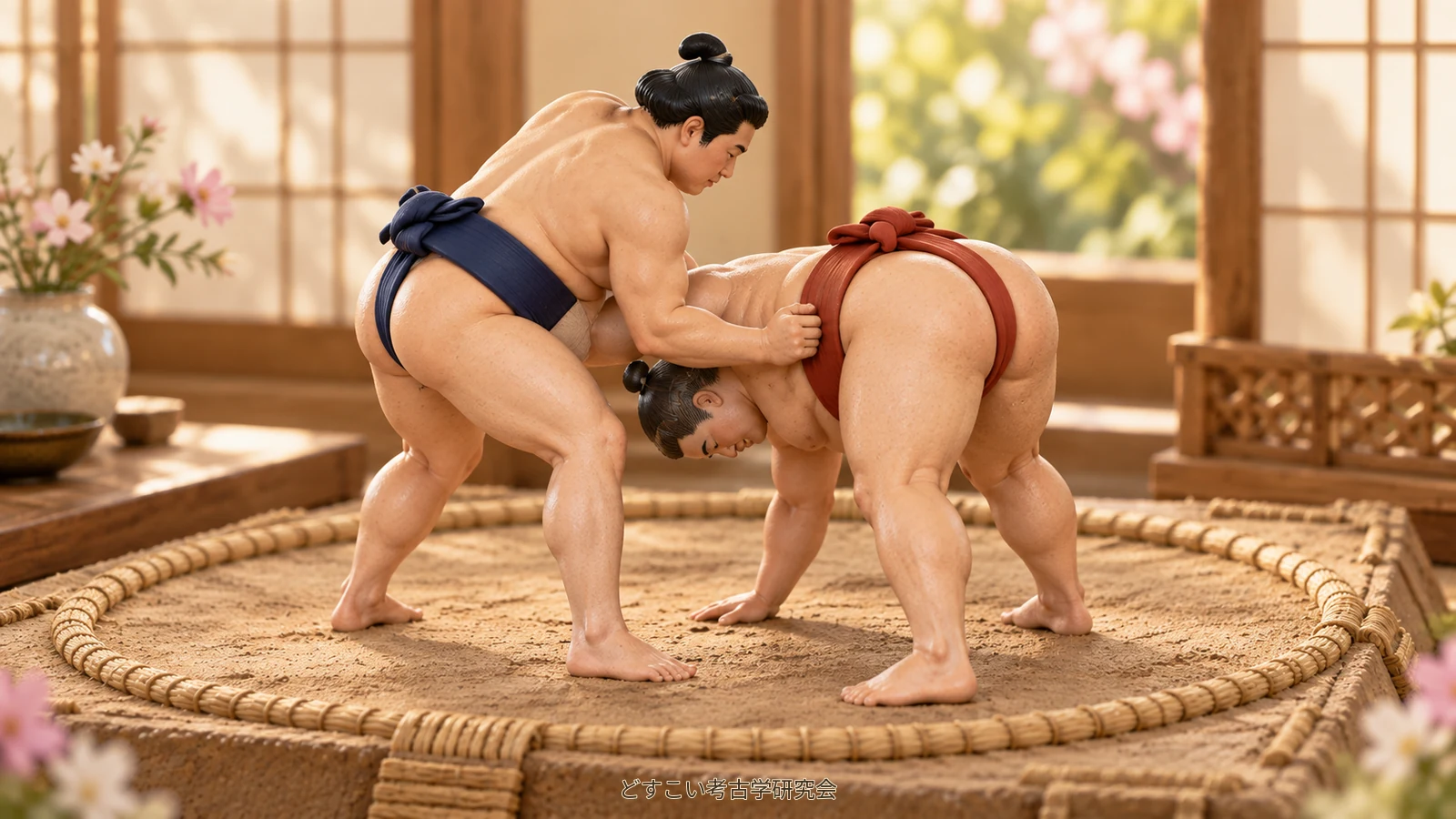
Both techniques begin with an *uwate*, an outside mawashi grip taken over the opponent’s inserted arm. Uwatedashinage adds a specific sequence: the gripping elbow controls that inside arm, the foot on the non-gripping side draws back, the winner opens his body and sends the opponent forwards as if pushing him out. For the next bout, find the upper belt grip, then move your eyes diagonally to the opposite foot. Does it withdraw just before the opponent pitches forwards?
The arena says “uwatedashinage,” and an international newcomer may hear only the familiar beginning, *uwatenage*. The extra *dashi* is easy to lose in the sound. On the dohyo, however, it gives you a surprisingly concrete place to look: not at the gripping hand, but at the foot on the other side of the body.
Establish the common grip first
In a belt clinch, an inserted arm travels beneath an opponent’s armpit. An *uwate* grip reaches over that arm to the mawashi from outside. The Japan Sumo Association defines uwatenage as throwing from this upper belt grip. It also notes that the opponent does not have to land on the clay; if the throwing force sends him outside while upright, the kimarite can still be uwatenage.
Uwatedashinage starts with the same upper grip. Seeing the belt hold therefore identifies the family, not the full finish. Keep watching after the hand has settled.
The official uwatedashinage sequence
The Association’s description provides several linked actions:
- Take the upper mawashi grip.
- Use that gripping elbow to contain the opponent’s inserted arm.
- Draw back the foot on the side that is not holding the belt.
- Open the body and throw the opponent forwards with an action compared to pushing him out.
The official page describes the loser as being drawn along and falling almost as if crawling across the clay. This is not a requirement to judge from a single final pose; it is an invitation to follow the sequence that produced the forward fall.
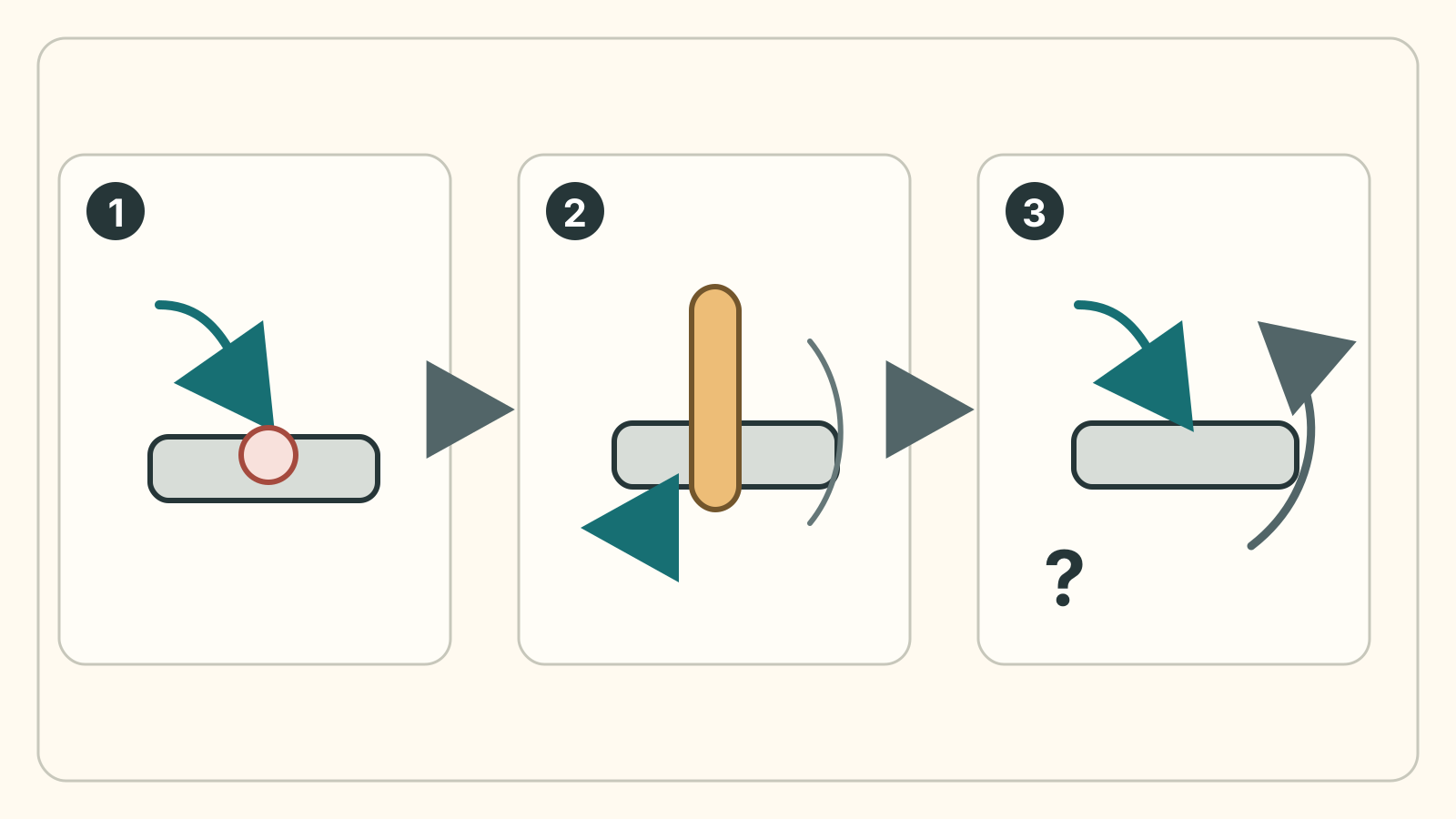
Detailed description of this diagram
Card 1 uses a grey belt band, an over-reaching blue curve and contact dot for the shared overarm grip. Card 2 keeps the belt, adds a gold inserted-arm role bar, a lower retreat arrow and an opening curve for the extra uwatedashinage sequence. Card 3 keeps the overarm symbol and a general throw arrow but adds a question mark so the viewer does not infer the same foot condition for uwatenage. Bands, bars and arrows encode no anatomical side, elbow lock, grip, stance, step distance, timing, forward angle, throw mechanics or judging test.
Graphic: SUMO ARCHAEOLOGY CLUB · Figure source 1 · Figure source 2 · Figure source 3
How that differs from uwatenage
The official uwatenage definition centres on throwing from the upper belt grip. It does not prescribe the opposite-foot withdrawal, body opening and forward-sending sequence set out on the uwatedashinage page.
Rather than inventing a shortcut based only on the loser’s landing direction, look for those positive uwatedashinage clues. Did the gripping elbow contain the inside arm? Did the non-grip-side foot make space by moving back? Did the winner’s torso open as the opponent went forwards?
If your seat hides the feet, do not force a verdict. Note the grip, listen to the announcement and return to the hidden side if a replay provides another angle.
Uwatedashinage vs shitatedashinage
Shitatedashinage also draws back the foot opposite the grip, opens the body and sends the opponent forwards. The difference comes earlier. Its official definition uses a *shitate*, the inside belt grip taken beneath the opponent’s arm, and tightens the armpit around that grip.
Use grip before footwork. Did the arm travel over the opponent’s inserted arm for uwate, or inside beneath the armpit for shitate? Only after fixing that map should you follow the opposite foot. Two visually similar forward falls can begin from different routes to the same mawashi.
One thing to watch in the next bout
When a wrestler secures an upper belt grip, draw an imaginary diagonal from that hand to his other foot. Ignore the rest for one second. If the opposite foot slides back and the torso opens while the opponent is sent forwards, predict uwatedashinage.
The throw may not arrive. The opponent may resist the elbow control, recover his stance or change the grip. That is still useful viewing: you have seen one required connection fail before the result. A name that first looked impossibly long has become a small diagonal across the body—one gripping hand, one retreating foot, and the space between them where a forward throw can appear.
Sources
- Japan Sumo Association, kimarite explanation for uwatedashinage (checked 2 September 2026)
- Japan Sumo Association, kimarite explanation for uwatenage (checked 2 September 2026)
- Japan Sumo Association, kimarite explanation for shitatedashinage (checked 2 September 2026)
Source links used for verification
Each link was used for the corresponding claim in this article; inclusion is not a blanket endorsement of the whole page.
Article verified:
- Japan Sumo Association kimarite: uwatedashinagePrimary source (as checked for this article)
- Japan Sumo Association kimarite: uwatenagePrimary source (as checked for this article)
- Japan Sumo Association kimarite: shitatedashinagePrimary source (as checked for this article)