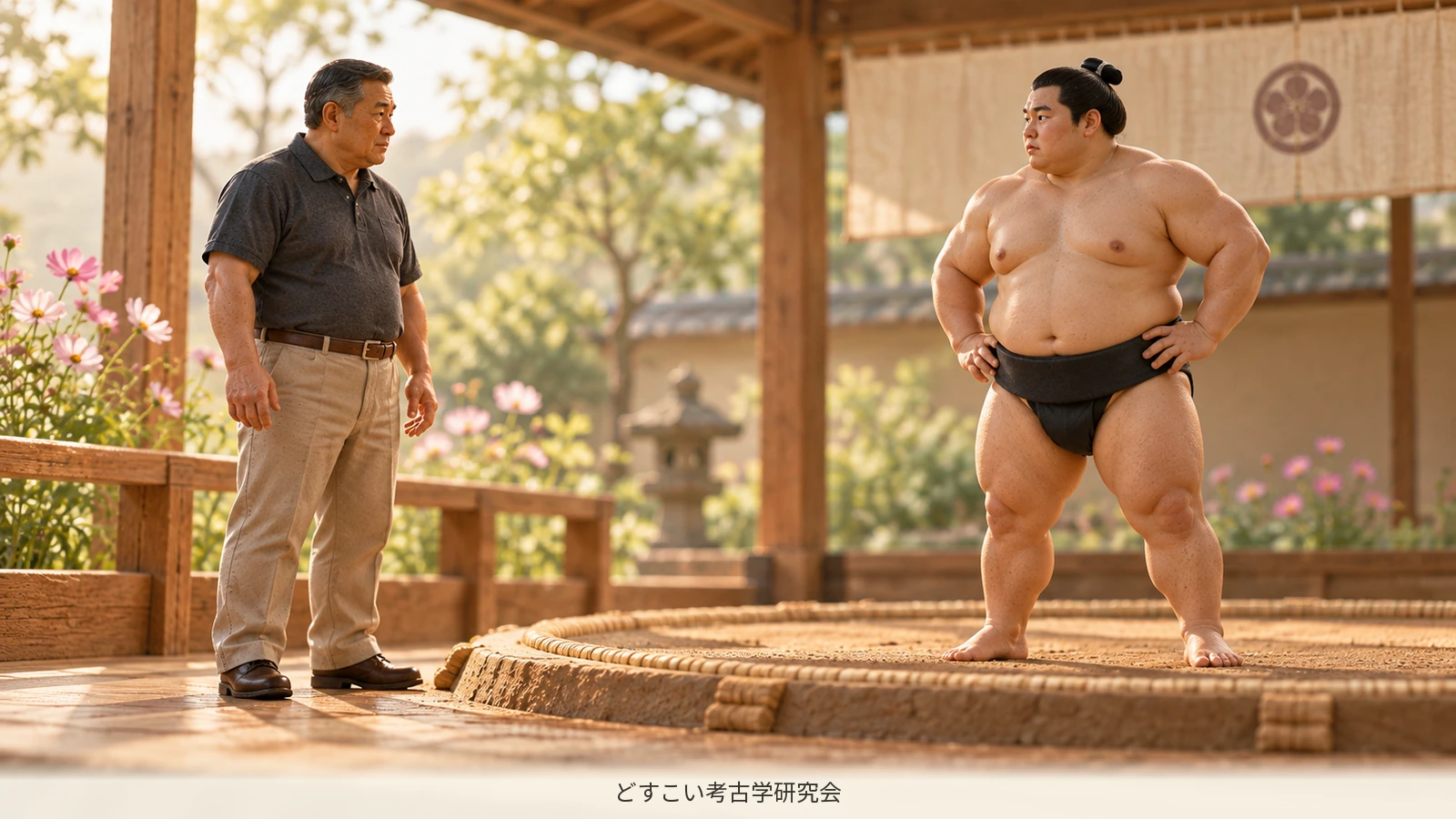
The Association’s current articles of incorporation define wakaimonogashira as members who supervise wrestler trainees in makushita and below and perform competition-related duties. Instruction and running of maezumo, initial-promotion arrangements and the shortened title kashira come from official explainers published in 2018 and 2025. Those dated accounts do not prove that every detail of present-day work is unchanged.
The dated official explainers place wakaimonogashira in maezumo instruction and progression. They do not reveal what a recruit knew or felt. Observe only externally checkable features—where groups wait, when names are called and how one group gives way to the next—without narrating uncertainty or reassurance as the recruit’s private experience.
The formal responsibility
The Association’s articles of incorporation establish wakaimonogashira as Association members. Their central responsibility is supervision of rikishi yoseiin—the official status for wrestlers ranked in makushita or below—along with other work related to sumo competition.
The literal components of the title can mislead an English reader into thinking it means “head of young people.” The boundary is not simply age. It is a role connected to lower-division wrestler trainees, some of whom may have spent many years in professional sumo.
Where the job becomes visible
Association explainers published in 2018 and 2025 identify maezumo instruction, support for recruits and shinjo arrangements as wakaimonogashira work. Those are dated descriptions. Beyond the supervision and competition-related duties in the current articles of incorporation, this article does not infer every present-day task or a guaranteed route onto a printed banzuke.
How maezumo and shinjo connect to first banzuke placement belongs in a separately sourced process guide. These role sources establish only that dated explainers described instruction and progression work. They do not establish that a recruit felt reassured, could concentrate, or regarded the moment in any particular way; private experience remains unknown without attributed words.
Former wrestlers in a new position
An official explainer published in 2018 said suitable people were hired after retiring as wrestlers who had reached juryo or makushita. Separately, the directory checked on 3 September 2026 lists former ring names, real names, highest ranks and stable affiliations. The dated hiring description is not treated as a complete current recruitment rule without a current governing source.
That description should not be shortened to “all were sekitori.” Makushita is explicitly included, and a makushita wrestler is not a sekitori. The official directory, rather than memory or fame, is the reliable way to check an individual career.
Not an elder and not an attendant
A wakaimonogashira is not an oyakata. Elders assume toshiyori names and have a different institutional status. Nor is this a tsukebito, an active lower-ranked wrestler assigned to support and learn from a sekitori. A wakaimonogashira has retired from active competition and has been hired into this Association role.
Like gyoji, yobidashi and tokoyama, wakaimonogashira retain stable affiliations. On some official stable pages, their names appear below the wrestler roster. That is a useful reminder that a heya is an organisation of more people than the athletes seen in bouts.
Watch the absence of confusion
You do not need to identify a particular official from a distant seat. During maezumo, watch the sequence instead: recruits gather, move to the proper place, compete and make way for the next group without having to negotiate the order in public.
Smoothness is easy to mistake for something that happens automatically. Here, it is evidence of experienced supervision. When you see a new wrestler’s tiny name on the next banzuke, remember that his first steps were guided by someone who once had a banzuke line of his own.
Return from a Label to the Next Observable Action
Do not reduce a person to body size, age, nationality, hometown, school or role title. Follow a hand position, task, bout sequence or official record in the next appearance instead. An attribute can start a question; it is not a conclusion about character, strength or future.
What One Bout Cannot Tell Us
One bout shows a movement sequence and an official result. Do not infer personality, emotion, injury, fatigue or the next strategy from a single moment. Record the visible cue in plain language, compare multiple days, and wait for an official announcement. Inner feelings remain unknown without the person’s attributed words.
Sources
- Japan Sumo Association, articles of incorporation, Article 51 (checked 2 September 2026)
- Japan Sumo Association, wakaimonogashira directory (checked 2 September 2026)
- Japan Sumo Association, Sumo Quiz No. 856 (published 13 May 2024; checked 2 September 2026)
- Japan Sumo Association, Sumo Quiz No. 1186 (published 8 April 2025; checked 2 September 2026)
Source links used for verification
Each link was used for the corresponding claim in this article; inclusion is not a blanket endorsement of the whole page.
Article verified:
- Japan Sumo Association articles of incorporationPrimary source (as checked for this article)
- Japan Sumo Association wakaimonogashira directoryPrimary source (as checked for this article)
- Japan Sumo Association Sumo Quiz No. 856Historical primary source (record from that period)
- Japan Sumo Association Sumo Quiz No. 1186Historical primary source (record from that period)