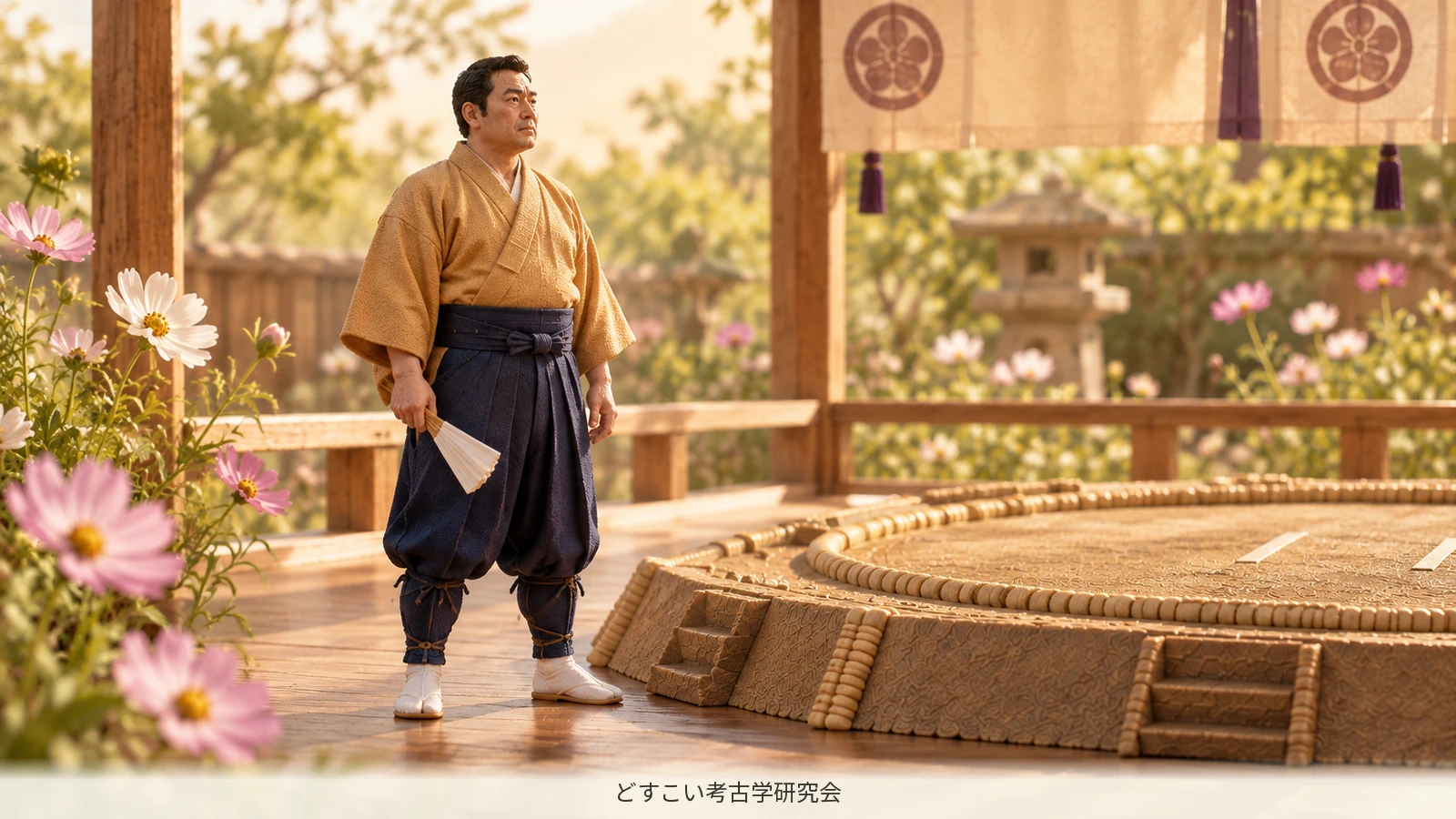
A yobidashi’s standard outfit consists of a kimono, tattsuke-bakama trousers, tabi socks and a fan. The Japan Sumo Association says these basic pieces do not change with professional rank, even though yobidashi themselves do have ranks. The easiest detail to find is below the voice: when the caller bends beside the ring, look for trousers that narrow closely around the lower leg. Those are the tattsuke-bakama.
Most first-time viewers find the white fan and the long, melodic call before they notice the caller’s clothes. Once you lower your eyes, the fitted trouser outline becomes another clue. The present source set directly supports calling order, attire, the plain fan and rank directory; duties such as cleaning, carrying equipment or ring preparation need a separate official duties source and are not inferred here from clothing.
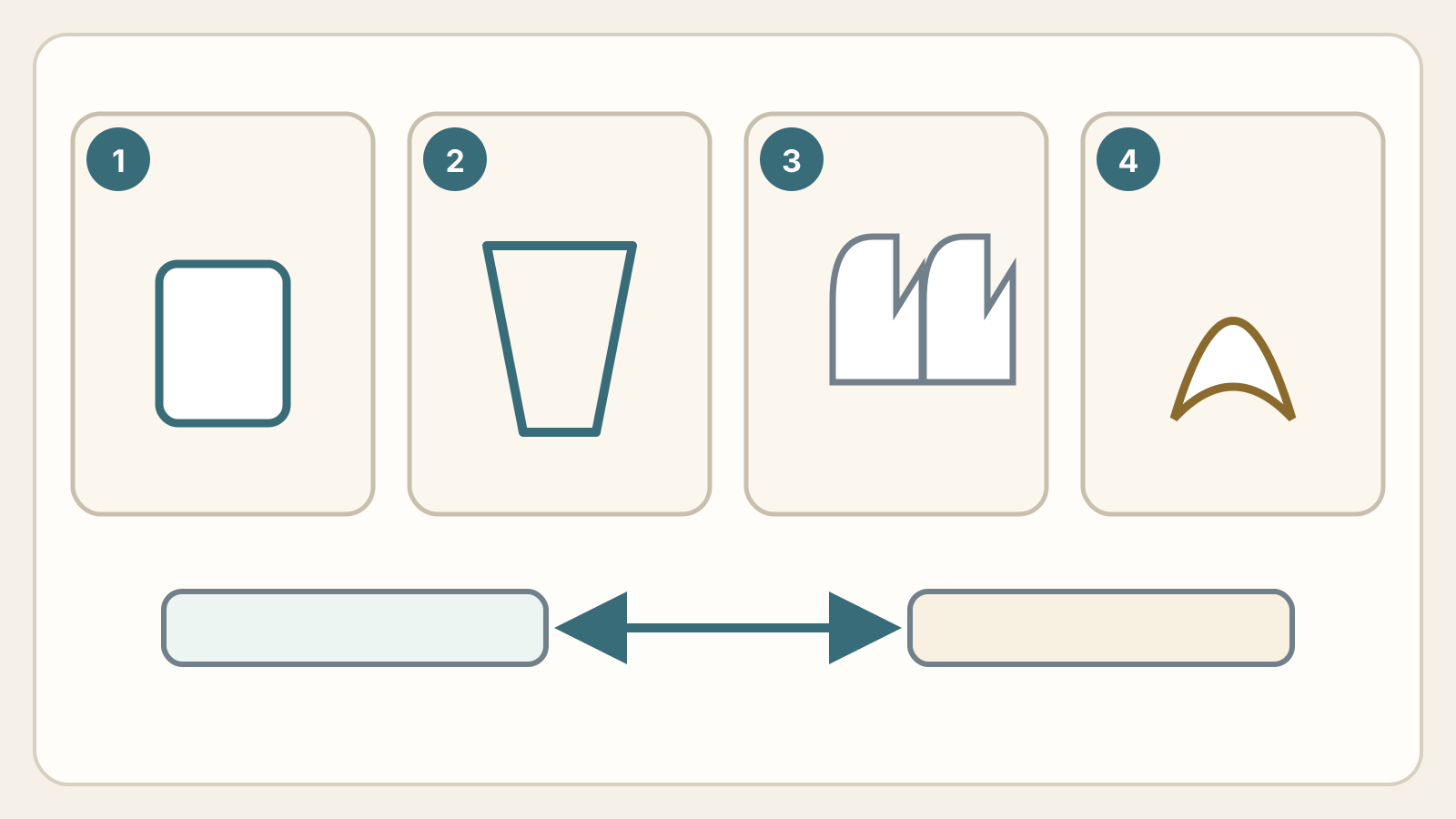
Detailed description of this diagram
The upper row contains four numbered category cards. Card 1 is a generic cloth block, card 2 uses converging lines only for the broad ankle-narrowing relation, card 3 has two abstract foot-category tokens, and card 4 has an unlettered fan-category token. Two anonymous rows below are joined by an equals sign to mean that the Association explainer lists the same basic component structure across ranks, not that individual garments are identical. No actual silhouette, pattern, colour, fabric, cut, seam, measurement, tabi construction, fan geometry, grip or person is reproduced.
Graphic: SUMO ARCHAEOLOGY CLUB · Figure source 1 · Figure source 2 · Figure source 3
Four pieces in the official description
The Association lists kimono, tattsuke-bakama, tabi and a fan. Tattsuke-bakama are a style of traditional trousers whose lower portion is fitted rather than left as a broad, open hem. From a distant seat, the narrowed outline around the calves can be easier to recognize than the pattern of the kimono.
Fine tailoring is difficult to establish from a distant seat. Start with the plain fan as the yobidashi clue and the gunbai as the gyoji clue; treat the fitted lower-leg outline only as a secondary observation affected by angle and obstruction. Do not reduce the person to clothing or assign a role or rank from dress alone; if it is unclear, leave the observation unresolved.
Same outfit structure does not mean “no ranks”
The Association’s current directory lists ranks such as tate-yobidashi, deputy tate-yobidashi, sanyaku-yobidashi and makuuchi-yobidashi. Yet its attire guide explicitly says that the outfit does not differ by rank.
A full comparison with rank-specific gyoji dress needs a separately cited gyoji source. The narrower point established here is that the Association’s directory gives yobidashi ranks while its attire explainer says the four basic components do not change by rank.
The white fan is not a cue card
The fan opened during the call is plain. The Association explains that the wrestler names are not written on it; holding it near the face is a gesture of care intended to avoid breathing directly onto or otherwise disrespecting the dohyo. The official article also describes it as a larger mai-ogi, a fan of the type used in Japanese dance.
It can look as though the caller is reading from the upper edge. Knowing that there is no script there changes the moment. The fan is not hiding uncertainty. It creates a small, deliberate boundary between the voice and the ring.
“Almost unchanged since Edo” needs a careful reading
The Association says the style has remained almost unchanged since the Edo period. That does not prove that every fabric, dye, cut and decorative motif has been identical for centuries. The solid claim is narrower: the four-part style described by the Association has a long continuity.
There is no need to inflate that statement into costume legend. The present-day motion is interesting enough. As the yobidashi crouches to work at the edge, the fitted lower legs become visible; moments later he opens the fan and sends a name through the arena.
One thing to watch next
Find the white fan first. As the second name fades, let your gaze drop to the tattsuke-bakama and tabi. When the gyoji enters, compare the shapes rather than trying to memorize ranks.
The profession’s full duties require sources beyond this attire set. Here we keep to what these four records establish about clothing, the fan and the rank directory, then use them only as clues for noticing whether the same caller appears again. If identity or rank is unclear, leave it unassigned; this article does not infer an individual’s assignment from appearance alone.
Sources
- Japan Sumo Association, Grand Sumo Quiz Nos. 1408, 840 and 1316; current yobidashi directory (accessed September 2, 2026)
Source links used for verification
Each link was used for the corresponding claim in this article; inclusion is not a blanket endorsement of the whole page.
Article verified:
- Japan Sumo Association Grand Sumo Quiz No.1408: yobidashi attirePrimary source (as checked for this article)
- Japan Sumo Association Grand Sumo Quiz No.840: the yobidashi's white fanHistorical primary source (record from that period)
- Japan Sumo Association Grand Sumo Quiz No.1316: order of the callsPrimary source (as checked for this article)
- Japan Sumo Association: current yobidashi directoryPrimary source (as checked for this article)