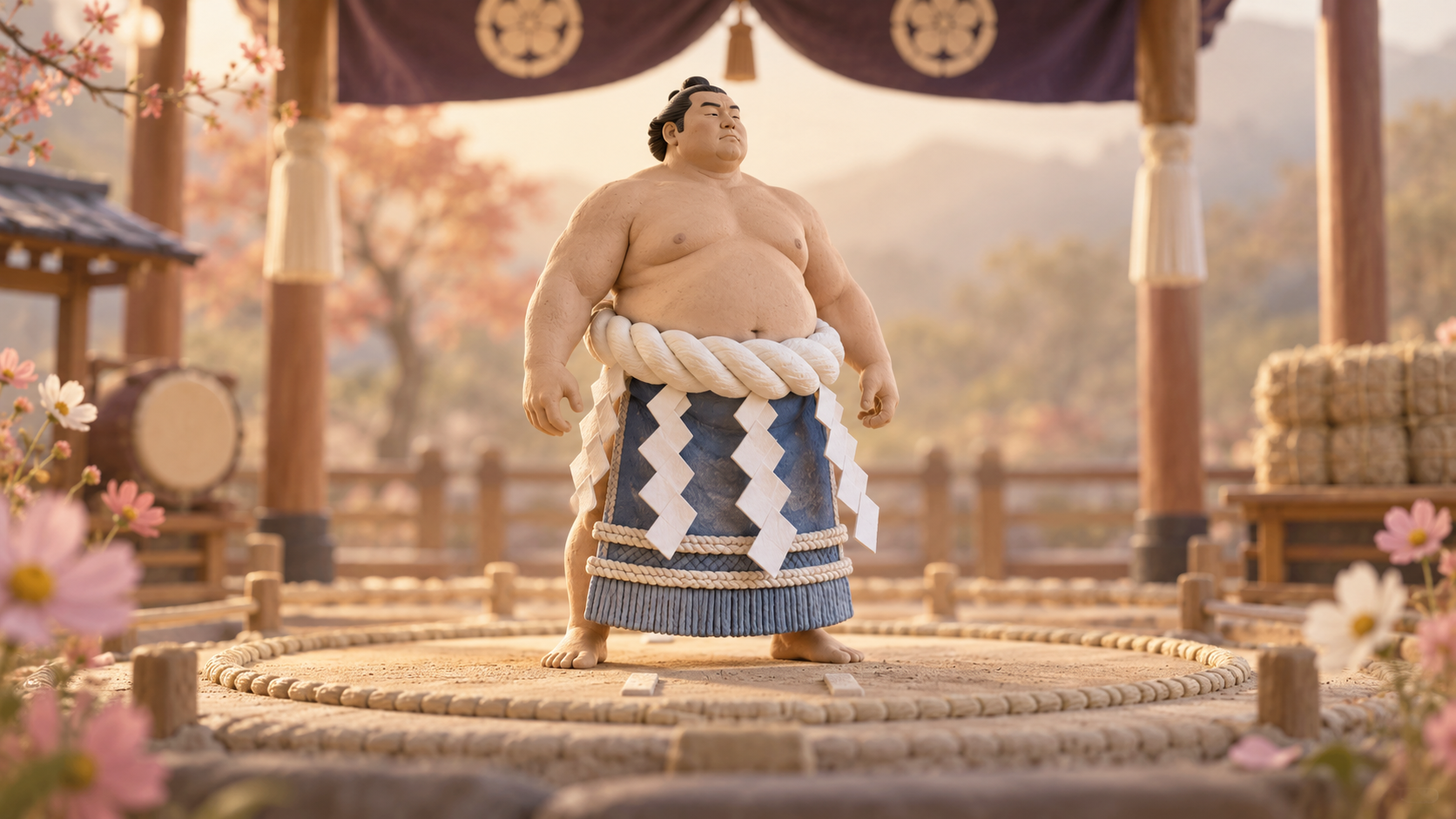
Yokozuna is the highest rank on the makuuchi banzuke, positioned above ozeki. At the arena, its difference becomes visible after the group makuuchi ring entrance: a yokozuna returns for a separate ceremony wearing the thick white rope that gives the rank its name. On your first viewing, forget trying to identify every style. Watch for the empty dohyo to be prepared for one wrestler and find the rope around his waist.
“The strongest wrestler” is a useful first approximation, but it does not explain why yokozuna feels unlike one more rung on a ladder. Historically, the word described permission for an ozeki to wear the rope and perform a special entrance before it developed into the top banzuke rank.
Yokozuna stands above ozeki
The official makuuchi order runs from yokozuna to ozeki, sekiwake, komusubi and maegashira. The September 2026 banzuke lists Onosato at East Yokozuna and Hoshoryu at West Yokozuna. Those names and sides are a dated snapshot, so a current article must check the next official banzuke rather than treating the cast as permanent.
The Japan Sumo Association’s terminology explainer says that ozeki, sekiwake and komusubi are ordinarily grouped as sanyaku, while yokozuna is now treated separately. That distinction is useful. Yokozuna is not merely “Ozeki Plus”; the rank carries its own historical path and visible ceremony.
The demotion point needs careful wording
You will often read that a yokozuna cannot be demoted and must retire when no longer able to meet the rank. The Association’s own historical explanation is more precise than a simple claim that there has always been a no-demotion rule.
Its quiz No.1149 says that the change making yokozuna the highest position was written down, but no provision was ever made about demoting—or not demoting—a yokozuna for results after promotion. The modern flow of not dropping the wrestler back down the banzuke, and retirement when he can no longer continue at the rank, grew from that history.
This matters because rules, conventions and expectations are not interchangeable. Words such as dignity or responsibility may be part of discussion around a yokozuna, but a fan’s aesthetic standard should not be presented as if it were a line in the cited regulation.
The separate entrance follows the makuuchi group
The Association explains that the makuuchi ring entrance is older and that the yokozuna ceremony developed as a more elaborate form of it. Its guide to *nakairi*, the interval before top-division bouts, says that the makuuchi and yokozuna ring entrances normally take place in that period.
That means the end of the group entrance is not necessarily the moment to leave your seat. The yokozuna appears separately, accompanied by attendants and wearing the rope. A different article can take you through the Unryu and Shiranui forms; you do not need those labels to appreciate your first ceremony.
Watch the dohyo become one person’s space
During the makuuchi entrance, names, colours and ceremonial aprons arrive in a circle. Then the ring clears and is reset around a single ranked figure. Watch only that transition. It turns an abstract line at the top of the banzuke into a change in the arena’s rhythm.
The rope is not just dramatic costume. Once you know the history, it is the old licence and the modern rank made visible at the same time. That is a small discovery capable of changing how the next entrance feels before the wrestler has taken a single competitive step.
Sources
- Japan Sumo Association, September 2026 banzuke and quizzes No.1149, No.1010 and No.1264 (verified 3 September 2026).
Source links used for verification
Each link was used for the corresponding claim in this article; inclusion is not a blanket endorsement of the whole page.
Article verified:
- Japan Sumo Association September 2026 banzukePrimary source (as checked for this article)
- Japan Sumo Association quiz No.1149: yokozuna as a rank and the demotion questionHistorical primary source (record from that period)
- Japan Sumo Association quiz No.1010: makuuchi and yokozuna ring entrancesHistorical primary source (record from that period)
- Japan Sumo Association quiz No.1264: the nakairi sequenceHistorical primary source (record from that period)