The *chonmage* is the compact topknot seen on lower-division wrestlers and on salaried wrestlers in training or daily life. The *oicho* is the formal topknot whose brushed end spreads like a ginkgo leaf; wrestlers ranked juryo and above must wear it when they compete. “Every sumo wrestler always wears the big fan-shaped style” is therefore wrong. At your next tournament, give the face a moment off and watch the back of one wrestler’s head as he steps toward the dohyo.
From a distant seat, black topknots can merge into one familiar symbol. Then you notice that one end is folded tightly while another opens into a glossy fan. Rank, occasion and an invisible specialist’s work have appeared in a silhouette.
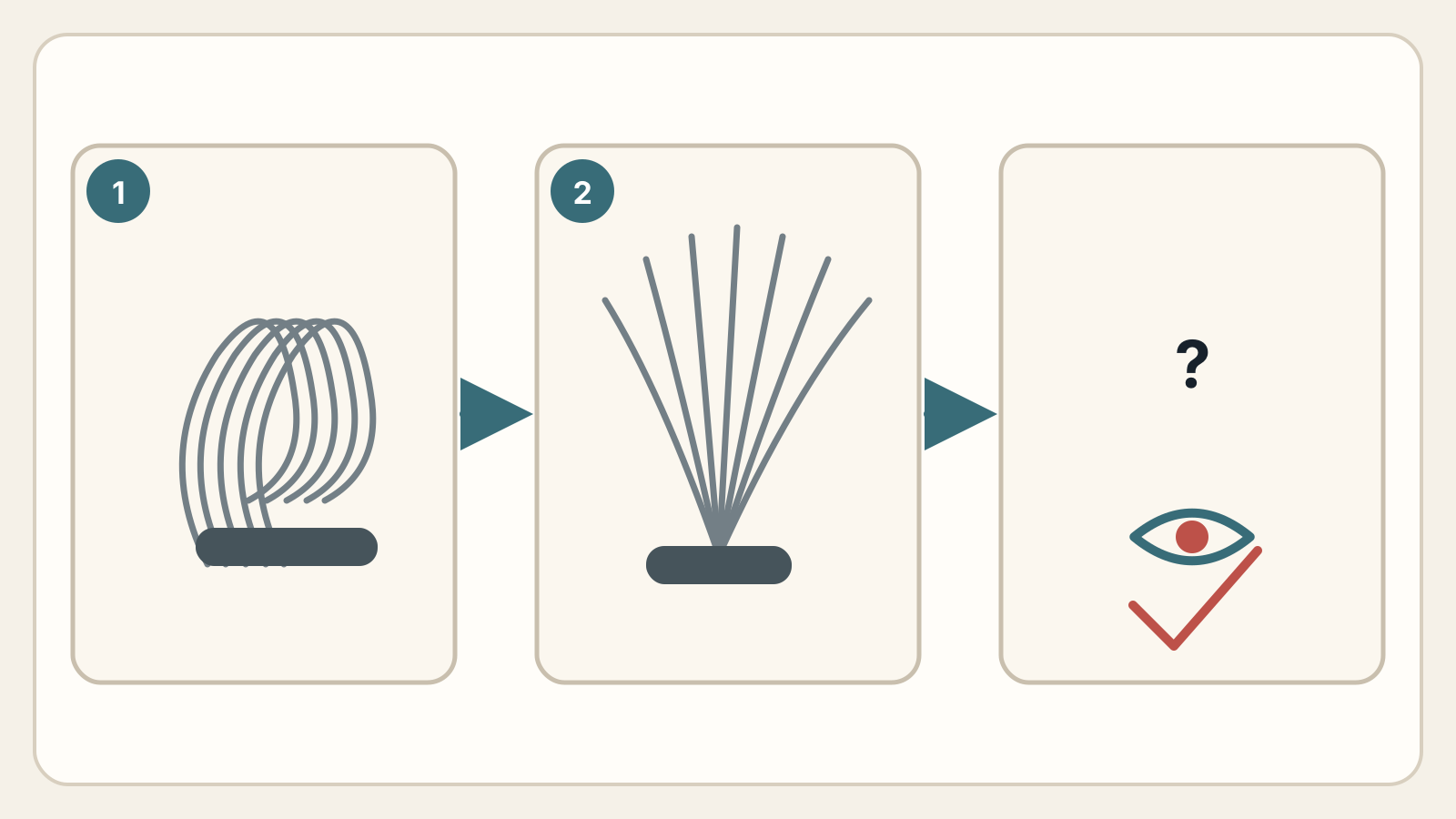
Detailed description of this diagram
The left card folds several abstract fibre curves into a compact bundle. The centre card spreads curves from one base into a broad fan, preserving only the official ginkgo-leaf comparison. The question mark and check in the right card say that oicho is a clue, not sufficient proof of current rank, because a makushita wrestler in a juryo bout and performers in certain ceremonial roles may also wear it. No head, face, hair texture, tying method, measurement, angle, identifiable person or historical hairstyle is depicted.
Graphic: SUMO ARCHAEOLOGY CLUB · Figure source 1 · Figure source 2
Look for the ginkgo-leaf fan
The Japan Sumo Association says the hairstyle is named *oicho* because the brushed end resting on the top of the head resembles a ginkgo leaf. The outline is often easiest to see from behind or at an angle: the end spreads broadly to either side instead of remaining a small folded knot.
Association rules require wrestlers qualified at juryo or above to wear the oicho when appearing in competition. Promotion from makushita to juryo changes far more than salary and the number of bouts. It changes the hair with which a wrestler walks onto the tournament dohyo.
Yet a salaried wrestler does not live in oicho permanently. The Association says he normally wears a chonmage in practice and ordinary life. At a regional tour, the morning practice session and the afternoon ring-entry programme can reveal both forms on the same person in one day.
A lower-division wrestler can still appear in oicho
The basic shortcut is sound: oicho for juryo and above, chonmage for makushita and below. But a shortcut becomes more interesting when you learn its exceptions.
If absences or late-tournament scheduling place a makushita wrestler in a juryo bout, the Association says he wears an oicho as a mark of respect for the higher-level contest. His equipment does not fully change with the hair: he retains the cotton practice mawashi and the softer cotton sagari used below juryo. The hairstyle has stepped over the boundary for one bout while the belt has not.
Wrestlers performing the bow-twirling ceremony or comic demonstration bouts may also wear oicho. Therefore, a fan-shaped topknot is not sufficient proof of a wrestler’s current rank by itself. It is a clue. Ask what role he is performing today.
A tokoyama made the shape
Specialist sumo hairdressers are called *tokoyama*. The Sumo Association lists them as members in their own right, with professional names, grades and stable affiliations. This is not a hairstyle every wrestler simply assembles alone in front of a mirror. Our separate tokoyama guide follows their grades and tools in depth; this comparison stays with what a newcomer can identify from the seats.
The Association’s explainer says mastering the oicho is said to take more than ten years and that even a skilled tokoyama may require twenty to thirty minutes for one wrestler. Those are presented as craft estimates, not a timed specification applying identically to every head. They still change the way the result looks: the few seconds you see at ringside may contain half an hour of someone else’s hands.
Old prints do not obey today’s two-style shortcut
Do not project the modern distinction uncritically onto an Edo-period woodblock print. The Association’s historical account says wrestlers once wore several hairstyles shaped by the customs and fashions of their period. It places the oicho’s rise in popularity around the late Edo period and says it became a standard wrestler’s style around the middle of the Meiji era.
The same account says that when the 1871 ordinance encouraged cutting topknots and abandoning swords, sumo was permitted to retain tied hair as part of wrestler custom. Today, it says, tokoyama are taught the two forms: oicho for the salaried ranks and chonmage below them. This is an official institutional summary; it does not establish a single named inventor of the hairstyle, and this guide does not invent one.
One thing to watch next time
During juryo ring entry, follow one head from behind and find the fan where the hair opens. Later, compare it with a makushita bout. If a makushita wrestler meets a juryo opponent, check whether his hair and belt seem to tell slightly different rank stories.
The topknot does not score points. Yet it quietly carries information about how far a wrestler has climbed, what duty he has today and whose trained hands prepared him. Once you spot the ginkgo leaf, the walk toward the dohyo becomes part of the performance rather than dead time before it.
Sources
- Japan Sumo Association, Sumo Quiz No. 344 on the oicho and competition rule, published 18 December 2022 (checked 2 September 2026)
- Japan Sumo Association, Sumo Quiz No. 813 on changing topknot customs, published 31 March 2024 (checked 2 September 2026)
- Japan Sumo Association, Sumo Quiz No. 864 on a makushita wrestler entering a juryo bout, published 21 May 2024 (checked 2 September 2026)
- Japan Sumo Association, Sumo Quiz No. 17 on changes at juryo promotion, published 25 January 2022 (checked 2 September 2026)
- Japan Sumo Association, official directory of tokoyama hairdressers (checked 2 September 2026)
Source links used for verification
Each link was used for the corresponding claim in this article; inclusion is not a blanket endorsement of the whole page.
Article verified:
- Japan Sumo Association Sumo Quiz No. 344: the oichoPrimary source (as checked for this article)
- Japan Sumo Association Sumo Quiz No. 813: history of wrestlers' topknotsHistorical primary source (record from that period)
- Japan Sumo Association Sumo Quiz No. 864: a makushita wrestler facing juryoPrimary source (as checked for this article)
- Japan Sumo Association Sumo Quiz No. 17: changes upon promotion to juryoPrimary source (as checked for this article)
- Japan Sumo Association directory of tokoyama hairdressersPrimary source (as checked for this article)