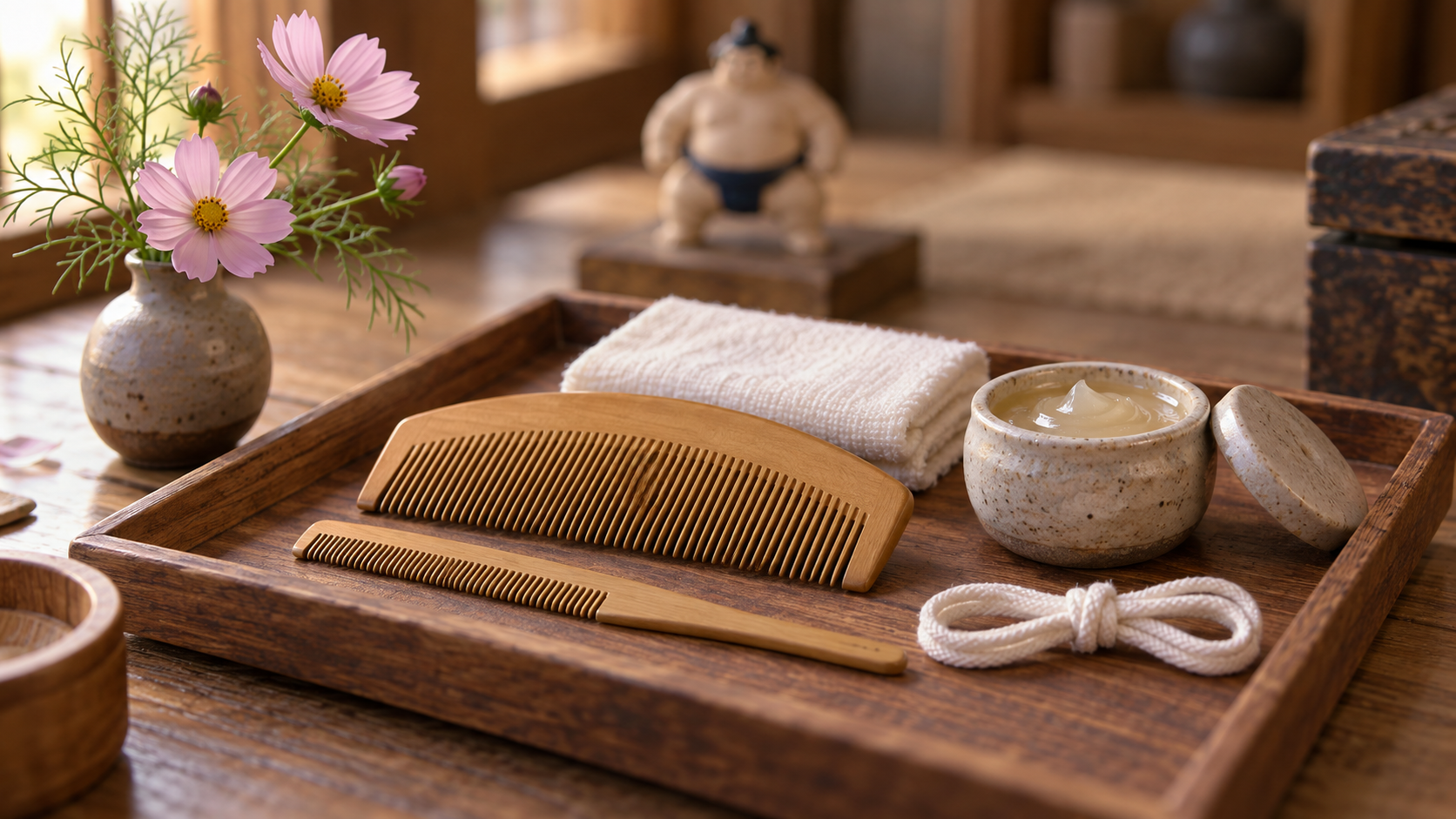
A tokoyama is a specialist hairdresser employed within the Japan Sumo Association to style wrestlers’ topknots. A sekitori in juryo or makuuchi wears the broad, ginkgo-leaf-shaped oicho for official tournament appearances. The silhouette moving in a ring-entering ceremony is not the wrestler’s work alone; it carries years of a craftsperson’s training.
Bouts naturally pull the eye toward hands, feet and faces. But when a wrestler turns during the dohyo-iri, the oicho’s balanced wings briefly become the clearest shape in the arena. Learn that one outline and sumo begins before the first tachiai.
Separate the current directory from dated explainers
The source that directly describes the current roster is the Japan Sumo Association’s tokoyama directory, checked on 2 September 2026. It supports only the professional names, real names, grades and stable affiliations displayed at that check.
The statements about who wears an oicho, the documented exceptions, the magebo and years of training come from four Association explainers published between 18 December 2022 and 16 May 2025. This article treats them as dated explanations, not proof that every rule and practice remained unchanged in September 2026, applies at every venue and role, or will remain fixed. Check the latest official banzuke for current rank and the day’s official bout or ceremony information for a current role. The selected sources do not form a complete change log of every governing rule.
Tokoyama are Association specialists
The Japan Sumo Association publishes an official directory of tokoyama showing their professional names, real names, grades and stable affiliations, from fifth class to the highest special class. The directory presents them as Association members rather than a list of outside salon stylists hired only for tournament days. It does not establish each person’s daily assignment or schedule.
Association explainers describe the everyday chonmage and ceremonial oicho as tokoyama work; this article does not generalise about what an individual wrestler can adjust himself. Assignments and grades can change, so use the current Association directory to identify a hairdresser and leave the name or assignment unresolved when appearance is the only clue.
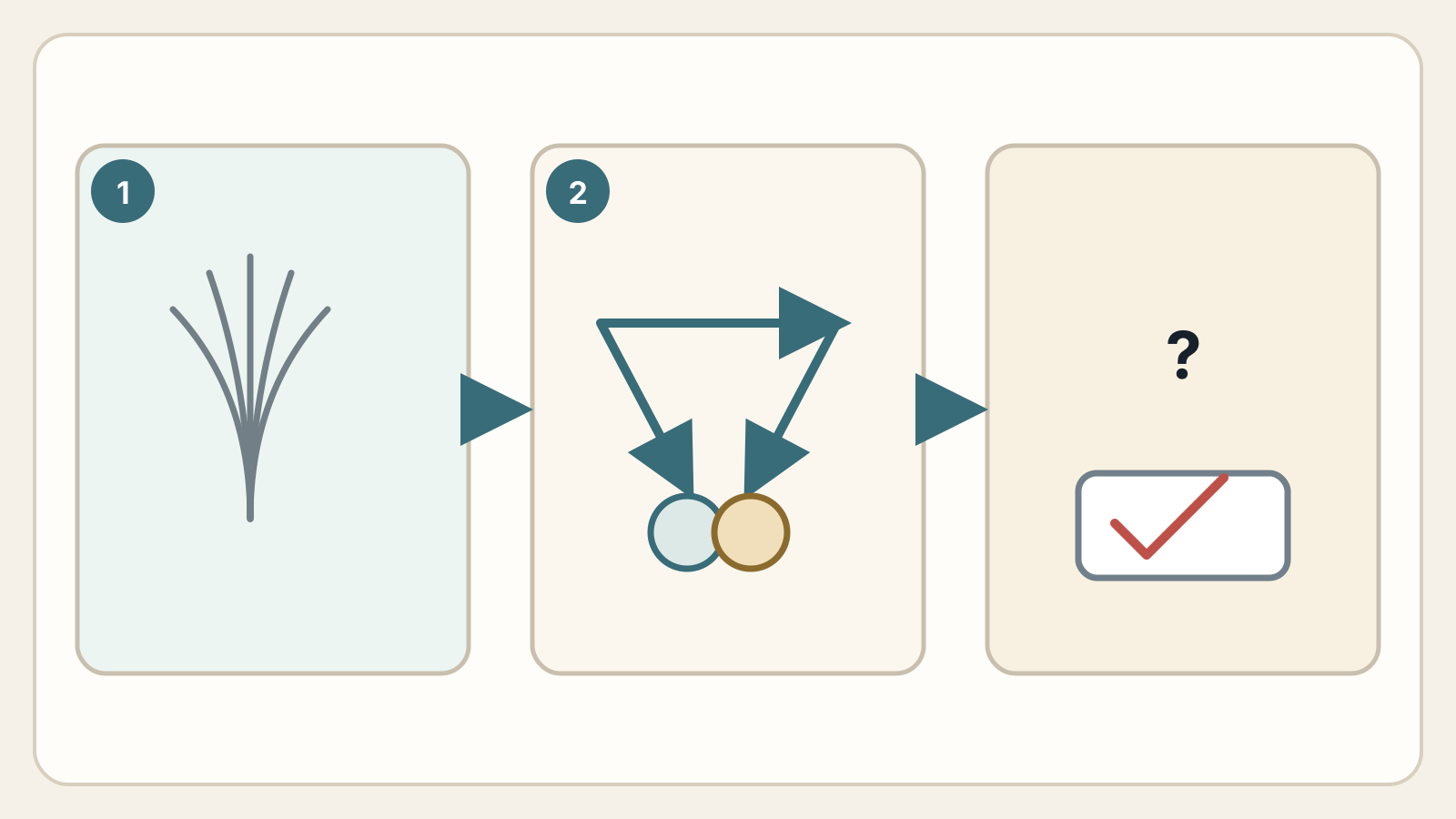
Detailed description of this diagram
The left card uses a fan of plain lines only for the official ginkgo-leaf comparison. The middle card branches to an exception token, and the right card pairs a question mark with a check. The flow separates what Association pages published from 2022 through 2025 said about ordinary sekitori use from their documented cases involving a makushita wrestler in a juryo bout and certain ceremonial roles. It then requires a current official banzuke and same-day bout or role check. The fibre fan is not a head, hairstyle facsimile or rank proof. No dimensions, angles, hair texture, identifiable person, tying procedure, magebo design or training duration is drawn.
Graphic: SUMO ARCHAEOLOGY CLUB · Figure source 1 · Figure source 2 · Figure source 3 · Figure source 4
Who wears the oicho?
The name refers to the end of the topknot spreading like a ginkgo leaf. Association explanations state that wrestlers qualified as sekitori—those in juryo and makuuchi—must wear the oicho when appearing in tournament competition. In practice and ordinary daily life, a sekitori normally wears the simpler chonmage.
There are useful exceptions to the rank rule. A makushita wrestler called up for a bout in the juryo schedule wears an oicho as a sign of respect for the higher division. Wrestlers performing the bow-twirling ceremony or comic demonstration bouts may also wear it. Hair alone therefore cannot prove someone’s current rank.
There is no formal minimum tokoyama grade
An official Association feature says there is no rule requiring a tokoyama to reach a particular grade before tying an oicho. That does not make the style easy. It takes years to learn the form and longer to reproduce it efficiently for many wrestlers on a tour.
Two Association features use different shorthand estimates: one says it takes roughly five years before a tokoyama can tie the style, while another says mastering the technique takes more than ten years. Those statements may distinguish basic capability from mastery, but the pages do not formally define the two milestones and cannot establish that interpretation. We preserve the honest conclusion—this is a multi-year craft—rather than forcing the estimates into one false precision.
A handmade tool creates the spread
To expand and shape the hair above and behind the ears, a tokoyama uses a steel rod called a magebo. The Association says it is not commercially available: hairdressers adapt a tatami needle to make their own. The tool behind the finished silhouette is itself a piece of personal craft.
The section folded onto the crown is called the otabusa. You do not need to remember that vocabulary during a first visit. Look once for the two broad sides of the “leaf,” especially when the line of wrestlers turns during a ring entrance.
A topknot records the force of a bout
An oicho may loosen during fierce contact. That is not evidence that the morning’s work was careless. It can look like a physical record: a precisely constructed form absorbing the same throws, grips and collisions as the wrestler beneath it.
Notice the clean outline in the dohyo-iri, then see how it moves in competition. Once the craft becomes visible, a wrestler’s back is no longer an empty view between front-facing moments. Someone else’s trained hands are present there—and affection for sumo can begin with that unexpected detail.
Sources
- Japan Sumo Association, tokoyama directory (checked 2 September 2026)
- Japan Sumo Association, Sumo Quiz No. 1224 (published 16 May 2025; checked 2 September 2026)
- Japan Sumo Association, Sumo Quiz No. 344 (published 18 December 2022; checked 2 September 2026)
- Japan Sumo Association, Sumo Quiz No. 813 (published 31 March 2024; checked 2 September 2026)
- Japan Sumo Association, Sumo Quiz No. 1156 (published 9 March 2025; checked 2 September 2026)
Source links used for verification
Each link was used for the corresponding claim in this article; inclusion is not a blanket endorsement of the whole page.
Article verified:
- Japan Sumo Association tokoyama directoryPrimary source (as checked for this article)
- Japan Sumo Association Sumo Quiz No. 1224Historical primary source (record from that period)
- Japan Sumo Association Sumo Quiz No. 344Historical primary source (record from that period)
- Japan Sumo Association Sumo Quiz No. 813Historical primary source (record from that period)
- Japan Sumo Association Sumo Quiz No. 1156Historical primary source (record from that period)