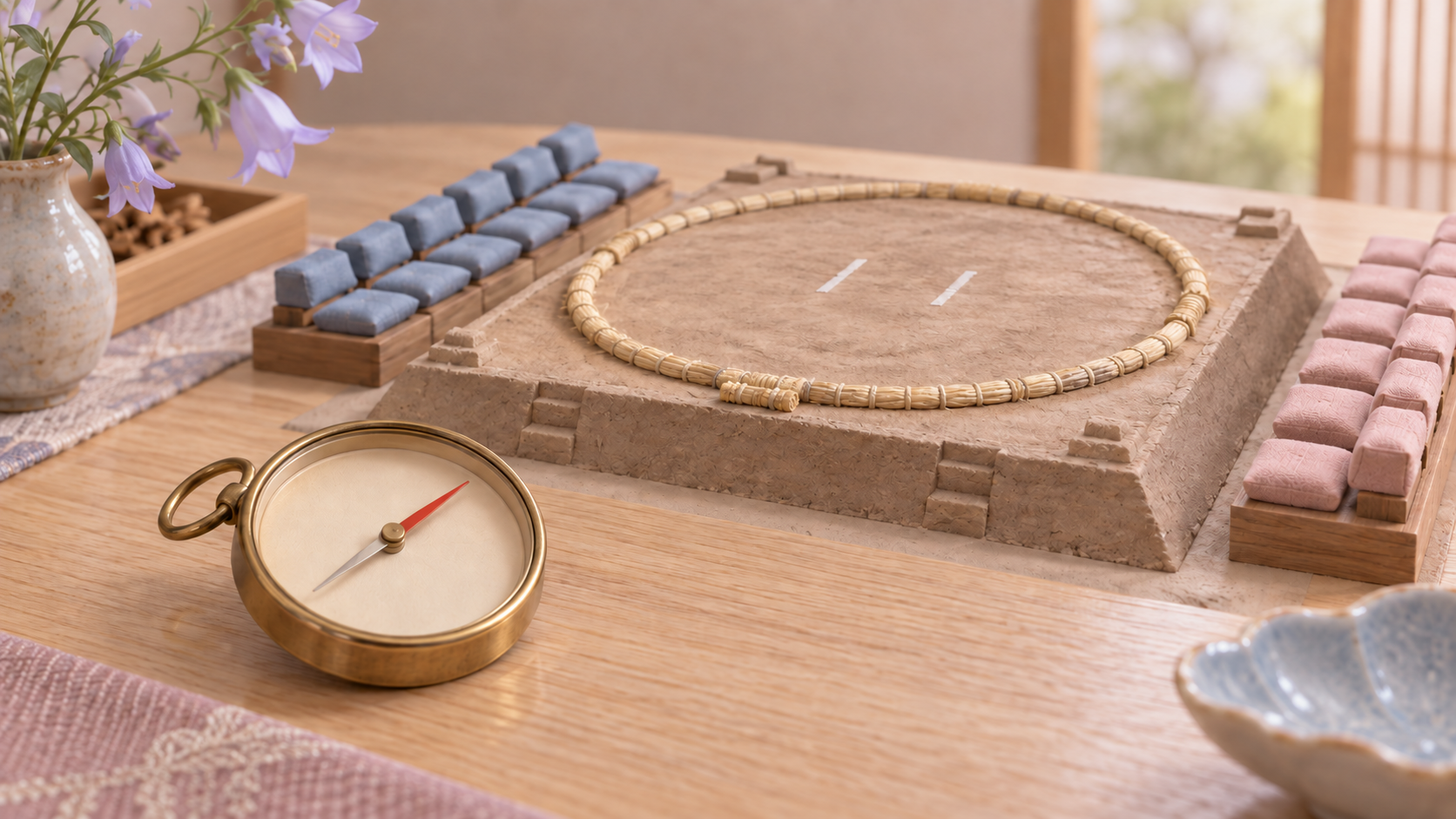
“East” at a sumo ring does not have to point towards geographical east. The Japan Sumo Association defines the dohyo sides from the arena’s front: East is on the left and West on the right. Because the physical direction faced by the front differs between venues, the compass bearing differs too. You do not need to rotate a map to identify a wrestler’s side; find the official front first.
An East wrestler may appear to enter from what looks like the right of a television screen. Your seat may be north of the dohyo even though its section is labelled East. Nothing is broken. Sumo’s labels describe positions in an arena convention, not the route of sunrise across the city.
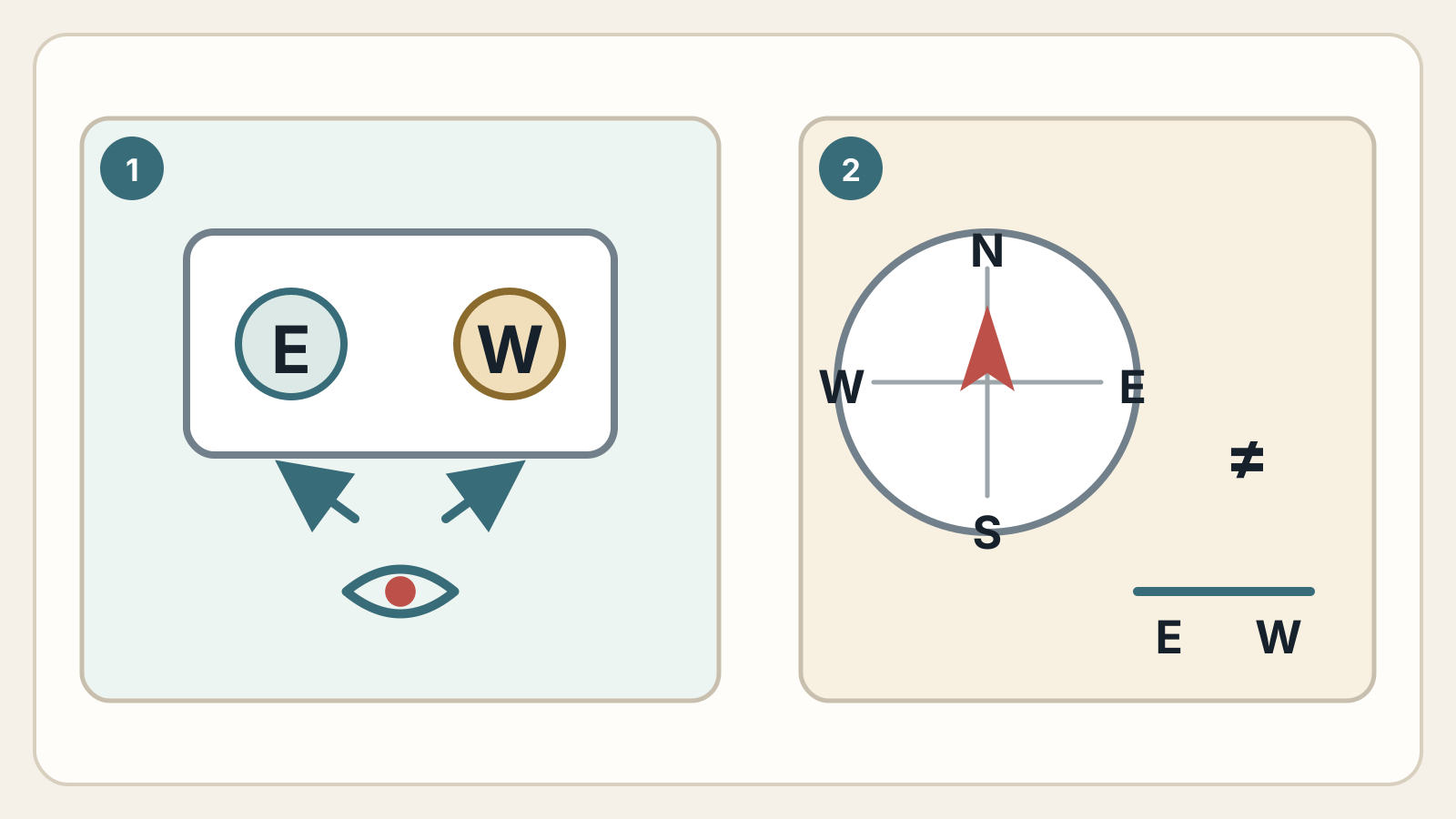
Detailed description of this diagram
The left card places an eye below an abstract viewing frame, with E on the frame's left and W on its right. The frame is not a ring or seating plan; it carries only the official-front left/right relation. The right card places N, E, S and W around a generic compass and a not-equal sign beside a separate E/W baseline, warning that the coordinate systems are distinct. No current venue bearing, building, hanamichi, entrance, seat, route, sunlight, camera position or permanent screen side is encoded.
Graphic: SUMO ARCHAEOLOGY CLUB · Figure source 1 · Figure source 2
Left and right only from the front
The Association’s quiz No.703 states that, viewed from the front, East is left and West is right. The words “from the front” matter. A camera can show the action from the opposite side, from East or West, or from an angle. Screen-left is therefore not a permanent synonym for East.
When the shot changes, do not force an instant answer. Ask whether you are looking from the front or from the opposite side. That one pause prevents a camera cut from making the wrestlers seem to exchange sides.
The venue’s compass is a separate system
The official page gives revealing examples as of its December 2023 publication. The East side at Ryogoku Kokugikan points geographically north; the examples for Osaka and Nagoya point east and north respectively; Fukuoka Kokusai Center’s points southwest. Venue names or arrangements should be rechecked when they change, but the principle is durable: the front establishes sumo East and West, so the compass result can differ by building.
This also means that an “East seat” should not be interpreted as being near a railway station’s east exit or receiving morning sun. Use the official seat map and access information for travel decisions.
Banzuke East is related but not identical
On the banzuke, East has precedence over West when two wrestlers share the same rank and numbered slot. That is a ranking relationship. Around the dohyo, East and West identify the sides from which the competitors appear and are called.
Keep three layers separate:
- Compass east and west: geography.
- Dohyo East and West: left and right from the official front.
- Banzuke East and West: precedence within the same rank and number.
One word can serve all three, but the question being answered is different each time.
Let one wrestler draw the map
The four coloured tassels hanging above the ring also correspond to directions and can help orient a spectator. They may be hard to see in some seats or shots, so they should be a clue rather than your only proof.
The easiest exercise is to listen when the yobidashi calls the East or West wrestler and follow only that competitor. Watch which hanamichi he uses and where he returns after the bout. An abstract label becomes a path through the building.
On the next broadcast camera cut, resist the urge to make East equal screen-left. Find the viewpoint first. Once you understand East and West as an agreement about perspective, the same dohyo becomes more interesting because every angle reveals a different face.
Sources
- Japan Sumo Association quizzes No.703 and No.1316 (verified 3 September 2026).
Source links used for verification
Each link was used for the corresponding claim in this article; inclusion is not a blanket endorsement of the whole page.
Article verified:
- Japan Sumo Association quiz No.703: dohyo East-West and compass directionHistorical primary source (record from that period)
- Japan Sumo Association quiz No.1316: East-West calling orderHistorical primary source (record from that period)