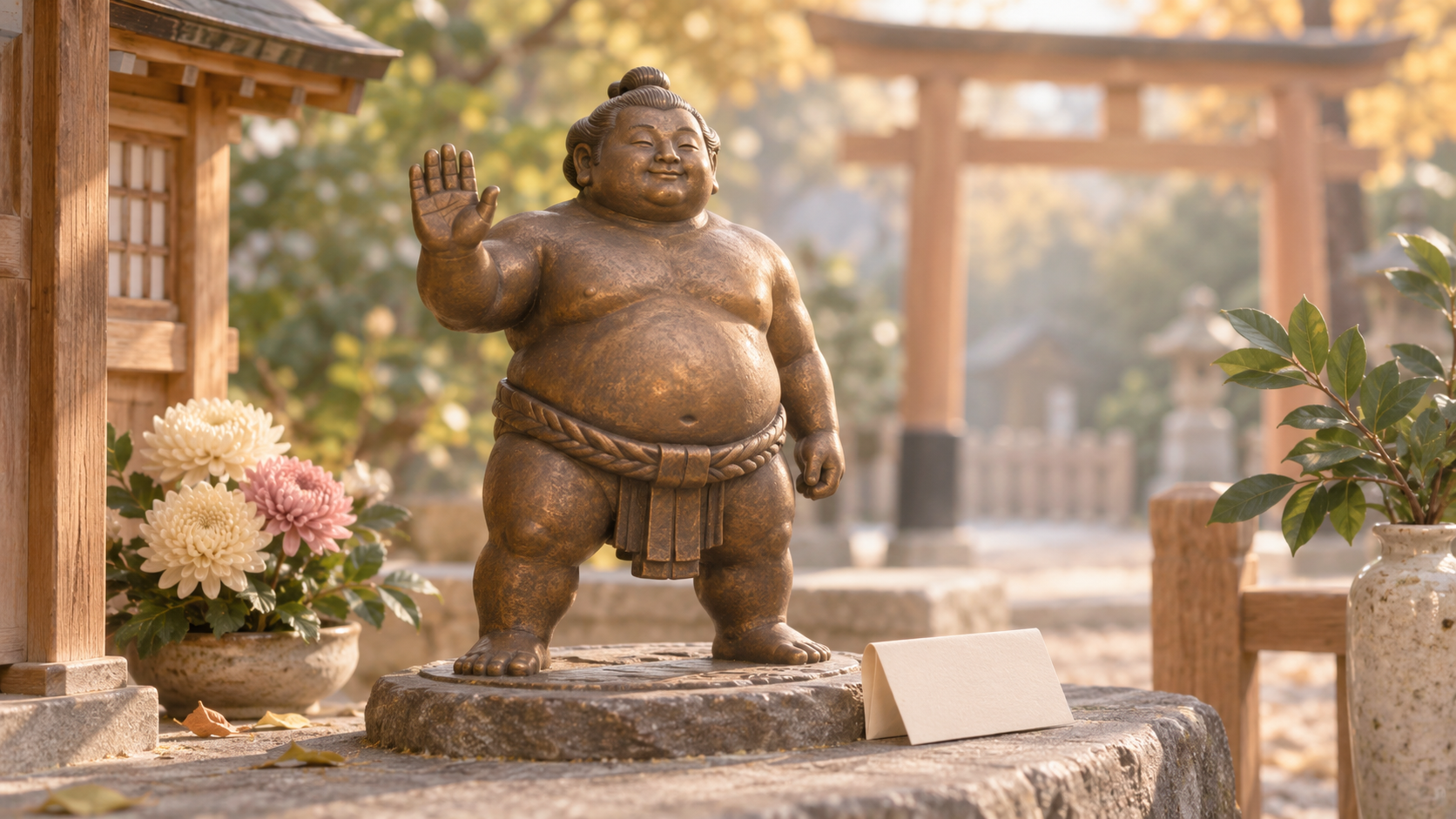
Sumiyoshi Shrine is a good single stop for a sumo visitor already staying around Hakata Station. The shrine’s official directions give an approximately eight-minute walk from JR/subway Hakata Station or two minutes from the Nishitetsu “Sumiyoshi” bus stop. They do not give a travel time from Fukuoka Kokusai Center, so calculate that complete journey live. Leave your large luggage at the hotel, look for one detail on the ancient wrestler statue, and treat worship—not sightseeing—as the first purpose of the grounds.
The delightful surprise is documented by the shrine itself: its grounds guide lists both an “ancient wrestler statue” and a sumo ring. The statue was made by Hakata doll artists Nakamura Shinkyo and his son Hoho. The shrine says the lines on its right palm resemble the character for strength, and tradition holds that touching the hand brings strength.
Keep the verified connection small
The official guide confirms the statue and ring. It does not, on the pages checked, date the statue, publish current use of the ring, or connect either one to the November professional tournament. That boundary matters. This article does not turn the shrine into “the origin of the Fukuoka basho,” nor promise that professional wrestlers will visit.
Other documented features include the main sanctuary, rebuilt in 1623 with support from Kuroda Nagamasa and designated an Important Cultural Property, and a Noh theatre designated by the city. You do not need to tour every structure. Worship at the main sanctuary, notice the wrestler’s hand, and stop while the visit still feels calm.
What the official hours and price do—and do not—say
The shrine’s site publishes reception hours of 9:00 a.m.–5:00 p.m. It does not label those hours as the universal opening and closing time for ordinary worship. The pages checked also do not publish a general grounds admission fee. Neither absence proves that prayers, amulets, shrine stamps or special ceremonies are free or continuously available.
Recheck ceremony notices, access and reception on November 1 and the visit date. If your sumo plan begins with the lower divisions, do not add the shrine simply because it looks close to the hotel. On departure day, work backwards from the train or flight and let transport win.
A suitcase changes the plan completely
The shrine’s official rules prohibit rolling suitcases along the stone approach to protect it. They also prohibit leaving brought items, including luggage or cameras, unattended on the grounds. Store substantial bags at a hotel, station or airport facility whose limits you have verified before setting out.
Eating is prohibited around the main sanctuary. Photography inside it is generally prohibited, and visitors are told to switch off phones there. Personal photography elsewhere may be allowed, but the shrine asks visitors to respect worshippers and gives specific guidance about photographing the sanctuary. The statue is never a reason to block a path or turn a sacred site into a photo set.
From one stone hand to the hands before impact
At the statue, look once at the lines said to form the character for strength. At the arena, shift attention from overall size to the wrestlers’ hands during the final preparations. Where do they settle before the opening charge? What changes just before contact?
This is an observation game, not a claim that the statue explains the modern start. Its value is smaller and more personal: one hand in a shrine teaches you to look more closely at two hands in the ring. A new interest in sumo can begin with a single carved line.
If indoor history and crafts fit your group better, use the Hakata Machiya Folk Museum guide. If a same-day departure leaves little margin, prioritise the post-sumo return plan. Sumiyoshi is a worthwhile stop only when time, luggage and respectful attention are all available.
Do Not Name a Technique from One Frozen Pose
We compare the shrine’s own description with multiple available views and the Japan Sumo Association’s technique definitions; one photograph is not enough. If no source identifies a particular bout, the sculptor’s chosen instant or a religious meaning, those points remain unknown. Hand and foot positions may suggest a technique, but that is a low-confidence inference with error from camera angle, sculptural simplification and missing artist documentation. The article therefore presents what makes one reading tempting and what contradicts it, without turning either into a fact. If the evidence cannot be resolved, the fallback is to keep it as an observation question rather than claim an origin story.
Evidence limits and event-day fallback
Confirmed fact: The shrine publishes access, the ancient-wrestler statue/ring, reception hours and worship rules for luggage and photography. Reception hours do not establish every grounds opening or every charge.
What remains unknown: Visit-date events/restrictions, access to each area, prayer/amulet/shrine-stamp reception and charges, crowds, steps, storage and the statue’s technique/intent remain unconfirmed.
Reasoned inference: A pose can invite a technique hypothesis, but one frozen view has camera-angle and sculptural-simplification error. Confidence is low; it is neither history nor religious meaning.
Editorial suggestion: Leave large luggage at confirmed hotel/station storage, follow worshippers and current signs, and inspect one detail. This is not the shrine’s official worship sequence.
Fallback: If an event, closure, luggage, photography or bodily condition fails, do not pursue the statue or an unverified route; shorten or remove the detour and return to arena/accommodation.
Sources
- Sumiyoshi Shrine official access guide, grounds guide and worship rules; checked September 2, 2026.
Source links used for verification
Each link was used for the corresponding claim in this article; inclusion is not a blanket endorsement of the whole page.
Article verified:
- Sumiyoshi Shrine official access guidePrimary source (as checked for this article)
- Sumiyoshi Shrine official grounds guidePrimary source (as checked for this article)
- Sumiyoshi Shrine official worship rulesPrimary source (as checked for this article)