Turn the restroom symbol into a current route before the need is urgent.
If you need an accessible multipurpose restroom, ask an attendant for three things when you enter: the route from your actual seat with the fewest barriers, a second option if the nearest room is occupied, and one clear landmark for the return. The official Kokugikan map includes accessible-restroom symbols, but the file now available is labelled for the May 2026 tournament. It is orientation, not a promise about September operations.
This guide is deliberately different from a floor-map inventory. Its purpose is to turn a general symbol into a usable personal route without requiring a long explanation at the gate.
Separate “mapped” from “available today”
The Japan Sumo Association floor plan marks men’s and women’s toilets, accessible multipurpose restrooms, lifts and stairs. That is primary evidence that these facility types have been mapped inside Kokugikan.
The date on the document still matters. A May tournament plan cannot establish which door, lift or controlled passage will be operating in exactly the same way during the September tournament. Temporary restrictions and event staffing are day-specific. Use the diagram to prepare your question, then let an attendant update it with current information.
A short request that carries useful detail
Show your seat number and ask:
“Could you show me the route with the fewest steps to an accessible restroom, and the next option if that one is busy?”
Add only the details that affect the route: whether you use a manual or powered wheelchair, a walking aid, need to avoid stairs, or cannot cover a long distance. Japan’s Ministry of Health advises disabled visitors planning an outing to identify accessible restrooms and lifts, and to check the location of a medical room at a sports venue. That is national planning guidance; it is not evidence that a particular Kokugikan room will be open.
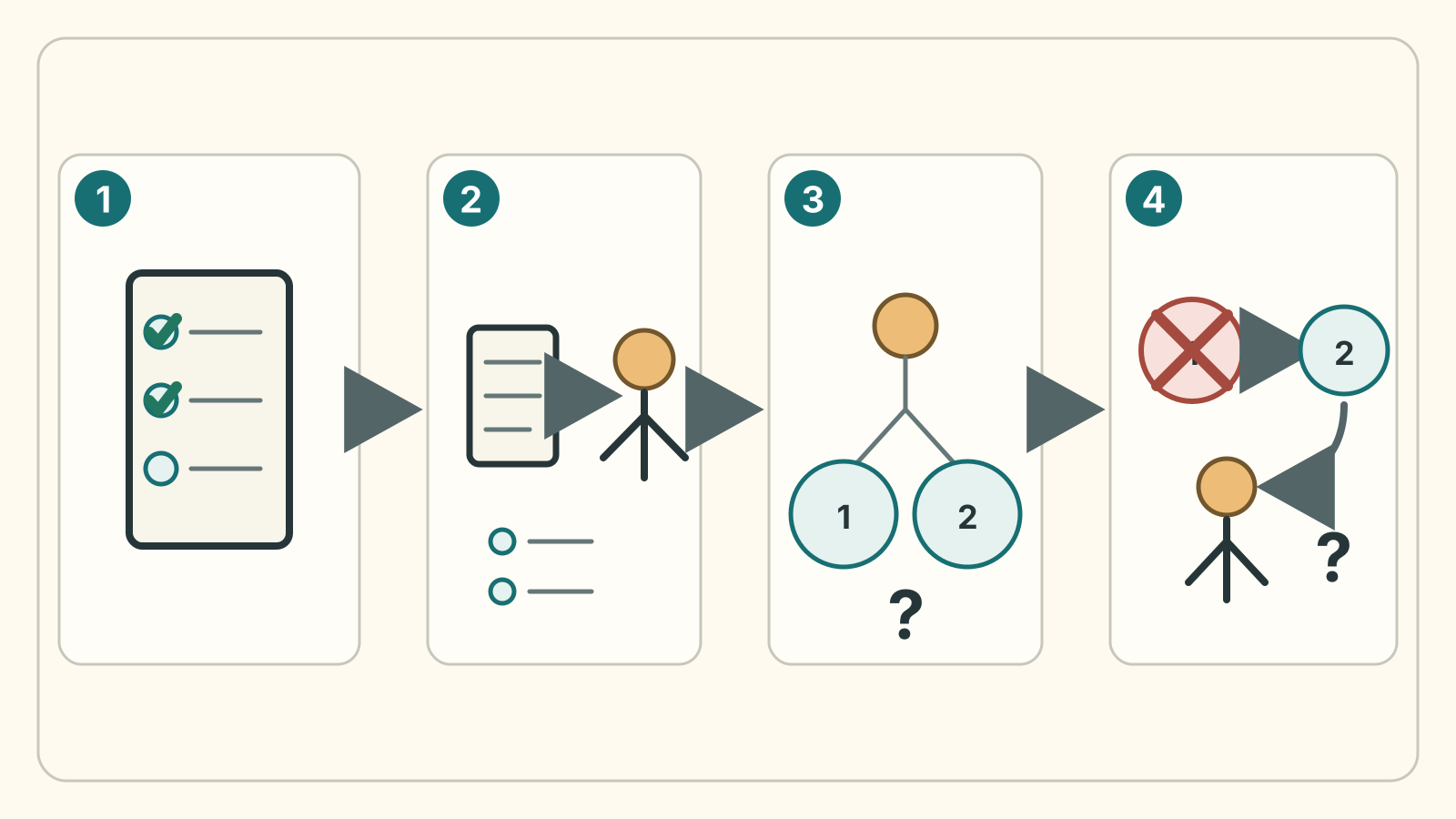
Detailed description of this diagram
Four cards run from left to right. Card 1 is an abstract three-item checklist, representing the need to name the exact function—for example ostomy equipment, an adult changing bed, transfer space or companion assistance. Its circles and lines depict no real fixture. Card 2 shows an abstract seat-reference sheet being presented to an attendant, with a separate small requirement list. It reproduces no ticket or uniform. Card 3 branches from the attendant to candidates numbered 1 and 2. The numerals indicate checking order only, not location, distance, route, features or vacancy; a question mark keeps live suitability unresolved. Card 4 crosses candidate 1 when it fails, moves to candidate 2, then returns to the attendant rather than treating another door as suitable. No actual room, door, grab rail, bed, room or turning dimension, transfer space, level change, lift, passage, waiting time, opening status or fitness for the individual is depicted or promised.
Graphic: SUMO ARCHAEOLOGY CLUB · Figure source 1 · Figure source 2 · Figure source 3
Plan the way back as carefully as the way out
A route is only half useful if you cannot recognise the return. Record your floor, seat number and side of the arena—shomen, mukojomen, east or west—plus one nearby entrance number or staffed point. Do not depend entirely on a phone battery.
The September 2026 spectator notice says that re-entry is permitted once and that the ticket stub must be carried. Using a restroom inside the building is not re-entry, of course, but it is worth making sure that the route you follow stays within the spectator area rather than drifting toward an exit.
Ask for a backup before the need becomes urgent
Knowing only the nearest room can leave you waiting without a plan. Ask for a second location at the start of the day. There is no official minute-by-minute queue forecast, so this article will not invent a supposedly perfect bout or programme break.
If you attend with a support person, both people should hear the route and return landmark. Agree on a meeting point that does not obstruct an aisle. During an emergency, abandon the ordinary restroom route and follow announcements and staff instructions.
Let preparation give the ring back your attention
Once the route is settled, you do not need to keep searching the concourse in your head. On the way back, glance toward a hanamichi, the aisle through which wrestlers approach and leave the ring. It carries two very different moods: concentration on the way in and the immediate aftermath of a bout on the way out. Knowing your own return route can make that small journey easier to notice.
Arrival note
- Floor, arena side and seat number
- Nearest accessible restroom
- Lowest-barrier route
- Backup if occupied
- Landmark for the return
- Nearest staffed point for help
Confirm “use and return,” not only “reach”
Before buying, separate a generally step-reduced route from an essential feature such as ostomate equipment, an adult changing surface, transfer space or companion assistance. A map symbol does not establish internal dimensions, rail position, changing-surface size or whether a companion can enter. Ask the organiser by naming both the feature and the body movement that depends on it.
On the day, make one round trip while the need is not urgent. Share the entrance, floor, turns and return landmark with a companion. Urgency, pain, wheelchair or cane use, and travel with a child change the time and assistance required even on the same route. Keep circulation clear and carry only the essential items needed for the break.
If the nearest room is occupied, closed or unsuitable, move to the confirmed second option; if that also fails, tell staff the required function again. A health-related need outranks waiting for a convenient break in the bouts. This is an editorial safety sequence, not a prediction of queues or event-day availability.
Keep evidence, unknowns and actions separate
Confirmed: The official map includes symbols for accessible multipurpose restrooms, lifts and stairs. The map itself is labelled for the May 2026 tournament.
Still unknown: We cannot confirm which rooms will be open, ostomate equipment, an adult changing surface, transfer space, door or rail dimensions, or waiting time. The word “multipurpose” does not establish personal usability.
Our preparation advice: While the need is not urgent, make one trial round trip that reflects the person’s movement, aid, support and belongings. This is not an official arena procedure and cannot guarantee use.
If both options fail: Do not infer that another suitable room must exist. Restate the exact function to staff and keep exit or going home available rather than making endurance the only plan.
Sources
- Japan Sumo Association, Kokugikan floor map, checked September 3, 2026. The PDF is labelled May 2026 and is not treated as a September operating guarantee.
- Japan Sumo Association, September 2026 Tokyo spectator notice, checked September 3, 2026.
- Japan Ministry of Health, Labour and Welfare, heat-illness prevention guidance for outing and venue preparation, checked September 3, 2026.
Source links used for verification
Each link was used for the corresponding claim in this article; inclusion is not a blanket endorsement of the whole page.
Article verified:
- Japan Sumo Association Kokugikan floor map labelled May 2026Historical primary source (record from that period)
- Japan Sumo Association September 2026 Tokyo spectator noticePrimary source (as checked for this article)
- Japan Ministry of Health heat-illness prevention guidancePrimary source (as checked for this article)