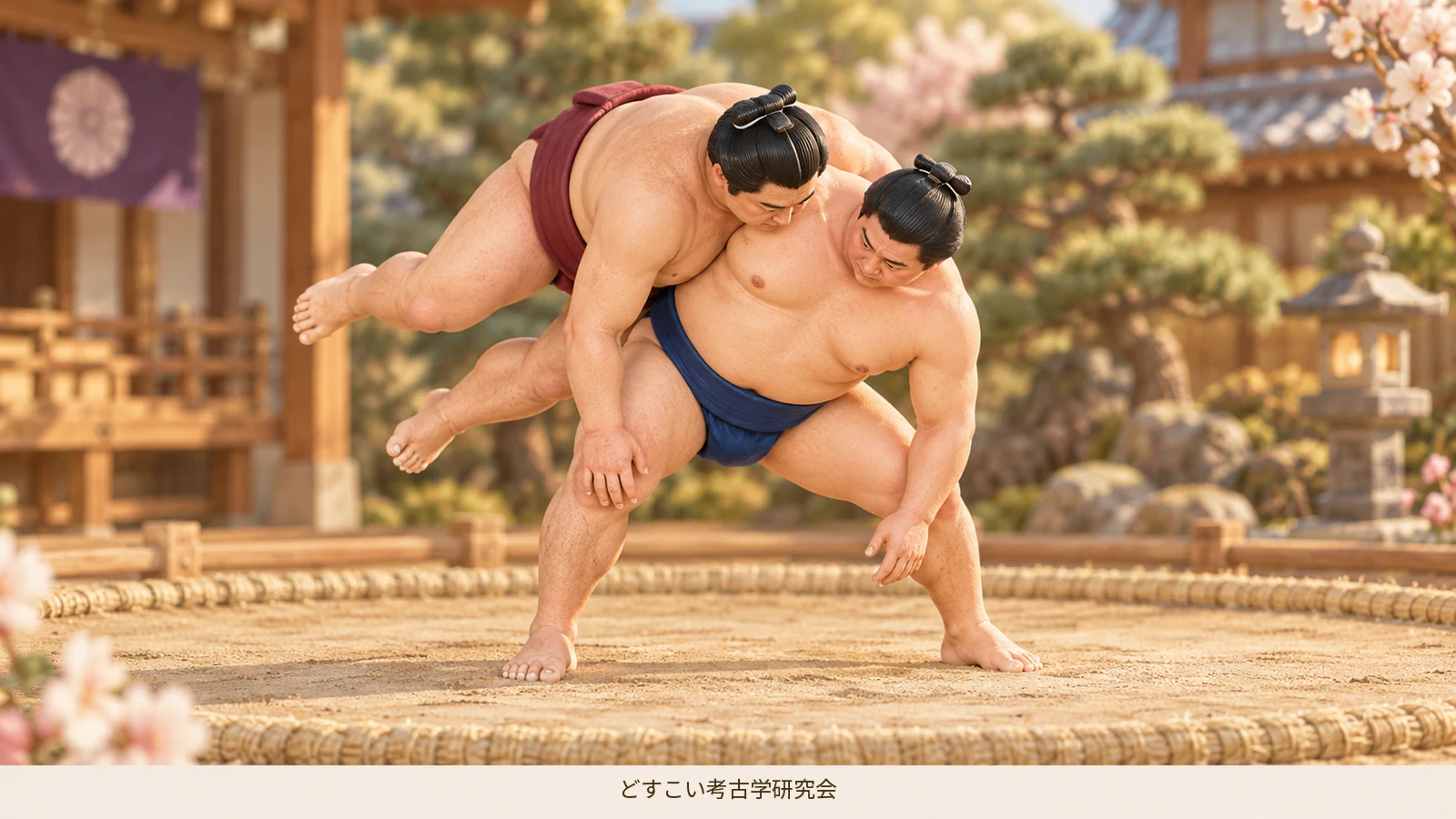
Koshinage is a hip throw. The wrestler inserts his hips deeply, loads the opponent’s body onto them and throws. The Japan Sumo Association says the grip can be overarm or underarm, and a belt grip is not even required: if the opponent is placed on the hip and thrown, koshinage is the result. So do not begin with the hands. In the next bout, watch whether the winner’s hip moves underneath and in front of the opponent’s centre, briefly becoming the platform for the turn.
A very large wrestler appears to become light for half a second, rises across another man’s waist, and rotates towards the clay. The last motion looks like an arm has flung him. Koshinage becomes clearer when you rewind to the quieter preparation: one hip moved low enough and deep enough to become a fulcrum.
The official definition does not require one type of grip
The Association defines koshinage by loading the opponent’s body onto a deeply inserted hip and throwing him. It explicitly says that the winner may hold an uwate (outside/overarm) grip or a shitate (inside/underarm) grip. He may also throw without taking the mawashi. What matters is that the opponent is carried on the hip.
This makes koshinage unusual for a beginner’s checklist. The hand position does not settle the name. Instead, watch the relationship of the two waists. Does the winner’s hip move lower and across the opponent’s centre? Does the opponent’s pelvis or torso travel over it as his feet become unweighted?
From a distant seat, you cannot measure where the weight truly sits. Use the visible path as a clue, then listen to the official announcement. A close hip is not automatically a load-bearing hip.
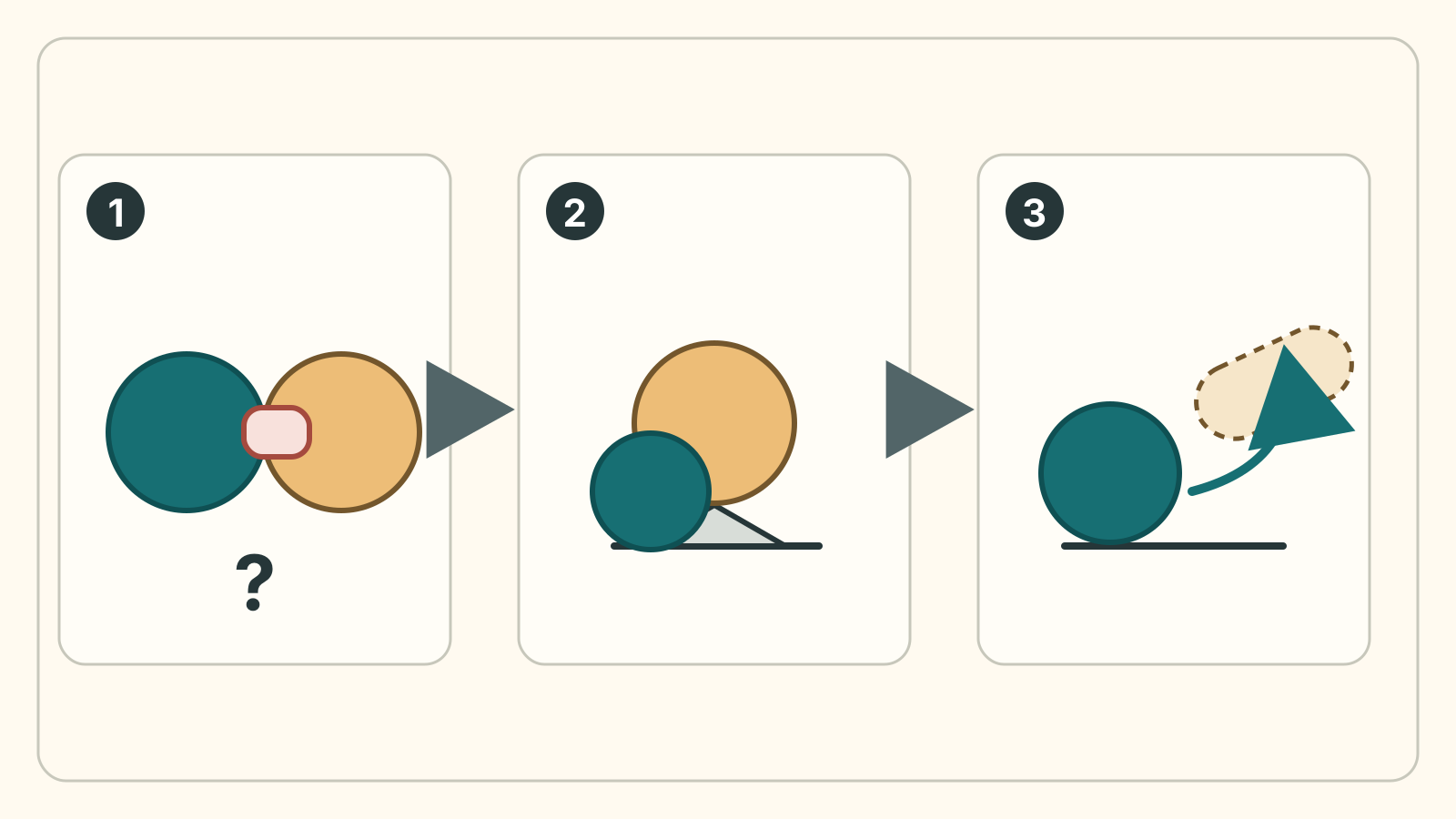
Detailed description of this diagram
Card 1 shows blue and gold competitor tokens with a question mark, preserving the official grip-neutral condition. Card 2 places the gold opponent token above a triangle on a ground line, with the blue token beside it, to encode only transfer onto the winner's hip as support. Card 3 uses a horizontal gold token and curved arrow as a categorical thrown state. The triangle, token height, overlap and curve encode no body, grip, hip depth, load point, leverage, angle, trajectory or execution instruction.
Graphic: SUMO ARCHAEOLOGY CLUB · Figure source 1 · Figure source 2 · Figure source 3 · Figure source 4
Uwatenage and shitatenage are named by the belt grip
Uwatenage is thrown from an outside grip taken over the opponent’s inserted arm. Shitatenage is thrown from the inside grip beneath that arm. Those names tell you where the throwing hand has reached the mawashi.
Koshinage asks a different question. An uwate or shitate may be present, but did the winner place his body deeply enough for the opponent to ride over his hip? If the belt grip supplies the decisive turning pull without that loading action, uwatenage or shitatenage remains the better candidate. If the hip becomes the platform, koshinage enters the picture even when a belt grip is visible.
More than one action may coexist in a real bout. A wrestler can hold an uwate while inserting his hip. The official kimarite identifies the action judged to have produced the victory, so use the announcement to test your visual reading rather than forcing one frozen frame to decide.
Kubinage begins with an arm around the neck
Kubinage, the neck throw, also involves the waist and a turning body. Its official definition starts with one arm wrapping around the opponent’s neck; the wrestler inserts his waist, twists and throws the opponent in a wrapping motion.
If the arm around the neck supplies the clear entry and the opponent is drawn into that wrapping arc, consider kubinage. If the defining event is the opponent’s body being loaded onto the attacker’s hip, regardless of a neck wrap or particular belt hold, consider koshinage.
“He used his hips” is not enough, because most effective throws involve the lower body. The sharper question is whether the hip became the surface carrying the opponent.
Getting low is only preparation
A wrestler may bend his knees and lower his waist for many reasons: to resist a charge, improve a belt position or begin another throw. A low posture alone does not make koshinage. The opponent must be placed onto the hip in the decisive throw.
A still photograph can show the waists touching but not whether one body is travelling over the other. Follow the sequence. Look for the opponent’s centre rising relative to the winner’s hip and the feet appearing to lose their ordinary support before the rotation.
One thing to watch in the next bout
When one wrestler suddenly drops his level in a yotsu exchange, ignore the belt for a moment. Watch the front-to-back order of the hips. If the winner’s hip passes beneath and across the opponent’s centre, and the opponent’s body briefly rides over it before turning, predict koshinage.
The defender may draw his hips away and keep his feet heavy on the clay. That failed load is worth seeing too. Hands are busy and belts are vivid, but each wrestler has only one centre. Koshinage invites you to watch that centre move. Once you see the fulcrum being placed before the throw, a spectacular flight no longer feels sudden—it feels like the last line of a sentence written lower down.
Similar Motion Does Not Set the Official Technique
A hand action or fall may look similar while the recorded kimarite differs according to the decisive action, sequence of balance loss and whether a body part touched down or crossed the ring first. Do not settle the difference between a similar technique, non-technique or foul from one camera angle; use the official result for that bout. A schematic marks viewing cues, not a substitute judges’ decision.
Sources
- Japan Sumo Association, kimarite explanation for koshinage (checked 3 September 2026)
- Japan Sumo Association, kimarite explanation for uwatenage (checked 3 September 2026)
- Japan Sumo Association, kimarite explanation for shitatenage (checked 3 September 2026)
- Japan Sumo Association, kimarite explanation for kubinage (checked 3 September 2026)
Source links used for verification
Each link was used for the corresponding claim in this article; inclusion is not a blanket endorsement of the whole page.
Article verified:
- Japan Sumo Association kimarite: koshinagePrimary source (as checked for this article)
- Japan Sumo Association kimarite: uwatenagePrimary source (as checked for this article)
- Japan Sumo Association kimarite: shitatenagePrimary source (as checked for this article)
- Japan Sumo Association kimarite: kubinagePrimary source (as checked for this article)