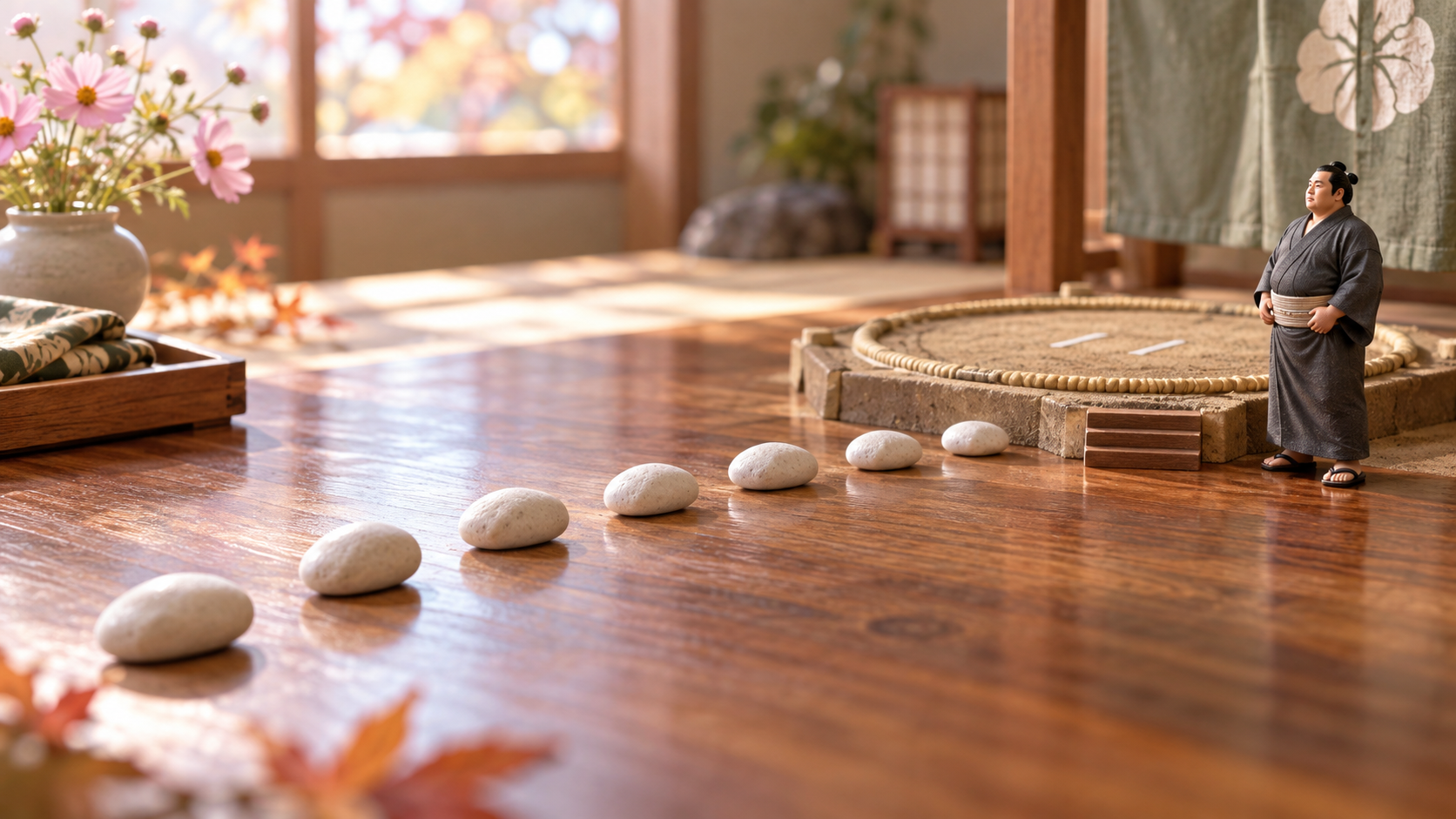
Wrestlers in makushita, sandanme, jonidan and jonokuchi normally have seven bouts across a 15-day grand tournament. One bout is assigned within days 1–2, another within days 3–4, and so on, with the seventh scheduled in the closing three days. A wrestler missing from today’s official bout list is therefore not automatically injured or absent: today may simply be one of his normal non-bout days.
You discover a young wrestler in an early match, search for him the next day and find nothing. If your mental model comes from makuuchi television coverage, where the leading wrestlers appear daily, the empty search feels alarming. Below juryo, however, a day without a scheduled contest is built into the tournament. His basho continues even when he does not enter the ring that day.
Sekitori compete 15 times; lower divisions normally compete seven
The Japan Sumo Association explains that wrestlers in makuuchi and juryo have one contest on each of the 15 tournament days. Together those two divisions make up the salaried *sekitori*. Makushita and the divisions below it follow a different pattern, normally competing seven times.
Seven does not mean casual or unimportant. Four wins secure a winning record and four losses a losing record, so each result occupies a large share of the final score. Before comparing a lower-division wrestler’s “3–1” with a makuuchi wrestler’s record, ask how many of his seven slots have actually been completed.
The basic rhythm uses pairs of days
The Association’s official explanation lays out the usual structure. Bout one falls on day 1 or 2; bout two on day 3 or 4; bout three on day 5 or 6; and bout four on day 7 or 8. The fifth and sixth bouts fall within days 9–10 and 11–12. The seventh is assigned on one of days 13, 14 or 15.
This is not a promise that a wrestler always competes on odd-numbered days, nor a fixed alternate-day calendar. Different wrestlers can be placed on different days within each pair. Adjustments are needed to make the programme work, and an Association explanation also notes rare cases in which an eighth contest is assigned. Use seven as the normal framework, then use the official daily bout list for the actual date.
“No bout” is not the same as kyujo
A scheduled rest day in this seven-bout system is ordinary. It is different from *kyujo*, withdrawal or absence from competition, and from a *fusen* result created when one side of an already scheduled match cannot appear.
Those distinctions matter because an empty cell tempts us to invent a health story. Do not turn one missing name into an injury report. Do not decide from this general article; check the Association’s current daily torikumi and absence information. Our guide to fusensho and kyujo explains how the official result symbols separate those situations.
Early sumo has its own tournament rhythm
A grand-tournament day progresses through jonokuchi, jonidan, sandanme and makushita before the two sekitori divisions. The lower divisions contain many wrestlers, but not every one of them competes every day. Instead of arriving with a long list of names to find, choose one wrestler from that day’s official programme and watch his single contest.
If someone catches your attention in his first match, look across the next two-day block rather than expecting him tomorrow. Finding his name again turns the seven-bout rule from an administrative fact into the pulse of one person’s tournament.
One small discovery in the next bout list
Follow one lower-division wrestler and label his next result “bout four of seven” rather than only “third win.” After the fourth contest he has passed the halfway point; after the sixth, he normally has one opportunity left.
On a day when he is not listed, pause before worrying and check the adjacent day. When you find him there, the apparent gap becomes a deliberate rhythm. Sumo no longer begins only when the televised stars arrive: the earliest divisions carry their own dotted path through all 15 days.
Sources
- Japan Sumo Association quizzes No.13 and No.1082 (verified 3 September 2026).
Source links used for verification
Each link was used for the corresponding claim in this article; inclusion is not a blanket endorsement of the whole page.
Article verified:
- Japan Sumo Association quiz No.13: seven bouts below juryoHistorical primary source (record from that period)
- Japan Sumo Association quiz No.1082: lower-division bout daysHistorical primary source (record from that period)