Shiori’s Research Notes #016
I knew the tokudawara as a place where a wrestler might keep a foot in. But why did those bales sit farther out? One photograph on Saturday morning had me wondering how many bales there were—and what was inside them.

Morning: why are the tokudawara there?
On Saturday morning, I opened a photograph of an empty dohyo. Following the bales along the near side, I found one sitting a little farther out than its neighbours.
A tokudawara—the place where a wrestler can still have a foot in at the edge. During a bout, I’m usually thinking, “He’s still in!” and watching the foot. This morning I was interested in the bale. Why move just that one out?
I enlarged the photograph and searched the far side. There was another. Following the circle seemed simpler, but these had deliberately been set farther out.
There are four tokudawara: one at the front, one at the rear, one to the east and one to the west. I knew their name, but I’d never really thought about all four positions together.
Looking at the tablet, I drew a circle in my notebook. Copying the camera angle would have given me an oval, so I imagined looking down from above. Then I added four little marks.
Now I wanted to count the bales between them. How many fitted from one tokudawara to the next? The near side looked manageable, but the ends overlapped at the back of the photograph. Was there a closer view somewhere? It was my day off. I had time to look.
Late morning: drawing twenty bales
Four bales fit between each pair of tokudawara. Four stretches of four make sixteen; add the four tokudawara, and there are twenty. On the next notebook page, I drew a bigger circle and divided it into individual bales.
Four, then a tokudawara. Another four. I made it all the way back to the start. They’d been difficult to count in the photograph, but drawing them made it much clearer.
I stopped to put away the laundry, leaving the pencil on the desk and going over to the daybed. As I folded a T-shirt on my lap, “four, then a tokudawara” was still going round in my head. Could I find all four stretches in that photograph now?
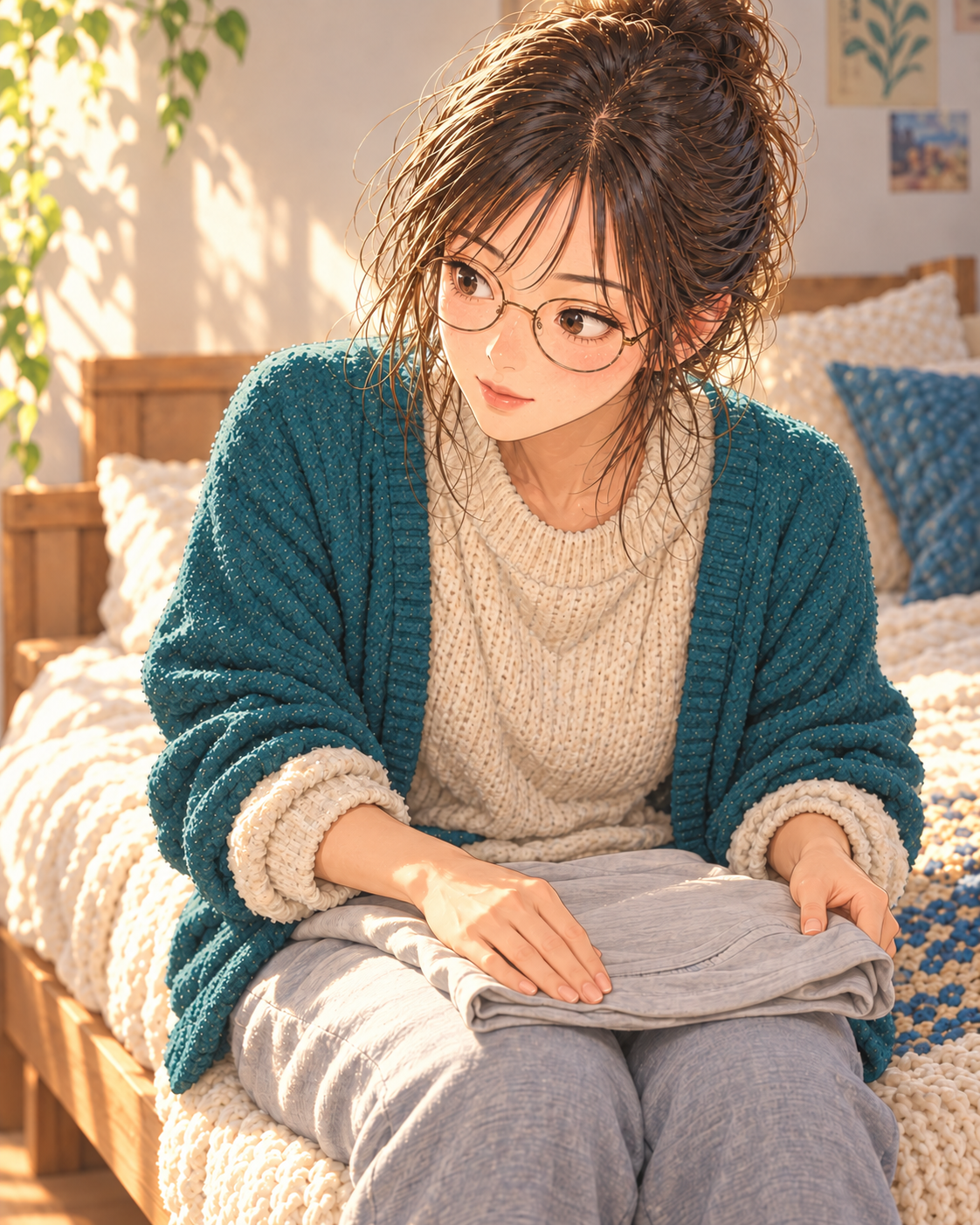
Once the rest of the clothes were folded and put away, I returned to the desk. I looked between my drawing and the photograph. The distant bales looked shorter; on the near side, I could make out their width. They weren’t nearly as uniform as the marks in my drawing.
I also checked which edge marks the contest boundary. It’s the outside edge of the circle formed by the bales, with a diameter of about 4.55 metres. I’d drawn the bales as little more than lines, so I added a larger view of one beside the circle. A foot on a bale isn’t, by itself, outside the ring.
In the diagram below, you can remove the marks around the four tokudawara. Can you still find them without the red circles? I tried counting all the way round with the marks hidden.
Can you find all four without the marks?
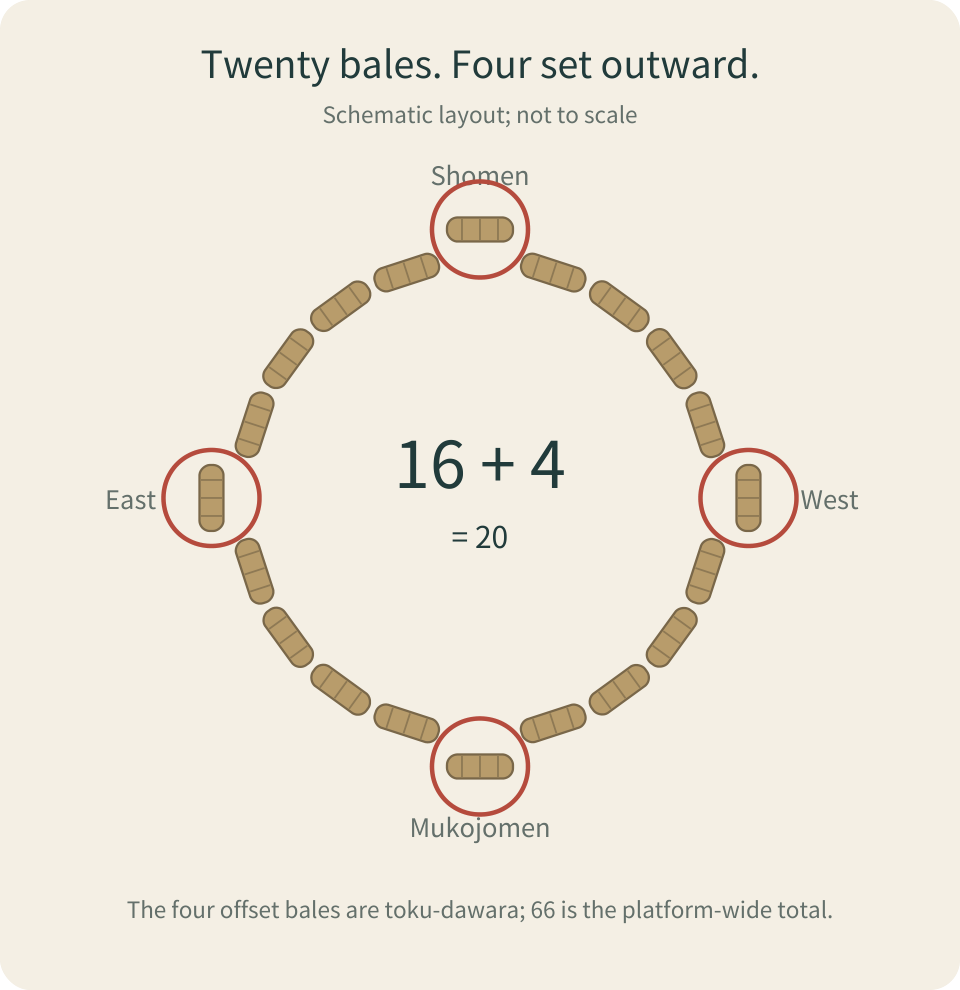
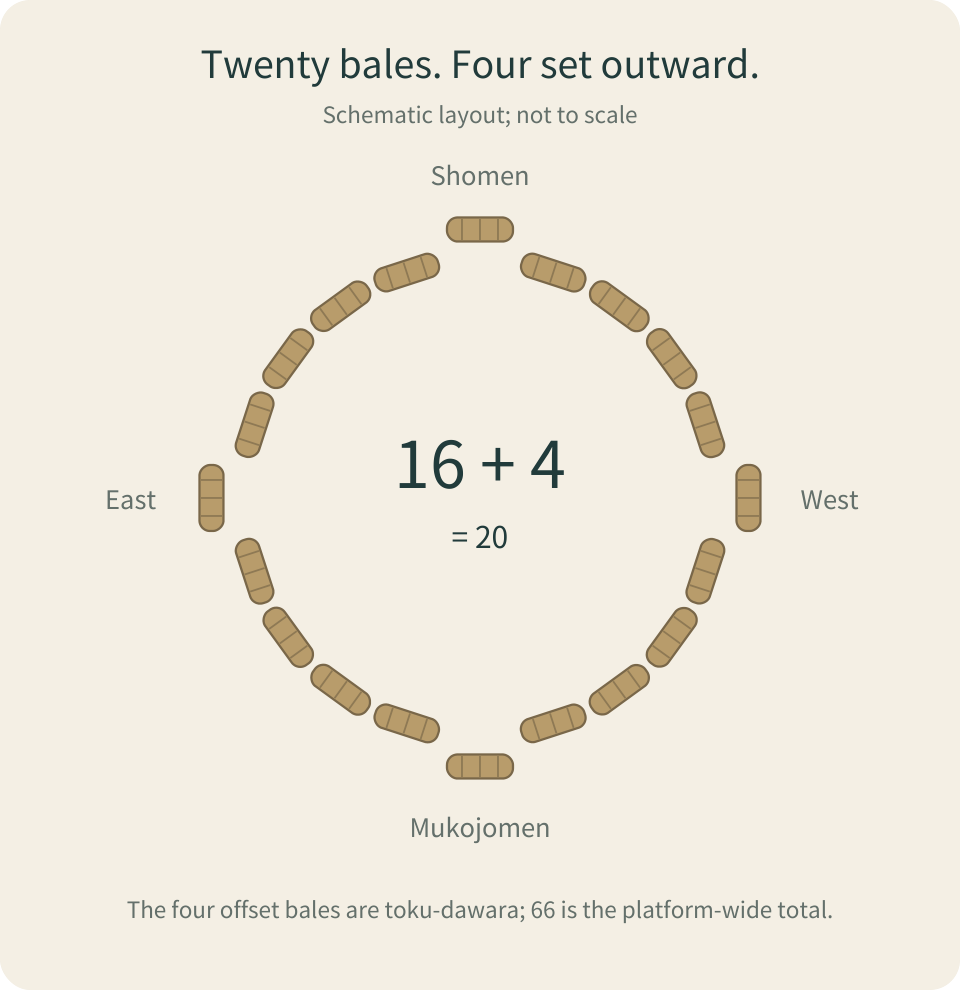 Remove the marks · keep the same viewShow the four marks again
Noon: a dohyo in the rain?
I found the explanation for the offset too. Tokudawara are said to have originated when sumo was held outdoors: openings were left so that rainwater collecting on the dohyo could drain away.
Rainwater! I hadn’t expected that.
I’d been thinking only of a place to keep a foot in during a bout. I liked finding a connection to outdoor sumo in the shape of the ring we see now.
After lunch, I washed the dishes. Even while drying my hands, I kept thinking about the rain. What did they do if it began to rain partway through? Were there days when enough water collected to make those openings especially useful?

Now I wanted to see a dohyo from that period. When and where had they used that shape? I left a note of my questions in the margin, then returned to the present-day ring.
Enlarging the photograph brought out the fine strands of straw on a bale. How much did they pack in to make it hold that shape? Wait—was it straw all the way through? I’d thought finding the origin would settle my question. There was something else I wanted to know.
Afternoon: there’s soil inside
In the afternoon, I took the tablet over to the daybed. I’d found photographs of the bales being made and sat down to have a good look.
There was soil inside the open straw. Oh, so that’s what fills them! The straw on the outside had made such a strong impression that I’d never thought much about what was underneath.
An unfinished one lay in the foreground, with long, closed bundles farther back. So this was how a bale took shape. I brought the tablet closer to look at where the straw was being gathered.
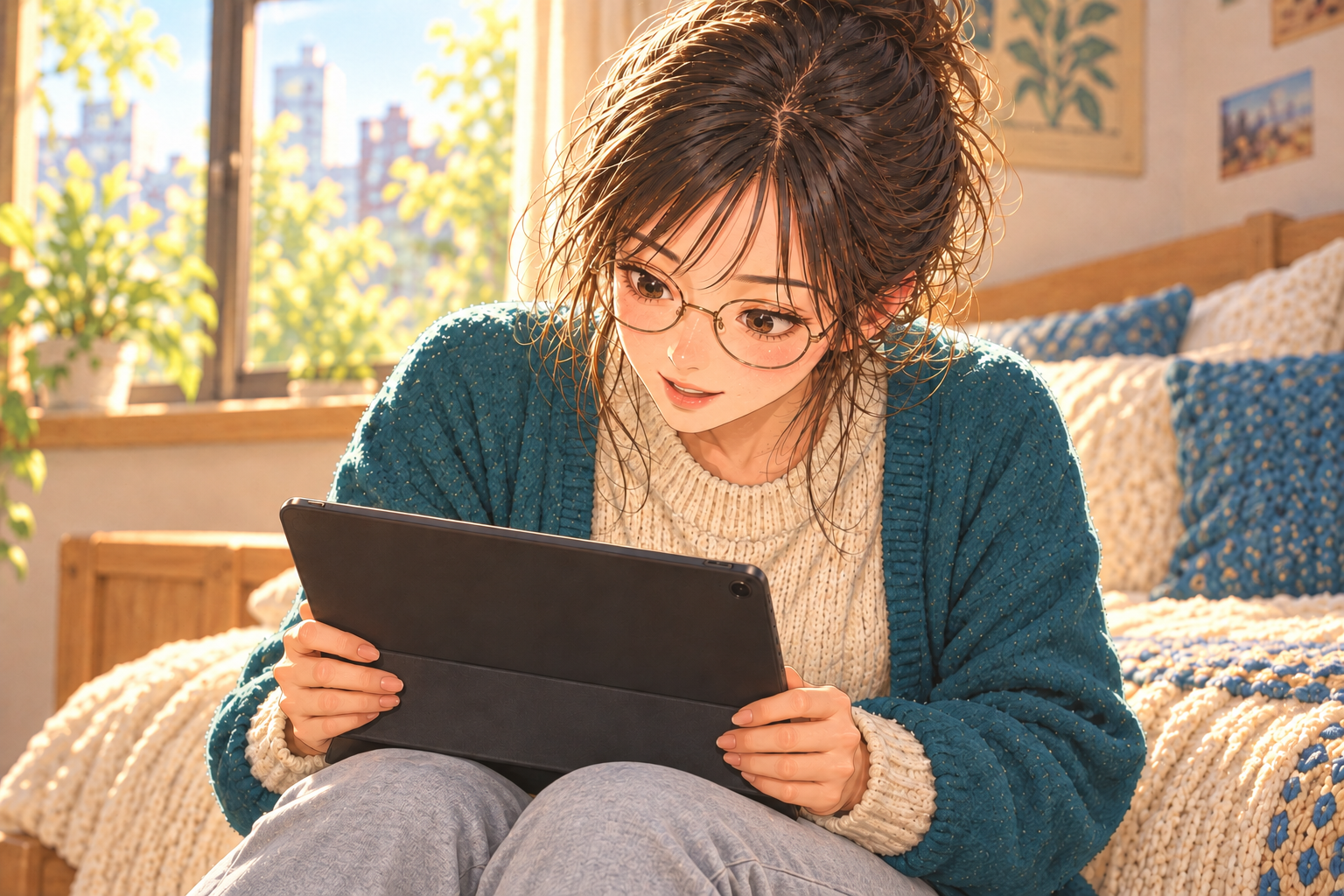
Another photograph showed a bale being fitted into a circular groove in the earth. They don’t just lay them on top. I kept enlarging the view, then pulling back to see the parts that would be buried in the finished dohyo.
Wrapping the soil into a bale, then fitting it into the groove. There was so much work behind the circle I’d drawn so quickly that morning. I looked again at the hands and the parts I could make out in the photographs.
Then I came across a total: sixty-six bales. Wait, wasn’t it twenty? This was a larger area. Twenty was the ring alone; sixty-six included the outside and the steps.
I wanted to write that down. Back at the desk, I returned the tablet to the stand on my left. Sixteen shobu-dawara and four tokudawara; twenty-eight kaku-dawara around the perimeter, four age-dawara, ten bales forming the steps and four at the water-bucket positions. That adds up to sixty-six.
The kaku-dawara caught my attention. Twenty-eight of them, and I’d barely looked at them! They were the square around the ring. I drew a square around my circle too, then returned to the wide photograph.
Late afternoon: it’s the same photograph!
Following the outer square, I found a short bale set diagonally across a corner. All four corners had one. So those were the age-dawara I’d just written down.
The straight rows beside them are the kaku-dawara. I’d been reading the first part of the Japanese name as kado. Kaku, then. I wrote it beside the square, hoping the position would help me remember.
When I reopened the tokudawara page, I stopped. This was the same photograph! In the morning I’d been so busy looking at the red circles around the tokudawara that I’d looked straight past the corners.
I’ve put links to both pages below. After looking at the marked photograph, try finding the diagonal bales in the unmarked version. Those were the ones it had taken me until late afternoon to notice.
The light outside was fading, so I switched on the desk lamp. My notebook had accumulated quite a few names. On the first page, though, there was only a circle and four small marks. That was all I’d been looking at that morning. I followed the original line with my right index finger.
Earlier, sixty-six might have meant no more to me than “a lot”. Now I could picture that little diagonal bale being included too. I still couldn’t recall every name straight away, but I thought I could find quite a few of them in the photograph.
Night: so much time with an empty ring
After clearing up from dinner, I opened the wide photograph once more. No enlarging it this time. Tokudawara, the kaku-dawara outside them, the age-dawara at the corners. There they were. I could find them one after another.
I’d spent so much of the day looking at photographs with no wrestlers in them. I’d only meant to find out about the shape of the tokudawara, but ended up wondering about the soil inside the straw too. Every answer sent me back to another photograph.
I left the tablet on the desk and took just the notebook to the daybed. One more look at that first circle. The detailed drawing and names were on the next page; this slightly wobbly circle could stay as it was.
After closing the notebook, I glanced towards the desk. Would I notice those corners when I watched sumo now? Although, once a bout started, I’d probably be caught up in the wrestlers again.

A whole day looking into the dohyo itself. I wouldn’t have expected that when I woke up. I’m glad I did it.
Sources
Japan Sumo Association, Sumo Quiz. The rainwater origin of the tokudawara is presented as an attributed explanation, as in the source.
- Japan Sumo Association, Sumo Quiz 824 · 2024-04-11
- Japan Sumo Association, Sumo Quiz 355 · 2022-12-29
- Japan Sumo Association, Sumo Quiz 898 · 2024-06-24
- Japan Sumo Association, Sumo Quiz 362 · 2023-01-05