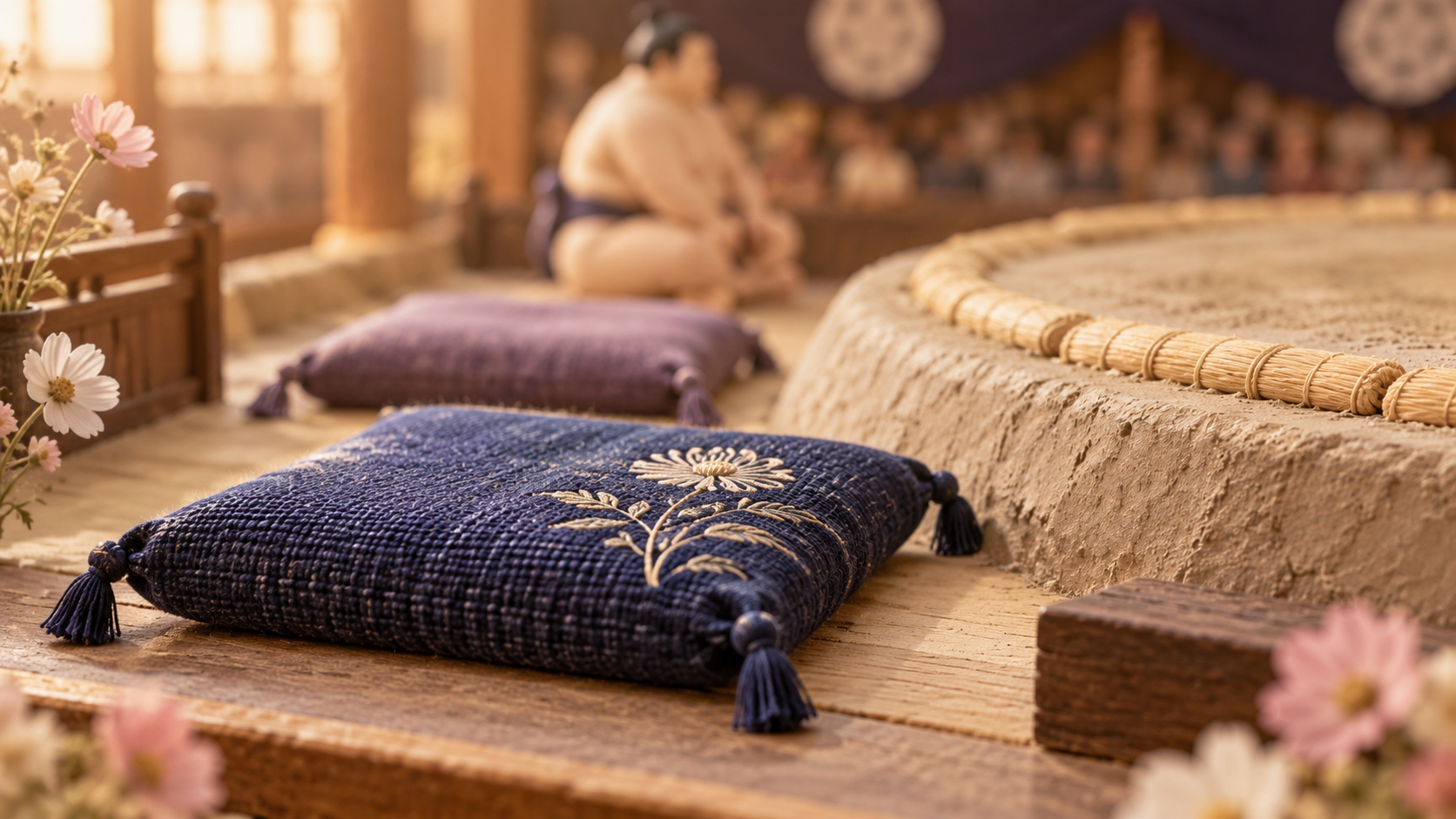
A wrestler may bring a ringside waiting cushion decorated with his own ring name only after reaching *makuuchi*, sumo’s top division. The Japan Sumo Association says *juryo* wrestlers use shared cushions, while wrestlers below juryo normally have no waiting cushion. There is one lovely border moment: competitors in the final five *makushita* bouts may use the shared juryo cushions. Rank is visible in the small object beneath them.
Broadcast cameras often find the next wrestler waiting beside the dohyo. His cushion can seem like a purely personal choice—perhaps a favourite colour or a gift. Look again and it becomes part of the rank system. A name of his own, a shared cushion or bare flooring tells a quieter story than the graphic on screen.
A personal named cushion begins in makuuchi
International introductions often explain that juryo and makuuchi wrestlers are *sekitori*, the salaried professionals. That important boundary does not give both divisions identical privileges. The Association’s official explanation says a wrestler must reach makuuchi before he can bring his own waiting cushion bearing his ring name.
A promotion to juryo transforms many parts of a wrestler’s daily life, but his ringside cushion remains shared. Promotion from juryo into makuuchi gives the object an individual identity. That distinction makes a first makuuchi promotion more tangible: his name has not only moved into the top division on the ranking sheet; it can now appear under him while he waits.
The basic ladder: personal, shared, then none
The Association sets out three main levels:
- Makuuchi wrestlers may bring a personal waiting cushion.
- Juryo wrestlers use communal cushions.
- Makushita and lower-division wrestlers normally have no cushion.
Do not identify a wrestler from cushion colour alone. Television colour, a partially hidden ring name and another wrestler’s equipment can all mislead. Confirm the bout and rank in the official order first, then enjoy spotting the name on the object.
This ringside cushion is also different from a spectator’s cushion in a floor-seating box. Fans should never touch, move or throw equipment from the working area around the dohyo.
The top five makushita bouts briefly cross the boundary
After the juryo ring-entering ceremony, five bouts involving the highest-ranked makushita wrestlers take place while the juryo competitors prepare. The Association calls this sequence the “top five makushita bouts.” Its January 2026 explanation confirms that wrestlers in these bouts may sit on the communal cushions used by juryo.
They have not become sekitori for the afternoon and the cushion does not predict promotion. Their official rank remains makushita until a later banzuke announcement says otherwise. What the object shows is the special place of this five-bout bridge in the day’s schedule: the competitors are immediately below the salaried division and briefly occupy its waiting space.
That is a useful guard against over-reading visual clues. A makushita wrestler on a cushion has not secretly been promoted. Check whether you are watching this particular late-makushita sequence.
Watch the divisions change through one afternoon
If you arrive early, you can see the material difference unfold. Lower-division wrestlers wait without cushions. The top five makushita bouts introduce juryo’s shared cushions. Juryo continues with the communal set. Later, makuuchi brings out cushions carrying individual ring names.
The banzuke is usually presented as dense Japanese calligraphy on paper. In the arena, the same hierarchy accumulates in ordinary things: hairstyle, silk belt, salt, ring-entering ceremony and a place to sit. You do not need to memorise them all. The cushion is one small, reliable observation point.
Follow one name from the floor to the dohyo
Before a makuuchi bout, find one named cushion near the ring. Match it to the official bout order, then wait for that wrestler to stand and enter the dohyo. A quiet patch at the edge of the broadcast becomes his few minutes before combat.
Months later, promotion or demotion may change the cushion beneath the same wrestler. Rank is not only a title beside his name; it rearranges the objects around his body. Once you see that, the journey from makushita to juryo and from juryo to makuuchi gains a texture no ranking table can quite provide.
Sources
- Japan Sumo Association, Sumo Quiz No. 738 on personal, shared and absent waiting cushions by division (published 16 January 2024; checked 3 September 2026)
- Japan Sumo Association, Sumo Quiz No. 1466 on the top five makushita bouts using juryo cushions (published 13 January 2026; checked 3 September 2026)
Source links used for verification
Each link was used for the corresponding claim in this article; inclusion is not a blanket endorsement of the whole page.
Article verified:
- Japan Sumo Association Sumo Quiz No. 738: waiting cushions and rankPrimary source (as checked for this article)
- Japan Sumo Association Sumo Quiz No. 1466: cushions for the top five makushita boutsPrimary source (as checked for this article)