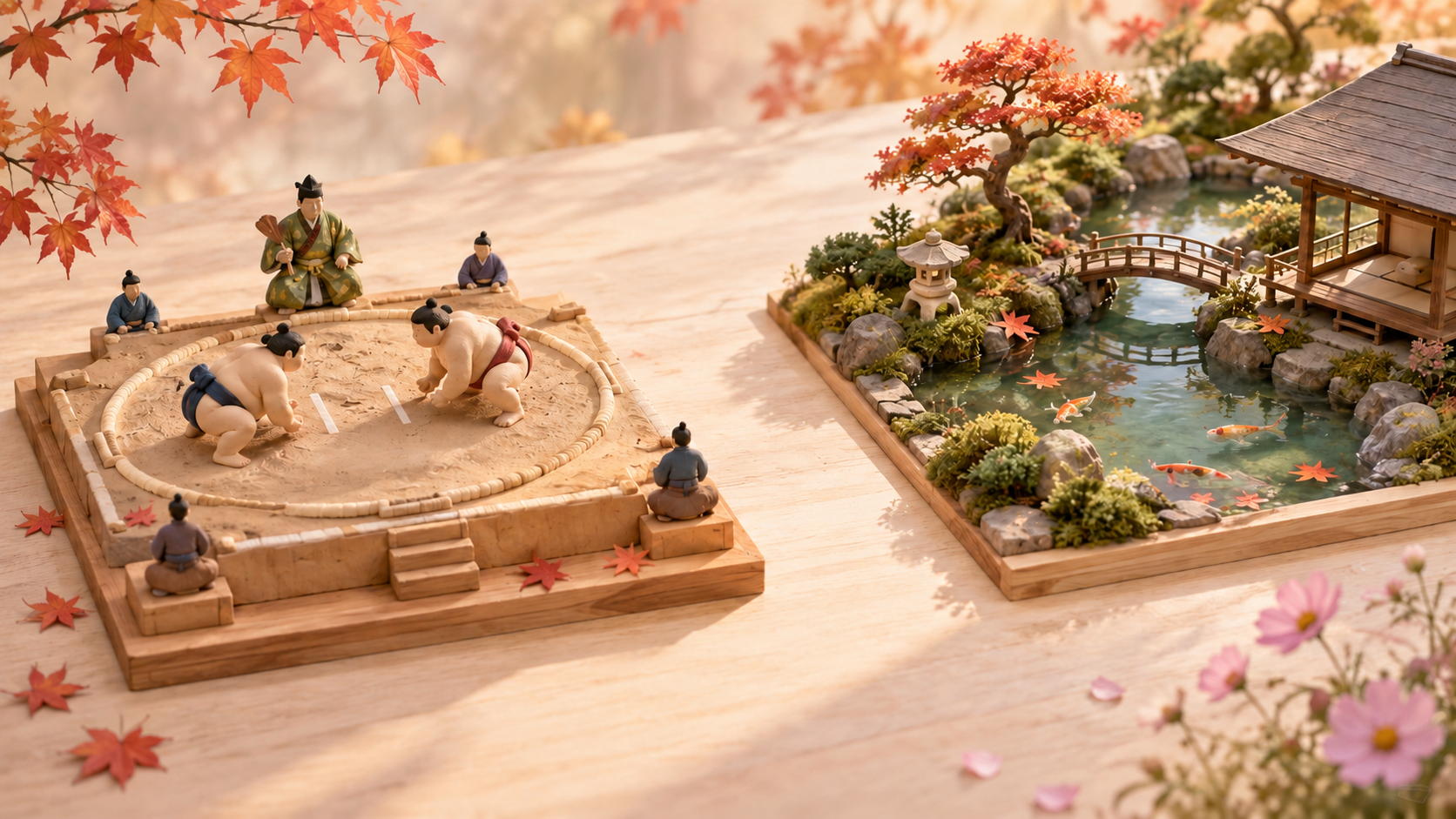
Yes—but make the day two anchors only: the sumo tournament and one other place. Fix the ring-entering ceremony, wrestler or block of bouts you most want to see, then work backwards through travel, last admission, luggage and rest. A first tournament, international arrival day, senshuraku, family day or low-energy day is already a complete trip with sumo alone.
The association’s Tokyo schedule runs from morning lower-division bouts toward the evening bow ceremony, and it repeatedly identifies its times as approximate. Sumo is live sport. Treating it as a booking that ends at an exact minute turns the final bouts into a clock-watching exercise.
For overseas visitors, jet lag and an unfamiliar station can quietly consume the buffer that looked generous at home. One attraction gives you a choice. Three attractions create obligations.
Protect one sumo moment first
Choose the part of the day you will not trade away:
- early lower-division sumo in a quieter arena;
- the juryo ring entrance and the start of salaried-wrestler bouts;
- makuuchi and yokozuna ring entrances;
- your chosen wrestler, with several bouts of buffer before his match;
- the final-day ceremonies, including the presentation sequence.
The day’s bout order and live progress matter more than an old minute-by-minute itinerary. If one wrestler is the anchor, check the official torikumi for that date and be seated well before his turn. The full tournament-day guide shows what you give up when you choose a later arrival.
Select by direction, not map distance alone
Test every attraction against five questions:
- What are the official opening, last-entry and closure rules today?
- Is its booked time flexible?
- Can you explain the complete route to the arena in one clear sequence?
- Can you do it without carrying the large suitcase?
- If you are 30 minutes late, can you shorten or cancel it without harming sumo?
A nearby dot may still involve a difficult station exit, queue or timed admission. A free outdoor stop on the line from your hotel may be safer even if its straight-line distance is greater. Weather, closure or disruption should be able to remove the attraction while leaving the tournament intact.
Tokyo: one Ryogoku stop, or one stop on the way
The Japan Sumo Association lists access via JR Ryogoku’s west exit and Toei Oedo Line Ryogoku. For a first visit, one place around Ryogoku—or the Sumo Museum inside Kokugikan when its tournament-day conditions permit—keeps the second anchor close to the first. Museum access and hours differ during a tournament, so use the current Sumo Museum tournament guide rather than assuming ordinary admission.
If you choose Asakusa, Ueno, the Tokyo Station area or another district, search the whole chain: hotel to attraction, attraction to the correct Ryogoku station, station exit to admission. GO TOKYO is useful for discovering options by area and duration; the attraction’s own official site remains the authority for today’s hours and booking conditions.
Fukuoka: add one place on the Hakata or Tenjin side
The current official access page for Fukuoka Kokusai Center shows bus approaches from both Hakata and Tenjin. Pick one attraction that follows the direction you are already travelling. A traveller interested in Hakata’s older streets could use the one-shrine Kushida plan; someone staying near the venue might choose the short Bayside detour.
Fukuoka City’s official visitor site contains attractive full-day itineraries. Use them to discover one anchor, not as a list to which you add an entire sumo tournament.
Days when the second anchor should disappear
- it is your first live sumo day and you do not yet know which divisions you enjoy;
- an international or long-distance arrival comes first;
- you want the complete senshuraku finish;
- weather, health, mobility or heavy luggage reduces the buffer;
- the extra activity has a rigid, non-refundable appointment.
Put two live pages side by side by the day before
By the day before, open the tournament’s date-specific page beside the attraction’s own official page. Check the attraction’s last admission, closure and cancellation terms, the complete route to the arena, and the weather; keep the ticket and route where you can retrieve them if mobile data fails. There is one fallback if current information remains unconfirmed, transport stops, you lose 30 minutes or a companion tires: remove the attraction and travel directly to sumo. Money already spent does not justify damaging the main anchor.
Commercial tours and attraction tickets should never be added merely because they can earn a commission. This site should compare them beside free walks, label advertising, and send readers to live availability, full price and cancellation terms. A thinner itinerary is often the better recommendation.
Bring back one shape from the second anchor rather than one hundred photographs: a shrine roof, a harbour horizon, the joint between old stones. Compare it with the suspended roof or rice-straw bales around the dohyo. That small connection is when sightseeing and sumo stop being boxes on a schedule and become one trip.
Evidence limits and event-day fallback
Confirmed fact: The official schedule shows a tournament day running from morning into the evening and describes published times as approximate. Venue-access and official tourism pages provide ordinary planning leads.
What remains unknown: Individual bout time, entry queue, transport, weather and the attraction’s live opening, booking and wait cannot be fixed without the travel date.
Reasoned inference: Limiting the day to sumo plus one attraction is likely to reduce collision points. Confidence is medium; it does not guarantee arrival or comfort.
Editorial suggestion: Protect one sumo moment first and add only one attraction whose cancellation outcome you accept. This is not an organiser rule.
Fallback: If live information is unavailable, the trip is 30 minutes late, a companion is tired, or weather or transport breaks the route, remove the attraction and go directly to the arena.
Sources
- Japan Sumo Association, Tokyo tournament-day schedule, Tokyo venue access and November 2026 Fukuoka access; checked September 3, 2026.
- GO TOKYO, “Best things to do in Tokyo”; official attraction discovery by area and duration; checked September 3, 2026.
- Fukuoka City Official Tourist Guide; official area and itinerary discovery; checked September 3, 2026.
Source links used for verification
Each link was used for the corresponding claim in this article; inclusion is not a blanket endorsement of the whole page.
Article verified:
- Japan Sumo Association Tokyo tournament-day schedulePrimary source (as checked for this article)
- Japan Sumo Association Tokyo venue accessPrimary source (as checked for this article)
- Japan Sumo Association November 2026 Fukuoka accessPrimary source (as checked for this article)
- GO TOKYO Best things to do in TokyoPrimary source (as checked for this article)
- Fukuoka City Official Tourist GuidePrimary source (as checked for this article)