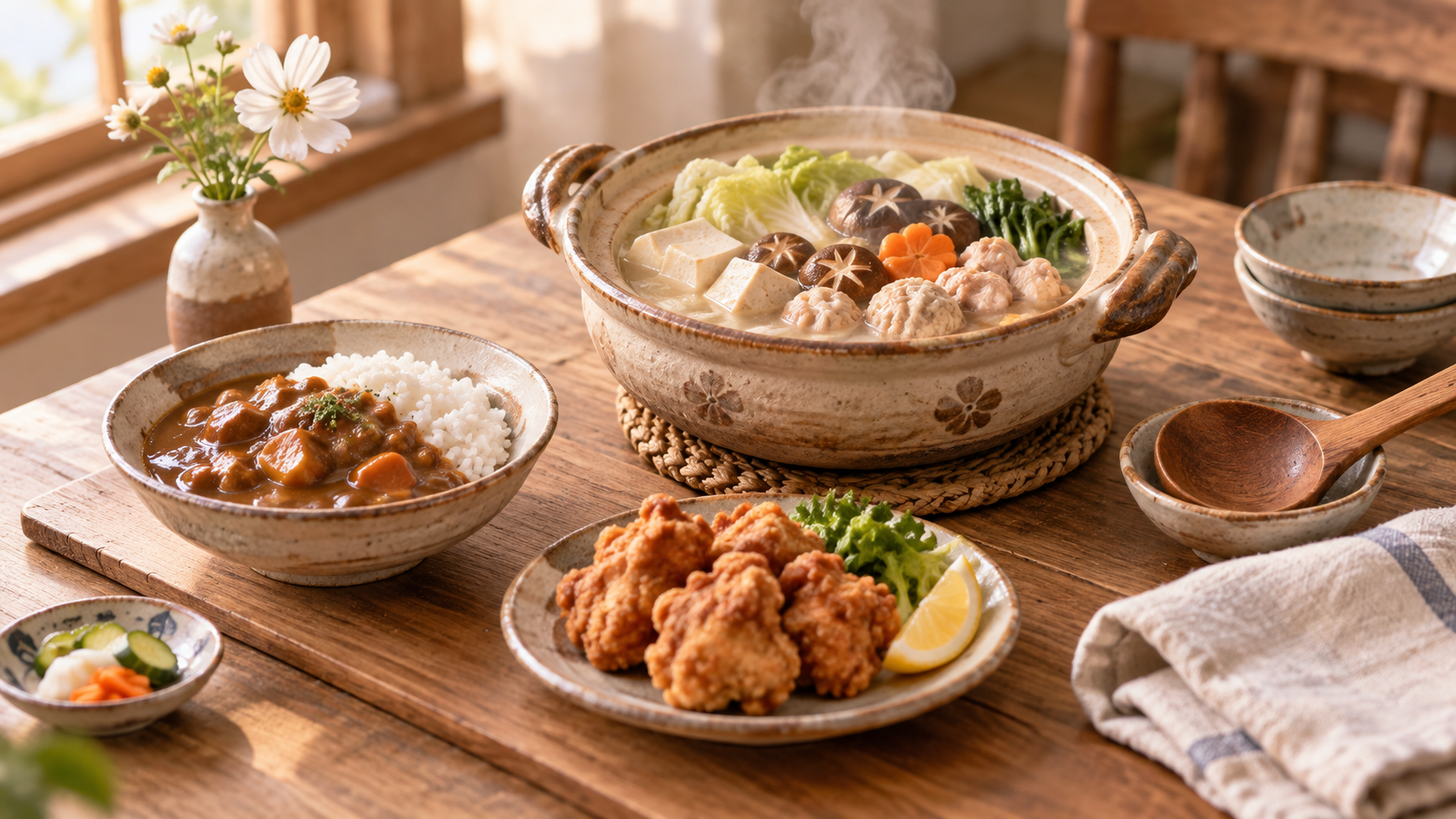
Chanko is not only the name of a Japanese hot pot. The Japan Sumo Association explains that food cooked by wrestlers can collectively be called chanko: curry or fried chicken may qualify too. If you have a chance to eat a bowl at Ryogoku Kokugikan, following one ingredient can open a question about food in communal stable life. One bowl cannot establish an individual wrestler’s nutrition, size or health.
Many overseas visitors meet the phrase *chanko nabe* before they know a single wrestler. That familiar translation is useful, but it can make the stable’s food culture seem like one fixed recipe. The better story begins with the people who practise, cook, eat and clean within the same daily community.
Detailed description of this diagram
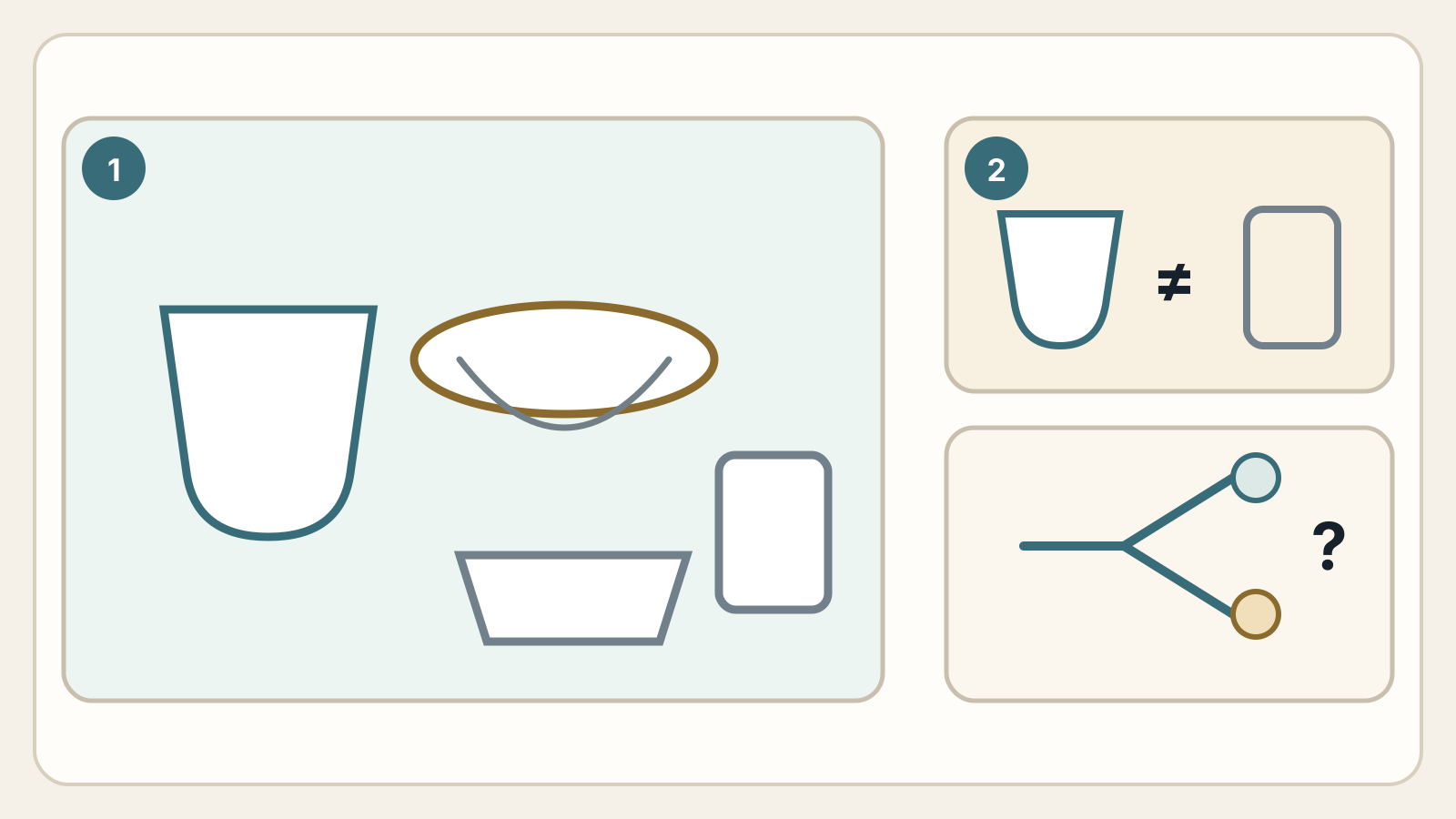
A large left frame contains four blank format tokens resembling a pot, plate, bowl and box solely to show a category broader than one dish type. At upper right, the same generic pot token is separated from the category frame by a not-equal sign, meaning chanko is not synonymous with hot pot alone. At lower right, branching lines and a question mark preserve multiple origin theories and no settled etymology. Tokens are not actual dishes, vessels, a stable, menu or recipe. Ingredients, flavour, colour, portion, nutrition, calories, price, service time, current availability, body effect and a single origin are absent.
Graphic: SUMO ARCHAEOLOGY CLUB · Figure source
Chanko does not mean one recipe
Japan Sumo Association Quiz No. 1141 says that food made by wrestlers is generally called chanko and is not limited to hot pot. This means *chanko* and *chanko nabe* are not perfect synonyms. There is no single official broth, protein or list of vegetables that turns a meal into the only authentic form.
The same official explanation also warns that the origin of the word has several theories and no settled answer. One theory connects it with the name of a Chinese-style metal pot; others connect it with ways of referring to elders, cooks, masters and pupils. Treat these as theories, not a charming certainty to repeat without qualification.
Why a shared pot makes practical sense
The Association’s Kokugikan food guide describes hot pot becoming established in sumo stables in the Meiji period because it could feed many people economically while combining meat and vegetables. That account helps a visitor see the pot as working equipment for communal life, not merely a themed restaurant dish.
Recipes naturally vary by stable, season and cook. Rather than looking for a secret ingredient that supposedly creates a wrestler’s body, notice the structure: vegetables, a source of protein, broth and something that can accompany rice. Training, rest, health and individual needs cannot be reduced to one bowl.
Check the arena menu on the day
The official page at the September 2026 address currently contains a note saying that its listed information is from the May tournament, while other wording on the page refers to the current tournament. Because that source conflicts with itself, this guide does not freeze a price, serving time, flavour or stable name as a September guarantee.
If eating chanko matters to your day, check the current arena signs and official guide after you arrive. Availability can change, and a popular serving may sell out. Food-allergy needs and rules for eating in different seat types require their own checks. Do not build the entire visit around one menu item.
Follow one ingredient, then return to the dohyo
Choose one ingredient in the bowl: tofu, cabbage, chicken, a mushroom or anything else you recognise. Notice what it contributes and how it takes on the shared broth. This is the food equivalent of following one wrestler through a tournament. A single thread makes a crowded scene easier to read.
Then return to the bouts without turning the meal into a body-building myth. The bowl cannot explain a wrestler’s size, strength or health. What it can offer is a warm glimpse of the work that continues away from the public ring. Sumo becomes more human when the arena’s clay, the stable kitchen and the people who maintain both begin to belong to the same day.
Keep More Than One Interpretation Open
We separate what the official or collection source establishes from our observation. A ritual, object or posture may have another interpretation or theory across periods, regions and explainers. When primary evidence does not establish a single origin or meaning, we leave it unknown or contested rather than turn visual resemblance into historical fact.
Evidence limits and event-day fallback
Confirmed fact: A 2025 Association explainer says food made by wrestlers is generally chanko, not only hot pot, and gives multiple unsettled origin theories. The Kokugikan page at a September URL retains May wording and is internally conflicted as current information.
What remains unknown: Live sales, price, time, flavour, stable name, stock, ingredients, cross-contact, seat eating and personal allergy safety are not established. A historical account cannot explain an individual wrestler’s diet, size or health.
Reasoned inference: Reading the pot as equipment for communal life, or following one ingredient back to sumo, is an editorial interpretation. Confidence is medium; it proves no nutritional outcome, unique food culture or individual diet.
Editorial suggestion: If eating it, separately confirm sale, ingredients and seat rules in the event-day official display and at the counter. Seek appropriate clinical advice for personal allergy questions; this article is not a safety assessment.
Fallback: If it is sold out, the page conflicts, or ingredients, cross-contact or seat rules remain unclear, do not depend on one bowl; choose verified food or eat before/after the visit.
Sources
- Japan Sumo Association, Quiz No. 1141 and the September 2026 Kokugikan food guide (checked 3 September 2026). The unresolved tournament-label conflict on the food page is disclosed above; changeable menu details are not treated as confirmed.
Source links used for verification
Each link was used for the corresponding claim in this article; inclusion is not a blanket endorsement of the whole page.
Article verified:
- Japan Sumo Association Quiz No.1141 on chankoHistorical primary source (record from that period)
- Japan Sumo Association September 2026 Kokugikan food guidePrimary source (conflicting details noted)