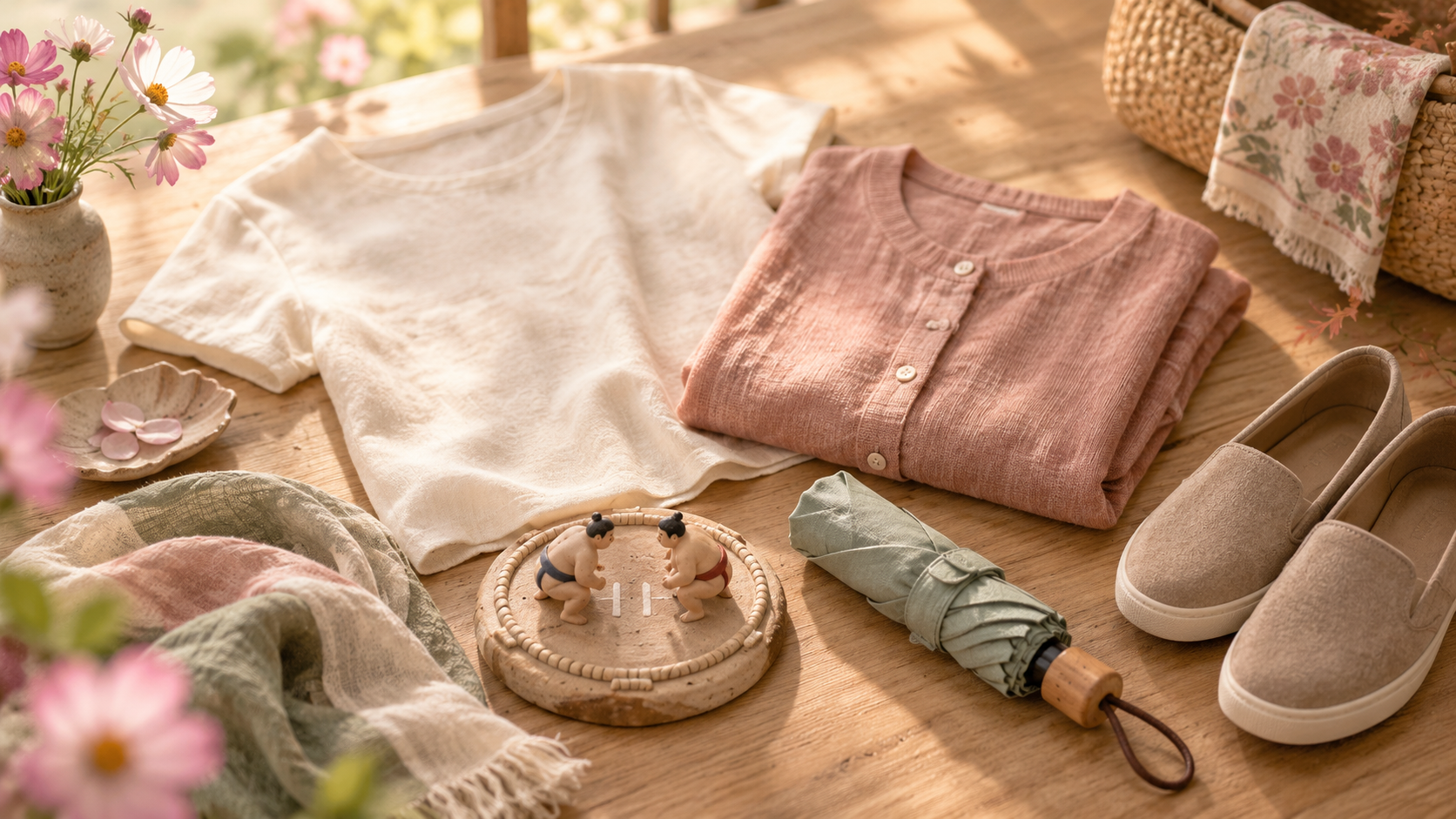
Start with a T-shirt or light long-sleeved top, carry one packable layer, and add a compact rain option if the forecast calls for it. For a masu box, choose clothing that remains comfortable on the floor and shoes that are easy to remove. The arena does not publish a guaranteed interior temperature, so layers are safer than claims that it is always cold or always warm.
September in Tokyo is technically autumn, but the tournament begins while summer heat may still be present. By the final weekend, the climate normals have shifted noticeably. The season moves during the same fifteen days as the banzuke story.
A simple “base, layer, rain” plan
You do not need a specialist sumo outfit. Pack around three functions:
- a breathable base top that can handle a warm walk to Ryogoku;
- one cardigan, overshirt or light wrap that fits back into your bag;
- a folding umbrella or light rain shell when rain is forecast.
Use clothing you already own before buying anything. The useful test is whether you can remove a layer, sit without restriction and keep wet items contained.
What Tokyo’s official climate normals say
The Japan Meteorological Agency’s 1991–2020 daily normals put September 13 in Tokyo at an average of 24.0°C, a normal high of 28.2°C and a normal low of 20.9°C. For September 27, the figures are 21.0°C, 25.1°C and 18.0°C.
Across the full month, the normal mean temperature is 23.3°C and normal precipitation is 224.9 mm.
These are climate normals, not the September 2026 forecast. Check the JMA forecast 24 to 48 hours before your visit, then look at both your arrival and departure times. A warm afternoon does not guarantee an equally warm trip home.
The three-degree drop in normal daily highs between opening day and the final day explains why one fixed “September outfit” is not reliable.
Is Ryogoku Kokugikan cold inside?
We found no current official fixed air-conditioning temperature or seat-by-seat comfort measurement for the arena. Body heat, an open doorway, your arrival time and how long you remain seated can all change the experience.
Visitor anecdotes may be useful personal clues, but they should not become a venue fact such as “the Kokugikan is always freezing.” Carrying one thin layer works across more situations: put it on when sitting still, and remove it when the concourse or crowd feels warm.
If you enter early, remember that your day may stretch from quiet lower-division bouts into a full arena for makuuchi. The atmosphere—and your own level of movement—changes along the way.
Masu-box clothing needs one extra test
A standard masu box is about 1.3 metres square and uses floor cushions. Clothing is not restricted to a particular style, but you may sit with bent knees, turn within a shared box and remove your shoes.
Before the trip, sit on the floor for a minute in the outfit you plan to wear. Check the waistband, knees, hem and any hard decoration. The aim is not to dress less well; it is to prevent your clothing from demanding attention during every shikiri.
The official guide says shoes and umbrellas go in the storage space behind your own box. Compact items usually simplify that small shared area. In severe weather, however, safety and the actual forecast matter more than packing elegance.
Chair seats are easier, but the bag still matters
Chair seating is on the second floor. You avoid prolonged floor sitting, but you may use stairs and walk around the concourse. Comfortable, familiar shoes remain the best default.
If you also carry binoculars, a power bank and travel documents, test the total bag weight with your layer and rain item inside. “Just in case” objects have a way of forming their own stable of contenders.
Rain-day mistakes to avoid
- letting a wet umbrella extend into a walkway;
- spreading bags across the limited floor area;
- checking only the afternoon high and ignoring the evening temperature;
- treating a climate normal as an actual forecast;
- treating one review of the air conditioning as a guaranteed seat condition.
If a typhoon or severe weather threatens transport, clothing advice becomes secondary. Check the Association, transport operators and JMA before travelling, and do not force the journey.
Thirty-second check the night before
- Check the forecast for both arrival and departure.
- Put one packable layer beside your base top.
- If you have a masu box, test the outfit while seated on the floor.
- Contain the umbrella or wet layer inside the bag.
- Choose shoes for walking and easy removal, not novelty.
Good clothing disappears from your attention. That leaves room to notice the embroidered kesho-mawashi, the changing colour of a gyoji’s robes, and the instant when a still arena becomes a collision.
Rehearse heat, air-conditioning, rain and floor sitting
Confirmed fact: JMA September normals provide seasonal context, not the forecast or indoor Kokugikan temperature for your visit.
What remains unknown: Indoor comfort, rain, storage room for wet shoes and umbrella, and changing space in crowds remain unconfirmed.
Reasoned inference: Comparing seasonal context with indoor-outdoor transitions suggests separating a light adjustable layer from rain protection increases options. Confidence is medium; this concerns adjustability, not an indoor-temperature estimate. Live forecast and notices override it.
Editorial suggestion: In the full outfit, rehearse floor sitting, standing, shoes, bagging a wet umbrella and opening the ticket. This is not a venue-dimension model; it tests body, hands, feet and belongings.
Fallback: Delete the detour, change layers and switch to chair seating, a shorter visit or no travel.
Sources
- Japan Meteorological Agency, daily September climate normals for Tokyo, 1991–2020 period, checked September 2, 2026.
- Japan Meteorological Agency, monthly Tokyo climate normals: September mean 23.3°C and precipitation 224.9 mm, checked September 2, 2026.
- Japan Sumo Association 2026 tournament schedule. The September tournament runs September 13–27.
- No fixed interior-temperature claim is made because no current official specification was confirmed.
Source links used for verification
Each link was used for the corresponding claim in this article; inclusion is not a blanket endorsement of the whole page.
Article verified:
- Japan Meteorological Agency daily September climate normals for TokyoPrimary source (as checked for this article)
- Japan Meteorological Agency monthly climate normals for TokyoPrimary source (as checked for this article)
- Japan Sumo Association tournament schedulePrimary source (as checked for this article)
- Japan Sumo Association September 2026 seating guidePrimary source (as checked for this article)