Tottari can emerge from a thrusting exchange or a contest for an inside arm. The winner captures one of the opponent’s arms with both hands, opens his body and twists that arm towards himself to bring the opponent down. “Someone grabbed an arm” is too broad. Look for two hands closing on the same arm, followed by the winner moving off the direct line. In the next bout, do not count the thrusts; watch whether the space between one wrestler’s hands suddenly disappears around one arm.
Tsuppari exchanges can make a beginner’s eyes chase every palm. Tottari offers a different rhythm. Two hands that were moving separately suddenly converge on a single target. For an instant, the crowded picture has one clear arrow—and the captured arm can redirect the whole opponent.
The official sequence begins with one arm and two hands
The Japan Sumo Association describes tottari as arising amid pushing and thrusting or the battle to insert an arm inside. The attacker embraces one of the opponent’s arms with both hands, opens his body and twists the arm towards himself to topple the opponent.
Watch it in that order. First, two hands gather around one arm. Second, the attacker turns his torso away from a head-on position. Third, the captured arm is drawn and twisted towards his side. If you start with the falling wrestler, the arm may already be hidden beneath two bodies.
From some seats, it will be impossible to tell whose hands own which arm. Keep your call provisional. After the announcement, rewind mentally or on an available replay to the first moment when the hands converged; that is more useful than guessing from the landing.
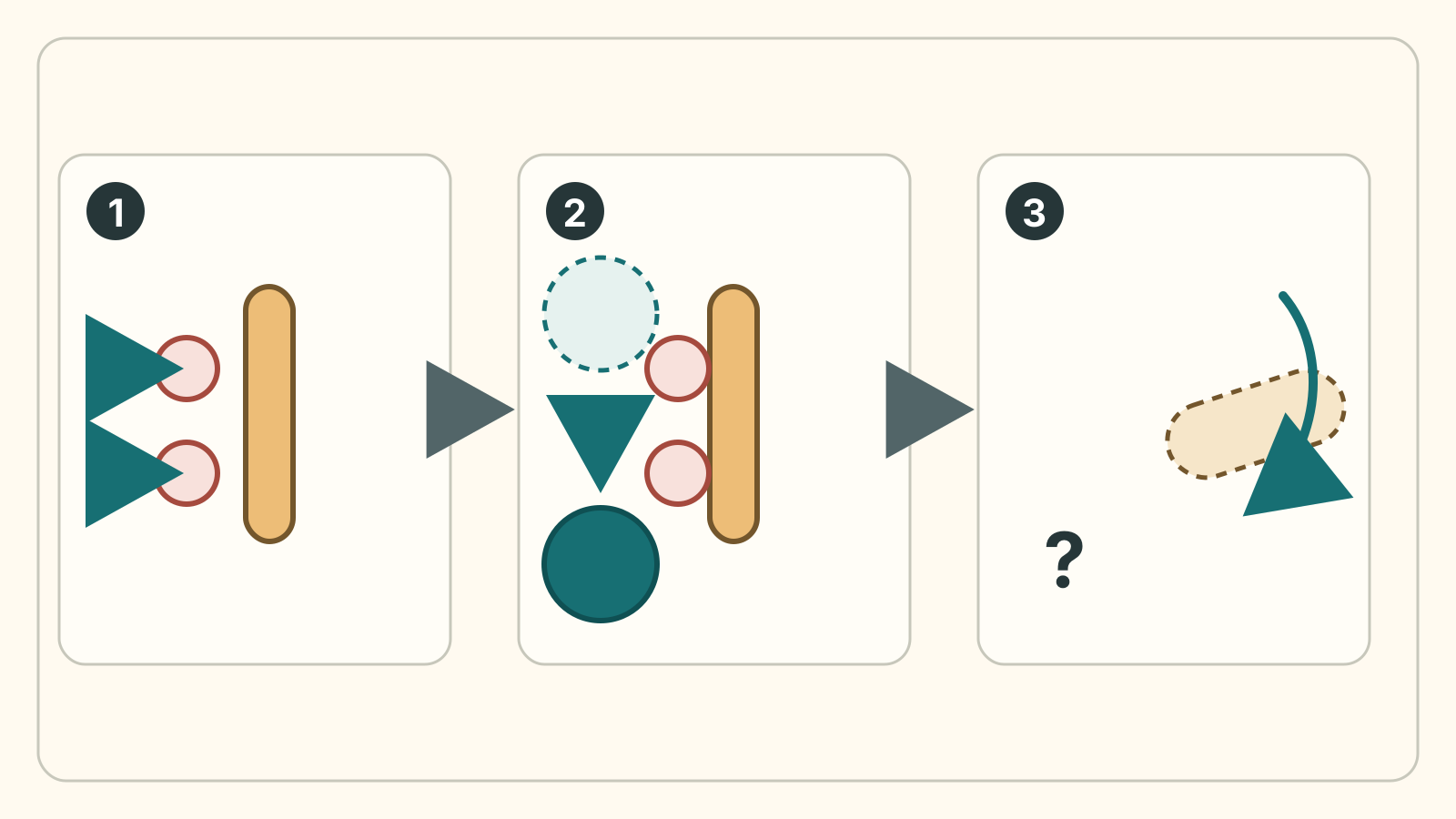
Detailed description of this diagram
Card 1 represents one opponent arm as a gold bar and the winner's two hands as two red contact dots converging on it. Card 2 keeps the bar and dots while moving a blue winner token off the line, recording body opening. Card 3 uses a horizontal gold token and a returning curve for the categorical twist-towards-self down state. The bar, dots and curve encode no wrist, elbow, shoulder, hand placement, grip, joint lock, torque, pain, sidestep, angle, fall path or execution method.
Graphic: SUMO ARCHAEOLOGY CLUB · Figure source 1 · Figure source 2 · Figure source 3
Sakatottari is the captured wrestler’s reversal
Sakatottari literally signals a reversal of the tottari situation. According to the Association, a wrestler who is being attacked with tottari pulls his captured arm free while twisting his hips and turns the technique back on the original attacker.
The final rotation alone may look ambiguous because both wrestlers are twisting. Return one second and ask who was initially captured. If the wrestler who first secured the opponent’s arm completes the inward twist, tottari is the candidate. If the captured wrestler extracts his arm, turns his hips and drops the attacker, consider sakatottari.
The “reverse” in the name is not merely a clockwise-versus-counter-clockwise instruction. It describes the relationship between the original attack and the response.
Kainahineri also uses two hands on one arm
Kainahineri, often rendered as arm twist, shares an important visual clue: the winner embraces one opponent arm with both hands. The Association’s definition then has him twist that arm outward to topple the opponent. Tottari has the wrestler open his body and twist the captured arm towards himself.
Hand count alone therefore cannot settle the difference. Once the hands converge, see where the winner moves and where the arm is guided. If the key direction is not visible, let the official call do the final work.
Kotenage is another neighbour, but it begins with the wrestler’s outside arm wrapping over the opponent’s inserted arm and pressing it down into a throw. The two-hands-to-one-arm convergence is the simpler early clue for tottari.
The name does not establish pain or intent
An isolated replay of an arm twist can look uncomfortable. The kimarite describes the decisive mechanics, not a diagnosis and not a finding about the winner’s intention. Do not state that a wrestler was injured unless a reliable announcement establishes it.
Precision makes room for both fascination and care: we can describe which arm was held and how the body opened without inventing what the wrestlers felt.
One thing to watch in the next bout
During the first thrusting exchange, watch the distance between one wrestler’s two hands. If they close around the opponent’s same arm and his body then opens away from the line of attack, predict tottari. Do not try to follow all four hands.
The opponent may pull his arm away before the twist develops. That failed capture is still a delightful thing to notice. A barrage that once looked like undifferentiated speed now contains a small tug-of-war: one arm is offered, claimed or recovered. Tottari teaches the eye that a wrestler does not always defeat the force coming towards him; sometimes he collects one moving part and lets it turn the whole body.
Sources
- Japan Sumo Association, kimarite explanation for tottari (checked 3 September 2026)
- Japan Sumo Association, kimarite explanation for sakatottari (checked 3 September 2026)
- Japan Sumo Association, kimarite explanation for kainahineri (checked 3 September 2026)
- Japan Sumo Association, kimarite explanation for kotenage (checked 3 September 2026)
Source links used for verification
Each link was used for the corresponding claim in this article; inclusion is not a blanket endorsement of the whole page.
Article verified:
- Japan Sumo Association kimarite: tottariPrimary source (as checked for this article)
- Japan Sumo Association kimarite: sakatottariPrimary source (as checked for this article)
- Japan Sumo Association kimarite: kainahineriPrimary source (as checked for this article)
- Japan Sumo Association kimarite: kotenagePrimary source (as checked for this article)