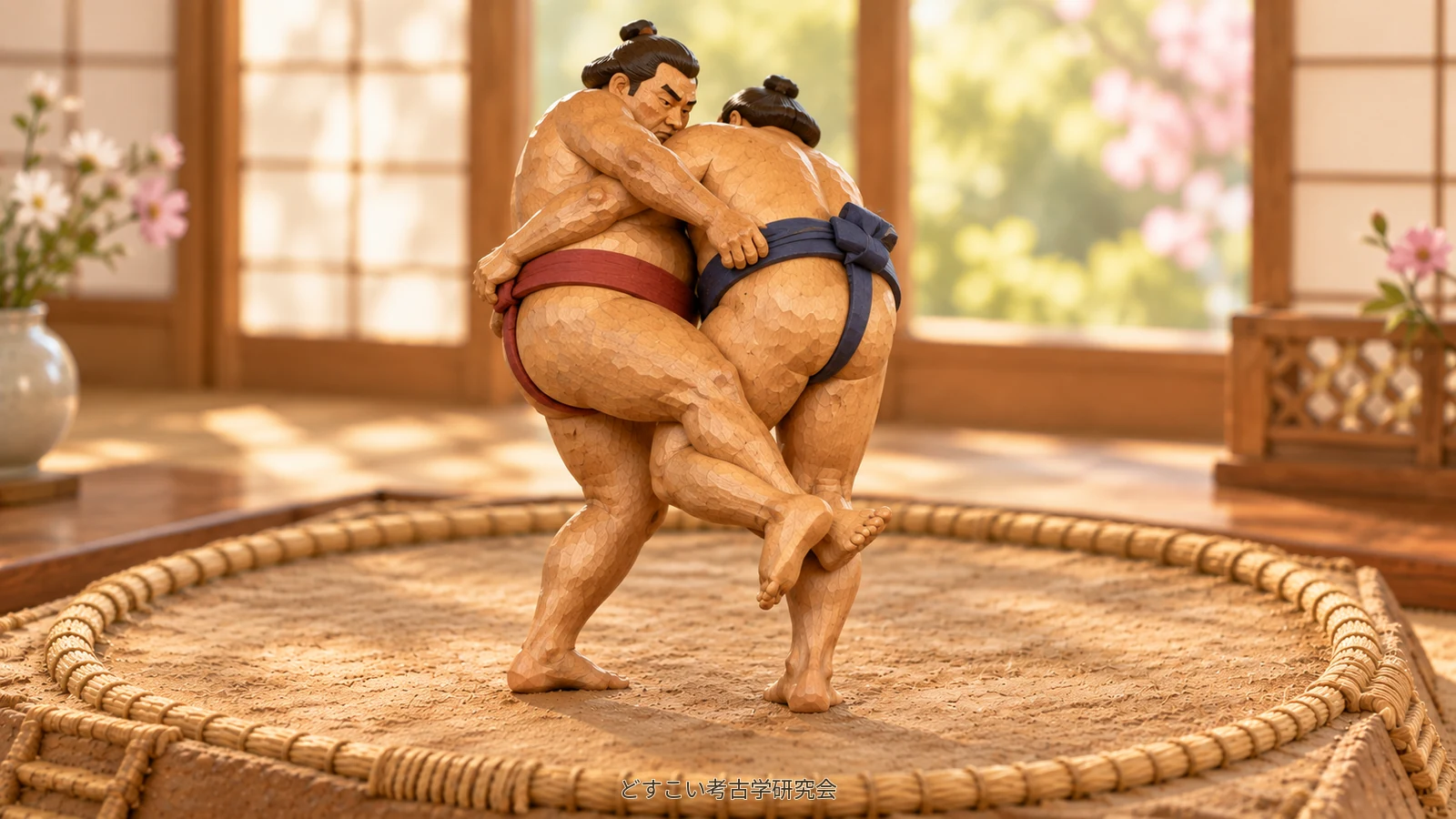
For uchigake, the winner uses his right foot against the opponent’s left leg, or his left against the opponent’s right. He hooks that opposite leg from its inside, pulls it away, breaks the opponent’s balance and brings him down backwards. “Inside” does not mean the centre of the ring. In the next bout, ignore three of the four feet: did one attacking foot enter between the legs and pull the target leg from its inner side?
A belt clinch can look almost motionless above the waist. Then one set of hips disappears and a wrestler lands on his back. Uchigake invites your eyes into the small window between the knees. The contest was moving all along; most of it was simply happening one floor below the mawashi.
Make one pair of opposite feet
The Japan Sumo Association defines the pairing explicitly. The winner’s right foot attacks the opponent’s left leg, or the winner’s left foot attacks the opponent’s right. Facing each other, those are the legs that meet across the centre line.
The attacking foot hooks the target leg from inside and pulls it away. The opponent loses his centre of gravity and falls backwards. Do not try to narrate right, left, right, left at full speed. Choose one attacking foot and pair it with the opponent’s leg directly across from it.
Once bodies rotate, the left side of a television screen is no longer a stable guide. “Inside” must remain attached to the target leg. The attacking foot arrives from the side nearer the gap between the two wrestlers’ legs.
Uchigake vs sotogake: the target stays, the route changes
Sotogake uses the same opposite-foot pairing: right against left or left against right. On the official page, however, the winning foot circles around the outside of that target leg and pulls it to topple the opponent backwards.
Because both finishes can produce a backward fall, the landing pose is not a reliable separator. Rewind to the route. Did the attacking foot travel through the gap between the legs for uchigake, or around the outer edge of the target leg for sotogake?
Our comparison article maps those two entrances side by side. Here the useful extra step is to follow the official sequence after the inside hook: the target leg is pulled and the opponent is brought down backwards. Video alone does not establish force or the exact biomechanics of the fall.
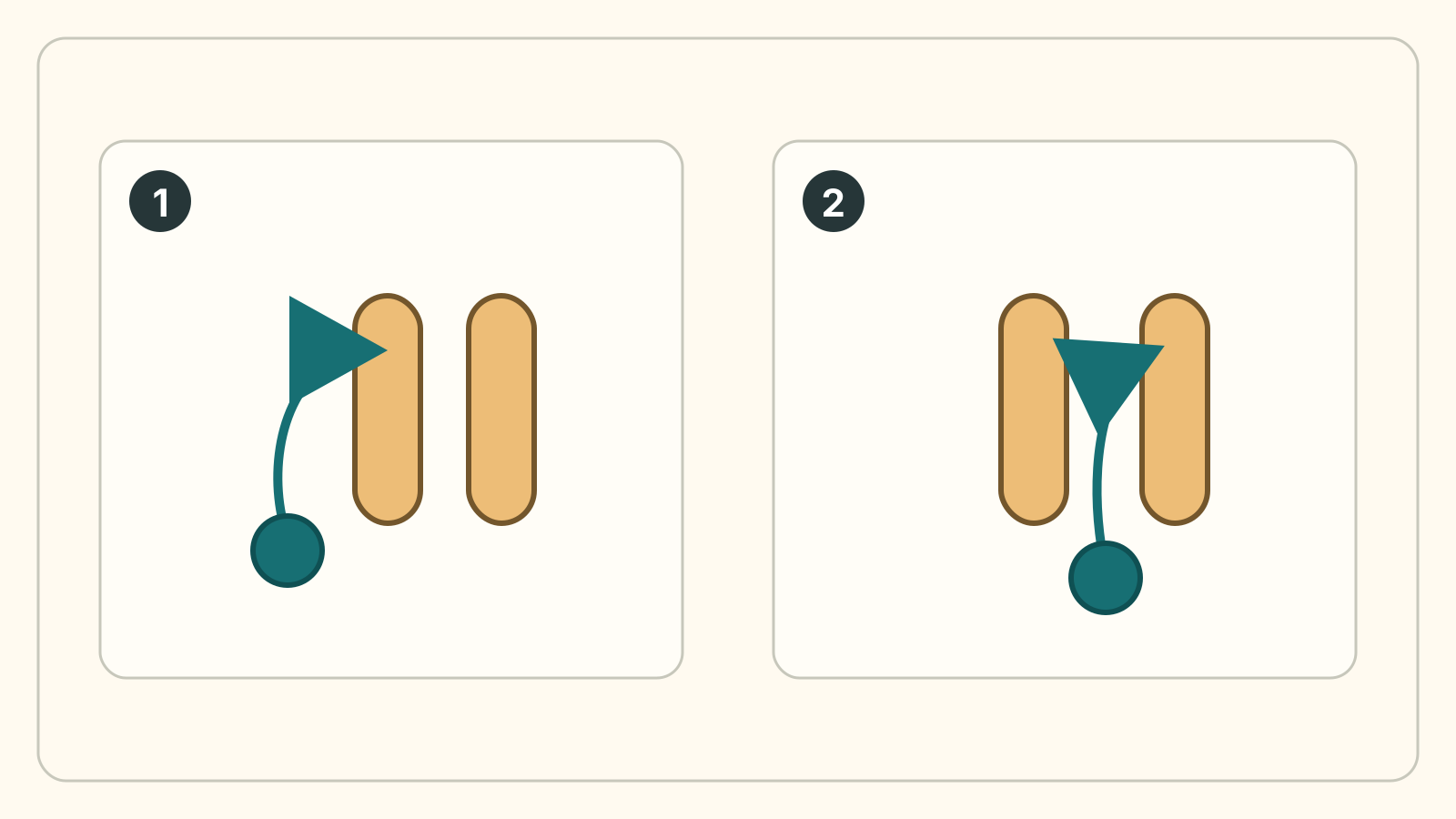
Detailed description of this diagram
Card 1 uses two gold vertical support bars and a blue curved cue from outside the pair towards the selected bar, encoding only the relative outside relation in the official sotogake definition. Card 2 uses the same pair and brings the blue cue from the space between them towards the selected bar, encoding only the relative inside relation in the official uchigake definition. The gold bars do not reproduce legs, thickness or stance, and the blue marker is not a foot or ankle. Curves do not prescribe path, hook height, pull, posture, fall direction or success. Left and right can reverse in a real bout; the visual isolates only outside versus inside of the opposite foot.
Graphic: SUMO ARCHAEOLOGY CLUB · Figure source 1 · Figure source 2 · Figure source 3
Uchigake vs chongake: opposite-side or same-side feet?
Chongake also uses a hook from inside, which makes it an important trap for a simple “inside equals uchigake” rule. The Association describes a different pairing. The winner’s right toes hook the opponent’s right heel, or left toes hook the left heel, from inside and draw it towards him. The winner arches his upper body and twists the opponent sideways or backwards.
Uchigake pairs right with left or left with right. Chongake pairs right with right or left with left and specifically connects toes to heel in the official explanation. First identify the paired legs; only then use the inside route.
Uchigake vs kakenage: pull the leg or lift the thigh?
For kakenage, the Association describes placing a leg into the opponent’s inner thigh during a belt clinch and throwing while lifting or springing that thigh upwards. It is not enough to say that “a leg was involved.”
Uchigake hooks the opposite leg from inside and pulls it away, breaking the base into a backward fall. Kakenage enters higher at the inner thigh and lifts as part of the throw. Look for contact level and direction: lower leg drawn away, or inner thigh raised.
One thing to watch in the next bout
Imagine a narrow window between the wrestlers’ knees. Select one foot belonging to the wrestler who appears to be setting the trap. Does it enter that window, catch the opposite leg from inside and pull? If so, keep an uchigake prediction while you wait for the official call.
The defender may withdraw the foot and stay upright. That is not a failed viewing exercise. You have seen a base being protected before a technique could acquire a name. Above, arms negotiate the belt; below, feet negotiate permission to keep standing. After learning uchigake, a “still” clinch can feel wonderfully crowded with choices.
Similar Motion Does Not Set the Official Technique
A hand action or fall may look similar while the recorded kimarite differs according to the decisive action, sequence of balance loss and whether a body part touched down or crossed the ring first. Do not settle the difference between a similar technique, non-technique or foul from one camera angle; use the official result for that bout. A schematic marks viewing cues, not a substitute judges’ decision.
Evidence limits and event-day fallback
Confirmed fact: The Association describes uchigake as using the right foot against the opponent’s left (or the reverse), hooking from inside, pulling that leg, upsetting the centre of gravity and bringing the opponent down backwards.
What remains unknown: The paired legs, inside/outside contact, pull and decisive action may be hidden. Amount of weight shift, force, intention, joint condition, pain and injury cannot be established by appearance.
Reasoned inference: Following one attacking foot with the opposite target leg can organise possible uchigake, sotogake or another finish. Confidence is medium; this viewing method is not an official judging criterion.
Editorial suggestion: Record only contact side and visible direction; do not extend an abstract cue into angles, force or a safe way to perform the technique. It is not coaching or medical advice.
Fallback: If legs overlap, the sole is hidden or another action may have decided the bout, do not classify; check the official result.
Sources
- Japan Sumo Association, kimarite explanation for uchigake (checked 2 September 2026)
- Japan Sumo Association, kimarite explanation for sotogake (checked 2 September 2026)
- Japan Sumo Association, kimarite explanation for chongake (checked 2 September 2026)
- Japan Sumo Association, kimarite explanation for kakenage (checked 2 September 2026)
Source links used for verification
Each link was used for the corresponding claim in this article; inclusion is not a blanket endorsement of the whole page.
Article verified:
- Japan Sumo Association kimarite: uchigakePrimary source (as checked for this article)
- Japan Sumo Association kimarite: sotogakePrimary source (as checked for this article)
- Japan Sumo Association kimarite: chongakePrimary source (as checked for this article)
- Japan Sumo Association kimarite: kakenagePrimary source (as checked for this article)