A yokozuna’s white rope uses materials and visual language that recall a Shinto *shimenawa*: hemp, a white covering and folded paper streamers called *shide*. A common misconception is that it is exactly the same object, or that this alone establishes that the yokozuna is a deity. Keep two official explanations clear instead: the Japan Sumo Association describes the wrestler’s rope and how it is made; the Association of Shinto Shrines explains what a shrine shimenawa marks. At the next ring entry, begin with one very small thing: find a single white paper streamer hanging at the front.
Most newcomers watch the wrestler’s arms, understandably. Once you notice the paper, however, the rope stops being a broad white belt and becomes a constructed object. That object contains hemp, cotton, wire, paper and many hours of work by people from the stable.
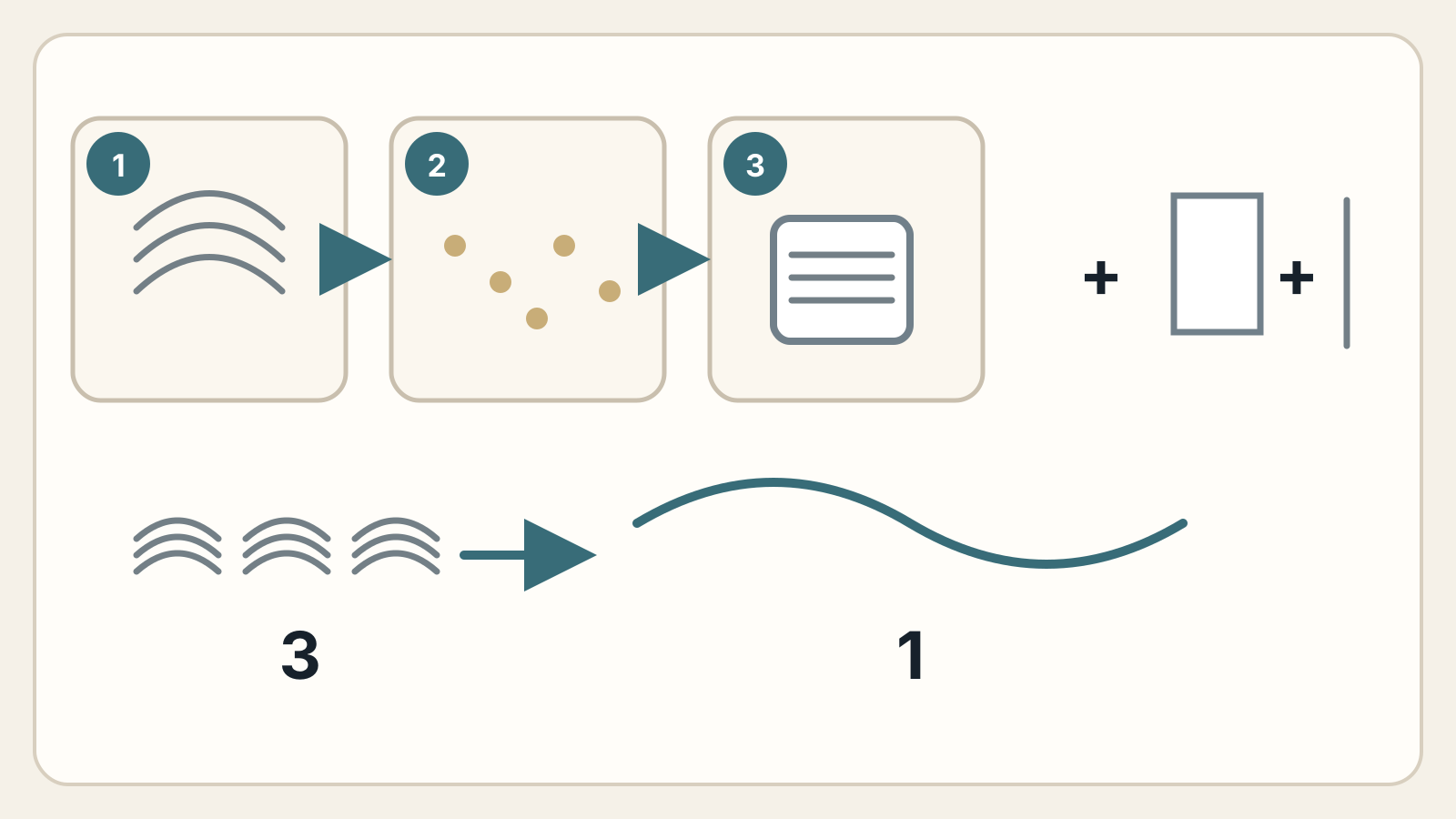
Detailed description of this diagram
Three upper cards connect an abstract fibre bundle, a dotted rice-bran category and an unmarked outer wrapping layer. Below, three prepared line bundles converge into one thicker abstract line. Separate blank paper and thin-wire tokens stand for cited shide and the copper wire used in rear loops; their forms are not facsimiles. The diagram gives no quantities, fibre count, length, thickness, twist direction, force, duration, shide fold, number or position, loop, knot, dressing method, body fit, weight distribution or theological interpretation. Shrine-context meaning is not automatically transferred to the sumo object.
Graphic: SUMO ARCHAEOLOGY CLUB · Figure source 1 · Figure source 2 · Figure source 3 · Figure source 4
The paper is called shide
The Japan Sumo Association calls the cut-and-folded chain of white rectangles hanging from the rope *shide*. Its official explanation says these streamers are made from fairly thick Japanese paper and inserted into the rope so that they hang at the front.
Inside the rope, hemp is softened by rubbing it with rice bran, then wrapped in bleached cotton. Three such ropes are made and twisted together. The Association gives a typical weight of about five to six kilograms, while noting that it varies with the wrestler’s build. Copper wire inside the loops at the back helps them hold their three-dimensional shape.
Those back loops also provide an easy clue to the ring-entry style. The Unryu style has one loop; the Shiranui style has two. You do not need to identify the arm sequence first. Wait until the wrestler turns and count the loops.
Put the number and the inference boundary first
The approximately five-to-six-kilogram figure is not our estimate from a photograph. It reproduces the range published by the Association, which says the value varies with the wrestler’s build. The source does not give the confidence with which that range applies to any named rope, its measurement method, measurement error, or separate hemp, cotton, paper and wire weights. We therefore do not calculate an individual rope’s mass from apparent thickness or loop count.
Our statement that the objects “recall” one another or share vocabulary is an inference. The method is a field-by-field comparison of the Sumo Association’s material, shide and rope-making descriptions with the shrine source’s shimenawa and shide explanation. The supported range stops at shared rope, paper-streamer and purity vocabulary. Origin, exact identity, deification and every theological meaning remain unknown. Confidence is medium for the vocabulary overlap and low for origin or theology. A source set that is not a complete ritual history is itself an error and uncertainty limit.
So is it a shrine shimenawa?
The Association of Shinto Shrines defines *shimenawa* as rope placed around a shrine precinct or ritual space to indicate that the area inside is sacred and pure. It also says paper shide inserted into the rope signify sacredness and purity.
The sumo rope plainly shares some of that vocabulary and appearance. Yet the Association’s sumo sources describe the yokozuna’s rope through its sport-specific construction and use. These sources do not require us to declare that every theological meaning attached to a shrine rope transfers directly onto the wrestler. A careful viewer can recognise the connection without turning it into an unsourced claim that the yokozuna is literally a deity.
For one documented historical milestone, the Sumo Association says that at a shogunal viewing in 1791, Tanikaze and Onogawa performed wearing pure-white ropes with shide. It describes this as the first yokozuna ring entry preserved in the historical record. Questions about an ultimate “origin” can involve later institutional histories, so this guide does not push that dated official statement further than it goes.
The stable makes and twists the rope
Making the rope is called *tsuna-uchi*. The Association says it happens when a new yokozuna is created and also before each of the three annual Tokyo tournaments. Wrestlers from the yokozuna’s stable lead the work; wrestlers from related stables in the same *ichimon* may help when the stable is small.
The preparation is called *asa-momi*: rice bran is used to rub and soften the hemp. Even a stable familiar with the job may need at least half a day, depending on how many hands are available. The calm white rope seen for a few minutes in the arena is therefore not merely an individual costume. It is stable labour made visible—many fibres and many hands brought into one line.
One thing to watch next time
Do not begin by trying to pass a quiz on Unryu and Shiranui. If visible, find one shide at the front and follow the rope when the yokozuna turns. A seat, obstruction or camera angle may hide the loops; if so, do not assign a count and return to an official explainer or another view. Only then move your eyes to the arms and rising motion.
The paper may flutter while a loop appears to hold its shape, although that view is not guaranteed from every seat or camera. In the same second, recall the hemp, folded paper, wire and rope-making documented by the sources rather than inferring hidden construction from the image alone. A ring entry that once looked like a remote ceremony becomes something unexpectedly tactile. You may not be able to touch the rope, but now you can see the work inside it.
Sources
- Japan Sumo Association, Sumo Quiz No. 1096 on the yokozuna rope and shide, published 8 January 2025 (checked 2 September 2026)
- Japan Sumo Association, Sumo Quiz No. 683 on *tsuna-uchi*, published 22 November 2023 (checked 2 September 2026)
- Japan Sumo Association, Sumo Quiz No. 492 on twisting three ropes, published 15 May 2023 (checked 2 September 2026)
- Japan Sumo Association, Sumo Quiz No. 855 on a documented 1791 ring entry and the later status of the rank, published 12 May 2024 (checked 2 September 2026)
- Association of Shinto Shrines, “Kamidana,” section on shimenawa and shide (checked 2 September 2026)
Source links used for verification
Each link was used for the corresponding claim in this article; inclusion is not a blanket endorsement of the whole page.
Article verified:
- Japan Sumo Association Sumo Quiz No. 1096: the yokozuna rope and shidePrimary source (as checked for this article)
- Japan Sumo Association Sumo Quiz No. 683: making the ropePrimary source (as checked for this article)
- Japan Sumo Association Sumo Quiz No. 492: twisting the ropePrimary source (as checked for this article)
- Japan Sumo Association Sumo Quiz No. 855: the yokozuna rank and ring entryHistorical primary source (record from that period)
- Association of Shinto Shrines: shimenawa and shidePrimary source (as checked for this article)