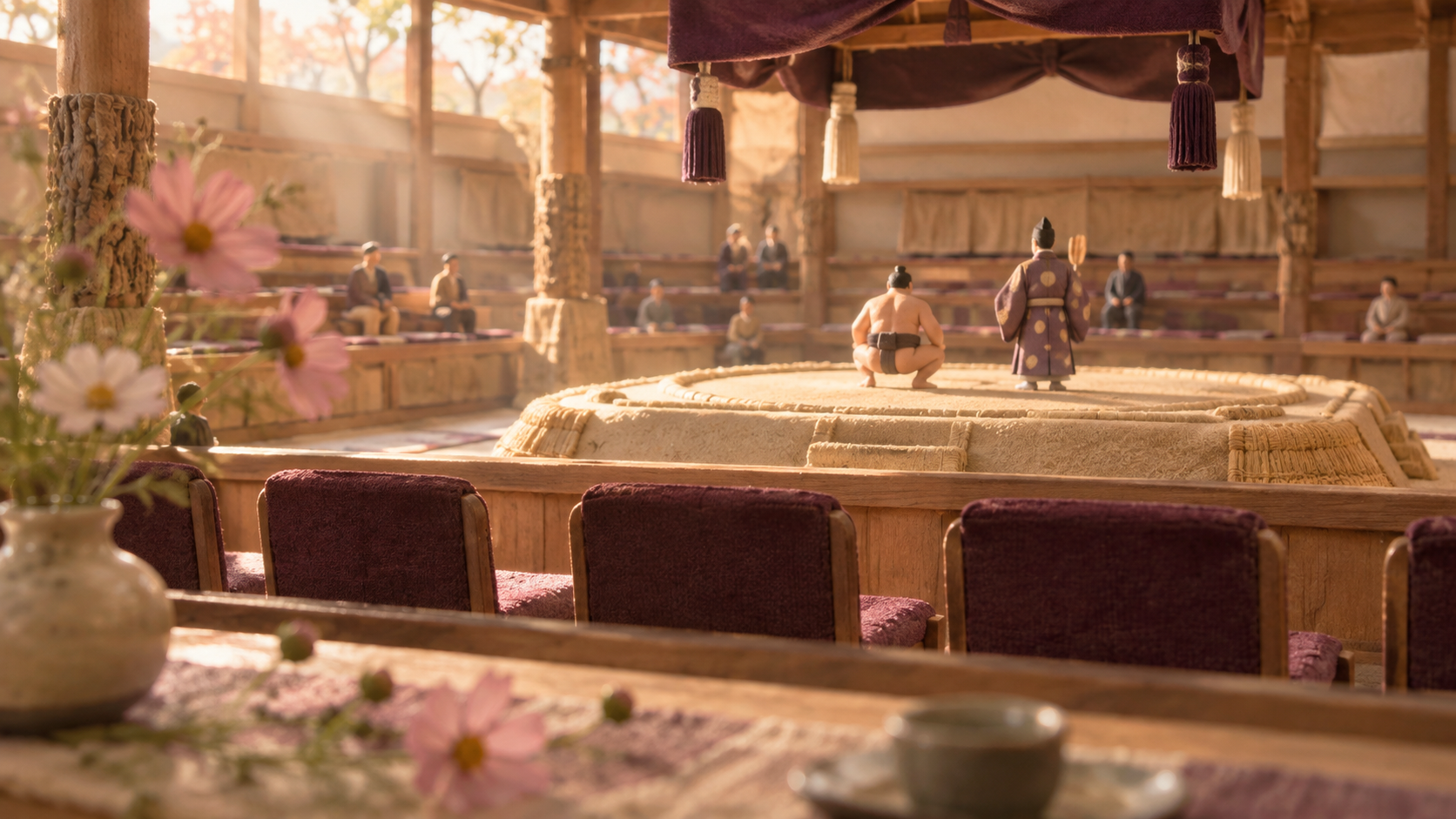
You do not need a famous name to enjoy makushita and the lower divisions. Choose one thing to notice—the yobidashi’s call, the speed of the shikiri or two steps after the tachiai—then identify the wrestler from the official results. A quieter arena contains more audible detail, not less important sumo.
Early honbasho action moves through divisions including jonokuchi, jonidan, sandanme and makushita. The sequence varies by date, so use the official timetable and bout information. This is not another complete day chronology. It is a way to avoid seeing the morning as an empty preliminary.
Do not mistake empty seats for an empty contest
More seats may be open than during makuuchi. Fewer voices do not reduce what the bout means to its wrestlers. It is one of a limited number of tournament contests. Avoid unnecessary movement or conversation during the action and receive the finish with applause.
The quieter building may separate sounds that merge later: a foot brushing the clay, a wrestler’s breath, the gyoji’s voice and the impact of the tachiai. The afternoon has greater crowd heat; the morning can have greater acoustic clarity.
Learn the shikona after the bout
Searching a dense banzuke while the wrestlers prepare can make you miss the opening. First note east or west, belt colour and one physical feature. Match those notes to the official result afterwards and learn the shikona then.
Wrestlers below juryo normally have seven bouts across the tournament, so the same person does not necessarily appear every day. Do not infer today’s participation from yesterday’s memory. Return to the dated official pairing.
Watch the two steps after impact
The opening collision can be too fast for a new eye. Ignore the impact once and follow only the next two steps. Did the feet advance? Did the upper body push while the base stayed behind? Did someone circle to the side? You can compare those choices without knowing a kimarite name.
Repeat the experiment for three bouts. What first looked like the same pushing contest begins to separate into different footwork. The aim is not to display knowledge; it is to take one honest question home.
Create a future reunion
Save one ring name with the date. It does not need to be the winner. Months later, you may find the name higher on a banzuke or meet it again in a juryo ring entrance. A quiet morning bout then stretches into a much longer story.
You have not “discovered” or acquired a young wrestler. You have simply remembered one moment without demanding a result. Morning sumo is a place to keep the small memory that exists before fandom has a name.
Three first-visit scenarios
If you have only ten quiet minutes, listen through three bouts and write down one sound. If you want a small research project, choose one wrestler after the result, record the date and check the next official pairing instead of assuming that person competes tomorrow. If a child or companion becomes restless, watch one complete bout, applaud, and leave the seat at an appropriate break; a short morning is still a real visit.
When you arrive without knowing which division is active, check the current official sequence rather than guessing from the number of spectators. Each scenario begins with what is actually happening, not with a fixed clock copied from another day.
Sources
- Japan Sumo Association September timetable, banzuke and official tournament results, checked September 3, 2026. Confirm each day’s participation from the current official information.
Source links used for verification
Each link was used for the corresponding claim in this article; inclusion is not a blanket endorsement of the whole page.
Article verified:
- Japan Sumo Association September 2026 dohyo timetablePrimary source (as checked for this article)
- Japan Sumo Association September 2026 banzukePrimary source (as checked for this article)
- Japan Sumo Association official tournament resultsPrimary source (as checked for this article)