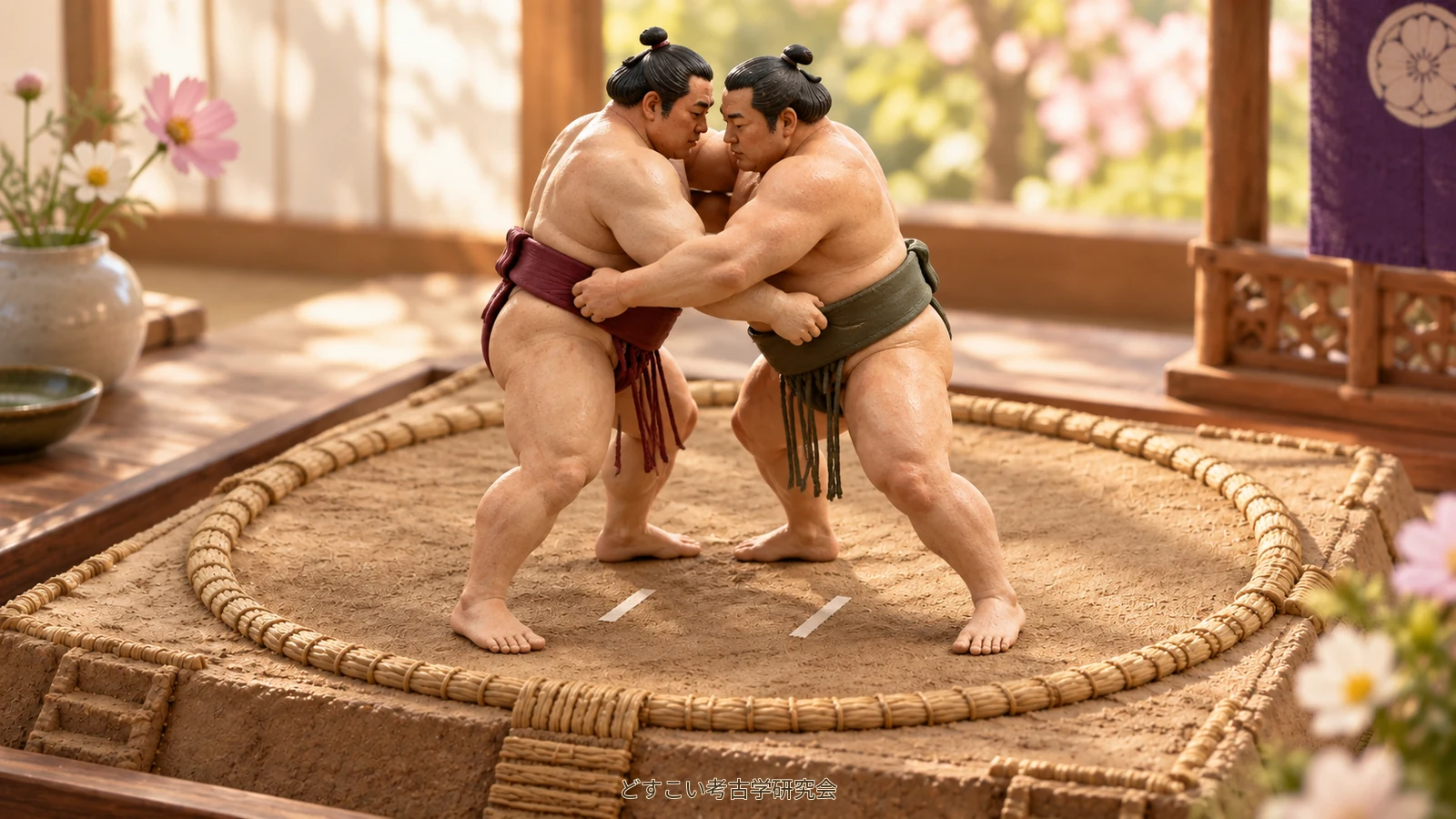
In *migi-yotsu*, both wrestlers normally place the right arm inside the opponent’s left arm and the left arm outside. The inside right hand can take a *shitate*, or underarm belt grip; the outside left can take an *uwate*, or overarm grip. *Hidari-yotsu* is the mirror image. The position is named for the arm inserted inside, not the outside gripping hand.
In the next bout, follow just one right elbow. This is a viewing exercise, not an official judging procedure.
An official profile may list “migi-yotsu, yori” as if those words were self-explanatory. To a new viewer, four arms meet, the bodies hide the belt, and the bout may change before either hand is identified. The Japan Sumo Association’s photograph makes the entry much simpler: find the arm on the inside first. One elbow can turn a profile label into something visible.
Yotsu describes a body-to-body position
The Association broadly contrasts pushing sumo, in which a wrestler attacks from separation, with *yotsu-zumo*, in which the wrestlers engage and work from a belt or close-body position. In migi-yotsu, each wrestler has the right arm inside. The right hand is therefore in position for a shitate grip, while the left arm works outside for an uwate.
Reverse all of that for hidari-yotsu: left inside, right outside. “Right yotsu” does not mean “the important grip is the right overarm grip.” Remember “right arm inserted,” and the name becomes much harder to reverse.
Shitate and uwate are about whether the arm passes inside or outside the opponent’s arm. They are not labels based only on which hand appears lower or higher on the belt. When the grip itself disappears behind two torsos, the elbow often remains the better clue.
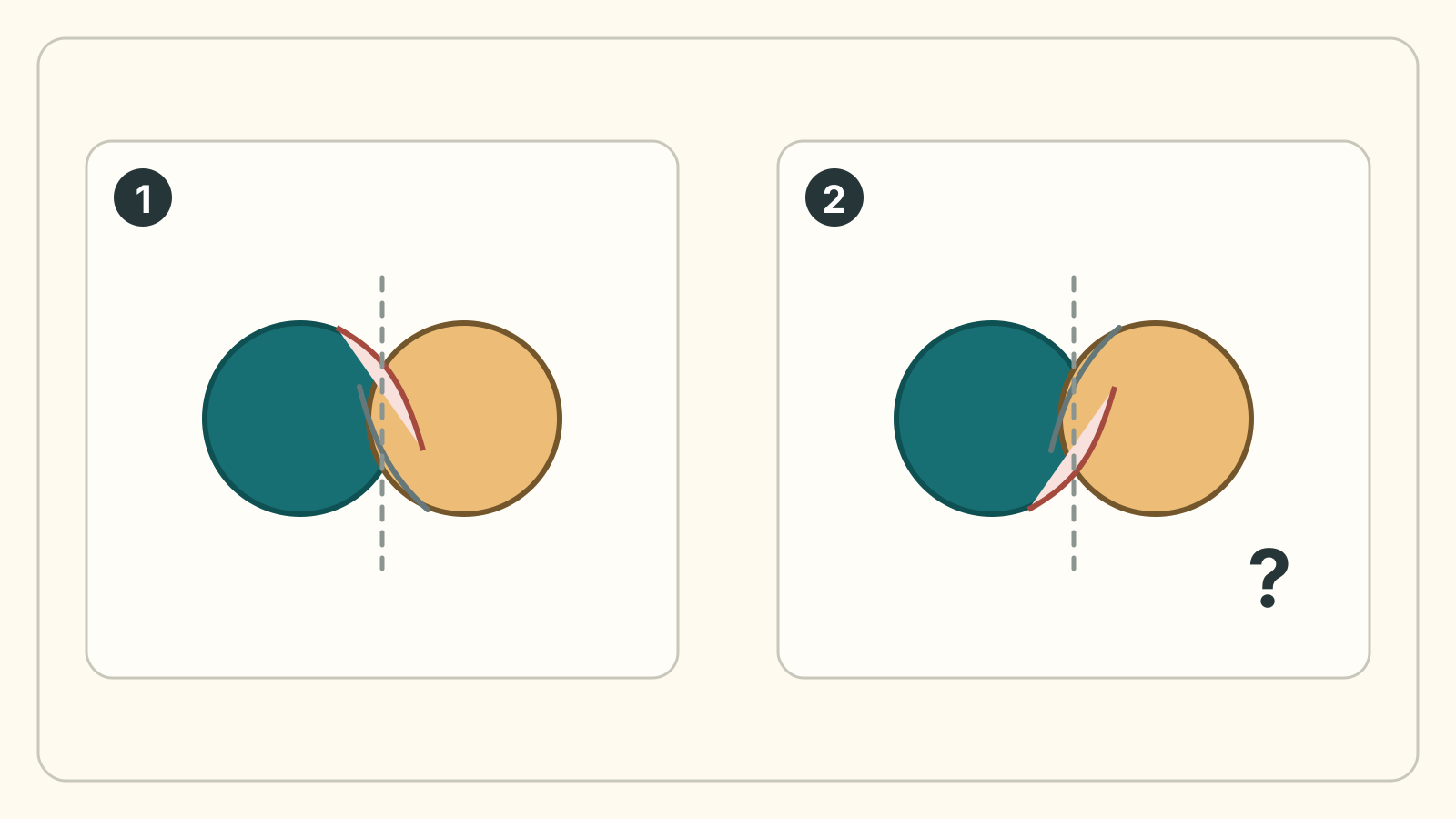
Detailed description of this diagram
Cards 1 and 2 face the same blue and gold competitor tokens across a centre line and mirror only which own-side relation band passes inside. Numbered caption mapping identifies card 1 as migi-yotsu and card 2 as hidari-yotsu. Curves and centre line encode no arm, mawashi, hand position, underarm/overarm height, elbow angle, dominance or winning probability. Ai-yotsu and kenka-yotsu are preference relations, not outcome predictions.
Graphic: SUMO ARCHAEOLOGY CLUB · Figure source 1 · Figure source 2 · Figure source 3
A position is not a guaranteed result
A wrestler reaching a preferred yotsu may have found a familiar working position, but that fact alone does not decide the bout. Foot placement, hip height, the opponent’s response and the next attack still matter. Do not turn a profile’s preferred style into a prediction presented as certainty.
Do not treat the first configuration you identify as a permanent label. Rather than naming every frame, ask one repeatable question: “Where is the right elbow now?” If its position is hidden, leave it unknown instead of guessing from the eventual kimarite.
Ai-yotsu and kenka-yotsu compare two preferences
The Association calls a matchup between wrestlers who prefer the same inside arm *ai-yotsu*. Two migi-yotsu wrestlers form right ai-yotsu; two hidari-yotsu wrestlers form left ai-yotsu. When one prefers migi-yotsu and the other hidari-yotsu, the matchup is called *kenka-yotsu*.
The literal sound of *kenka*, “quarrel,” can be distracting in English. It does not mean the wrestlers are personally fighting outside the rules. It is a compact way to say that their preferred configurations differ. It may prompt you to watch the battle for inside position, but it does not guarantee one particular sequence.
A one-elbow exercise for the next bout
Before the tachiai, choose one wrestler. If the official profile lists migi-yotsu, keep your eyes on that wrestler’s right elbow for the first exchange. Does it enter beneath the opponent’s left arm? Does an outside arm block or lift it? If the bodies separate or the elbow is hidden, record only that the preferred close position was not visible to you at that moment.
Once the right arm enters, glance at the opposite left arm. It may be searching outside for an uwate. That single transition gives later articles about yorikiri and uwatenage somewhere to attach.
A bout can seem to slow down once two wrestlers lock together. Follow one elbow and the apparent pause fills with movement: an arm enters, is blocked, returns and reaches again. Migi-yotsu and hidari-yotsu are not vocabulary tests. They are two small maps for noticing that a close contest is still changing.
Sources
- Japan Sumo Association, Sumo Quiz Nos. 281, 590 and 1083 (accessed September 3, 2026)
Source links used for verification
Each link was used for the corresponding claim in this article; inclusion is not a blanket endorsement of the whole page.
Article verified:
- Japan Sumo Association Sumo Quiz No.281: the arms in migi-yotsuPrimary source (as checked for this article)
- Japan Sumo Association Sumo Quiz No.590: ai-yotsu and kenka-yotsuPrimary source (as checked for this article)
- Japan Sumo Association Sumo Quiz No.1083: names for yotsu positionsPrimary source (as checked for this article)