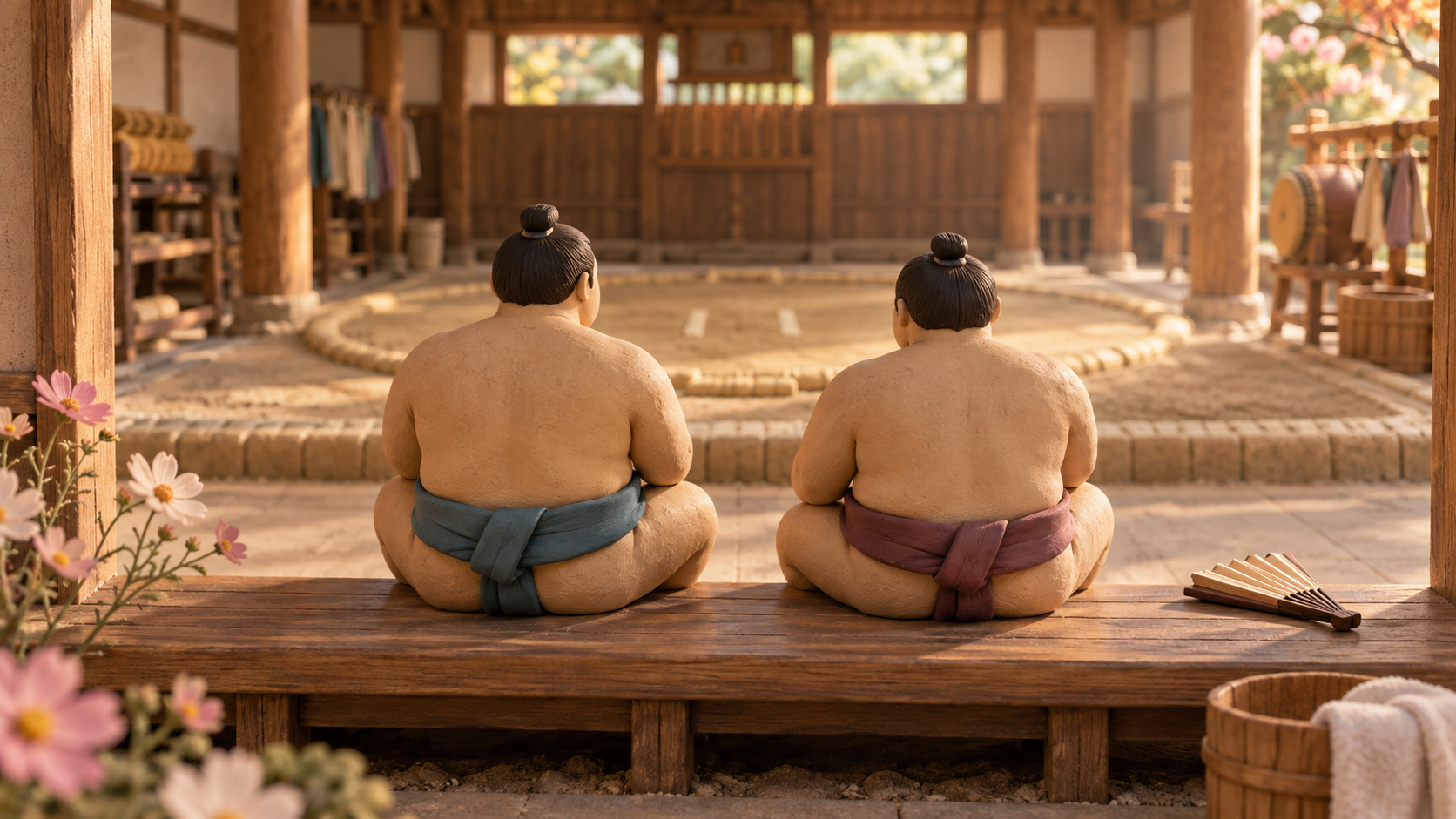
Wrestlers from the same stable do not face one another in the regular scheduled bouts of an official tournament, known as the honbasho *honwari*. A championship playoff is different. If stablemates finish level for the best record in their division, they can meet to decide the title. Chiyonofuji and Hokutoumi, both yokozuna from Kokonoe stable, did exactly that in the July 1989 top-division playoff. The accurate rule is therefore “not in the regular schedule,” not “never.”
The distinction becomes thrilling when two wrestlers from one heya climb the same leaderboard. You keep expecting the head-to-head bout that would normally separate rivals, but it never appears on the next day’s torikumi. Their scores can travel side by side until the scheduled tournament is over. Only if they are still tied for the championship does the door between them open.
Stablemates are kept apart in honwari
Japan Sumo Association Sumo Quiz No. 674 states directly that wrestlers belonging to the same stable do not meet in honwari. *Honwari* means the set of regulation bouts scheduled as the tournament itself. These are the matches listed day by day before the championship is settled.
The English shortcut “stablemates never fight” loses the boundary word and creates confusion when a playoff clip appears. Keep three labels separate:
- a regular honbasho bout in the honwari;
- an additional championship playoff after records are tied;
- a special event or knockout tournament with its own format.
The no-match rule applies to the first category. The other two can produce a bout that the normal honbasho schedule would not.
To establish whether two wrestlers are current stablemates, use their Japan Sumo Association profiles and the official stable directory. Similar shikona, a shared ichimon grouping or a past affiliation is not enough. Stables can be inherited, renamed or reorganised, so the date of the roster matters.
Close relatives are also separated in regulation bouts
The same official Association explainer says that wrestlers within four degrees of kinship do not meet in honwari even when they belong to different stables. That includes brothers and can include cousins. The restriction is therefore not only about sharing a training home.
Again, the key word is honwari. The source does not support the broad claim that relatives can never stand opposite each other in any sumo context. It specifically explains why two close relatives in different heya will not be paired in the regular tournament schedule, leaving a championship playoff as the possible meeting point.
Family relationships should not be inferred from surnames, rumours or fan databases. When kinship is material to an article, use an Association biography or another primary identification. The rule is precise; the evidence identifying the people should be precise too.
A playoff can put stablemates on opposite sides
If more than one wrestler shares the best final record in a division, an additional playoff decides the championship. Stable affiliation does not prevent that deciding bout.
The Japan Sumo Association’s feature on the July 1989 tournament gives a memorable example. Chiyonofuji and Hokutoumi were both yokozuna of Kokonoe stable. They did not meet in the regular schedule, but their records led to the first top-division championship playoff between two yokozuna from the same stable. Chiyonofuji won by uwatenage.
Another famous playoff placed the brothers Takanohana and Wakanohana opposite each other in November 1995. The broader lesson is not to collect exceptional trivia. It is to understand the emotional pressure of the format: people who share daily training and a stable identity can be required to reduce one tied championship to a single winner.
That is why following two stablemates across fifteen days feels different from waiting for ordinary rivals to meet. Their contest is indirect. Each faces a different opponent, and each result changes the possibility of a bout that can occur only at the end.
A special tournament can use a different draw
The Japan Sumo Association’s guide to the 50th Grand Sumo Tournament in February 2026 explicitly advertised possible same-stable matchups as something unavailable in normal official tournaments. Its knockout bracket was determined by a draw rather than the honbasho banzuke and scheduling process.
This gives viewers a useful fact-checking habit. When you see footage of stablemates wrestling, check the event name and date before announcing that the honbasho rule was abandoned. Was it a championship playoff? A one-day elimination event? An exhibition? The mawashi and dohyo may look familiar while the competition structure is different.
It also creates a legitimate event-ticket angle, but only when the event is current. A past tournament brochure proves the format of that edition; it does not promise that the next edition will use identical rules, prices or participants. Link readers to the latest official event page rather than selling an evergreen guarantee.
The rule has a history, not an eternal origin story
Japan Sumo Association Sumo Quiz No. 1206 says that same-stable bouts did occur in Edo-period professional sumo. At that time, relationships between wrestlers and the feudal domains that supported them could matter more to matchmaking than the stable affiliation familiar today. Wrestlers attached to the same domain were kept apart even when same-stable pairings could happen.
We should not project the modern heya system backwards and write that stablemates have “always” been separated. What counted as the decisive group changed. This historical contrast makes the present rule easier to see: a bout list is not created from rankings alone; it also contains an idea of who belongs together.
Follow the bout that is not scheduled
Choose two current wrestlers from the same stable and track their records for one tournament. Do not wait for a regulation head-to-head—it will not be placed on the schedule. Instead, notice how one wrestler’s loss changes the other’s championship route, even though they never touch on the dohyo.
If they remain level at the top through the final regulation bout, the possibility becomes real: one extra meeting, after all the ordinary pairings are finished. Even if the playoff never comes, the exercise changes how you see a stable. The heya is no longer just a word beside a profile. It is a relationship visible in the very bout that the schedulers do not make.
That is a lovely sumo paradox. The sport is built from individual contests, yet an absence in the fixture list reveals a team. Learn one favourite wrestler’s stable, find one stablemate, and suddenly there are two separate bouts to care about every day.
Sources
- Japan Sumo Association, Sumo Quiz No. 674 (published 13 November 2023; checked 3 September 2026)
- Japan Sumo Association, Sumo Quiz No. 1008 (published 12 October 2024; checked 3 September 2026)
- Japan Sumo Association, 50th Grand Sumo Tournament guide (event held 8 February 2026; checked 3 September 2026)
- Japan Sumo Association, stable directory (checked 3 September 2026)
- Japan Sumo Association, Sumo Quiz No. 1206 (published 28 April 2025; checked 3 September 2026)
Source links used for verification
Each link was used for the corresponding claim in this article; inclusion is not a blanket endorsement of the whole page.
Article verified:
- Japan Sumo Association Sumo Quiz No. 674 on same-stable and close-relative regulation boutsHistorical primary source (record from that period)
- Japan Sumo Association Sumo Quiz No. 1008 on a same-stable yokozuna playoffHistorical primary source (record from that period)
- Japan Sumo Association 50th Grand Sumo Tournament guideHistorical primary source (record from that period)
- Japan Sumo Association stable directoryPrimary source (as checked for this article)
- Japan Sumo Association Sumo Quiz No. 1206 on Edo-period same-stable boutsHistorical primary source (record from that period)