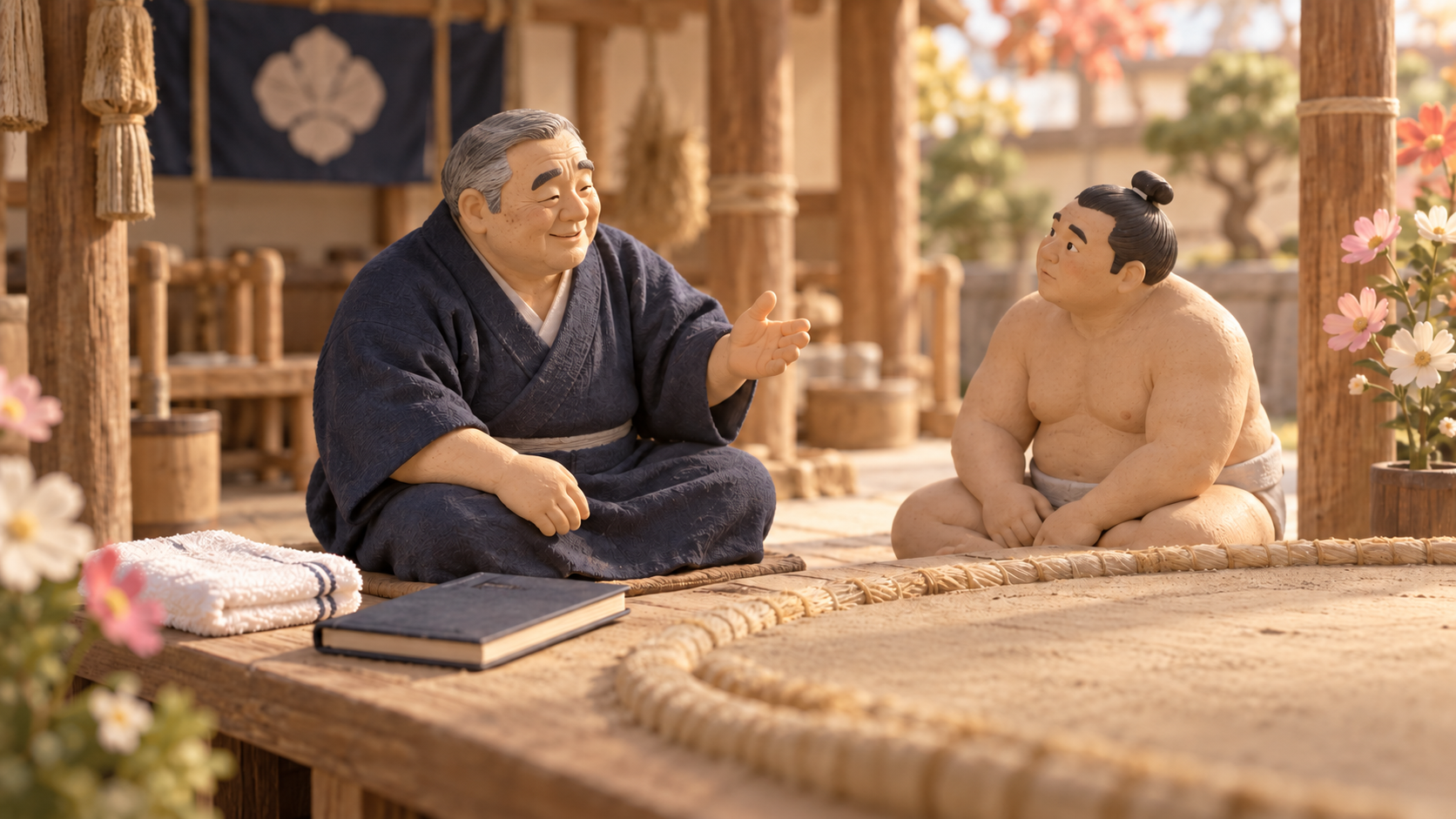
In professional sumo, toshiyori is the formal status of an elder, while oyakata is the respectful everyday way people address one. A qualifying former wrestler assumes an established elder name and works in coaching or Japan Sumo Association operations. Not every oyakata, however, is the master who runs a stable.
Broadcast introductions can sound like a puzzle: “So-and-so Oyakata, formerly the wrestler X.” Two names are not two people. One belongs to the wrestler’s active career; the other belongs to the elder role taken after retirement. Once you hear that bridge, retired favourites begin to reappear throughout today’s sumo.
Formal status and form of address
A dated Japan Sumo Association explainer says that a former wrestler who meets its conditions and acquires an elder name can assume that name. The four sources used here are not treated as a complete current rulebook for eligibility or rights in an elder name. In ordinary sumo speech, people address these elders as oyakata.
For a beginner, a useful distinction is therefore:
- toshiyori: the formal institutional status and inherited elder name;
- oyakata: the familiar respectful title used when speaking to or about that elder.
The ordinary Japanese word toshiyori can refer to an older person, but that is not what the term means here. It is a specific role within professional sumo.
The Association’s current elder directory is the safest lookup. It connects an elder’s present name with his real name, former ring name, highest rank and current organisational standing. Those entries can change, so use the live directory rather than an old fan list when the present identity matters.
An elder is not automatically a stablemaster
The English word “coach” can hide an important distinction. Individual stable pages may list one elder as the stablemaster and other elders as affiliated members. The master leads that heya; another oyakata in the same stable is still an elder but is not thereby its head.
If several familiar former wrestlers appear under one stable, do not guess who runs it based on fame or highest active rank. Check the “stablemaster” field on the Association page. This small habit prevents a surprising amount of confusion.
Their work extends beyond daily coaching
Elders do not all perform one identical job. The Association’s departmental assignment page places them in areas such as judging, regional tours, public guidance, communications and tournament operations. It also notes that stablemasters belong to the department responsible for daily-life guidance.
That means a former wrestler may reappear beside the dohyo as a judge, in an official explanation of a winning technique, or behind the planning of an event. Departmental assignments can change; this article explains the structure, not a permanent job label for any one person.
An inherited name keeps sumo time connected
A shikona is the ring name by which many fans remember an active wrestler. A toshiyori name belongs to the elder career that follows. Because both names are preserved in official profiles, an old bout can be connected to a published current elder identity or assignment. A directory entry alone does not prove that the elder personally coaches a particular wrestler each day.
The history of each elder name goes much deeper, but you do not need to memorise a genealogy. Connect one current elder to one former ring name. That single connection is enough to make the system human rather than abstract.
Listen for “formerly…” in the next broadcast
The next time an oyakata is introduced, listen for the former ring name before worrying about his department. If you remember the wrestler, a bout from your past suddenly has an afterlife. If you do not, look up just his highest rank and current stable.
Retirement then stops looking like a person vanishing from sumo. It can be the moment the camera moves: from the centre of the dohyo to the people teaching, judging and organising around it. That is why the second name is worth noticing.
Return from a Label to the Next Observable Action
Do not reduce a person to body size, age, nationality, hometown, school or role title. Follow a hand position, task, bout sequence or official record in the next appearance instead. An attribute can start a question; it is not a conclusion about character, strength or future.
What One Bout Cannot Tell Us
One bout shows a movement sequence and an official result. Do not infer personality, emotion, injury, fatigue or the next strategy from a single moment. Record the visible cue in plain language, compare multiple days, and wait for an official announcement. Inner feelings remain unknown without the person’s attributed words.
Sources
- Japan Sumo Association, Sumo Quiz No. 1153 (published 6 March 2025; checked 2 September 2026)
- Japan Sumo Association, elder directory (checked 2 September 2026)
- Japan Sumo Association, departmental assignments (checked 2 September 2026)
- Japan Sumo Association, stable directory (checked 2 September 2026)
Source links used for verification
Each link was used for the corresponding claim in this article; inclusion is not a blanket endorsement of the whole page.
Article verified:
- Japan Sumo Association Sumo Quiz No. 1153Historical primary source (record from that period)
- Japan Sumo Association elder directoryPrimary source (as checked for this article)
- Japan Sumo Association departmental assignmentsPrimary source (as checked for this article)
- Japan Sumo Association stable directoryPrimary source (as checked for this article)